
People usually search for this


Stacking Peptides: Common Research Combinations Explained

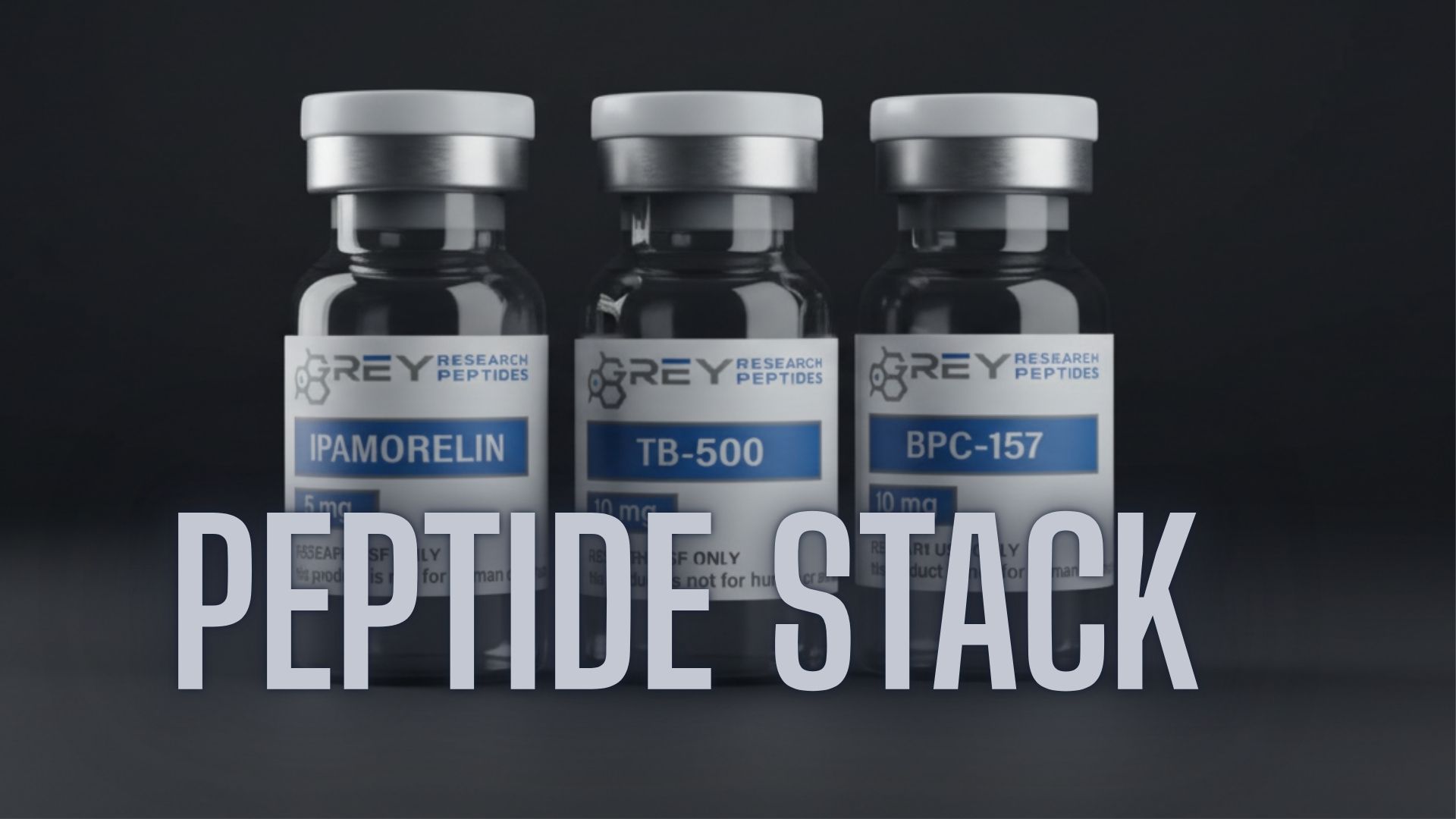
The idea behind stacking peptides is that two compounds together can produce greater results than each one alone. In pharmacology, this is known as an additive or synergistic effect, and it is precisely this phenomenon that underlies the concept of peptide stack. Peptides are highly specific: each binds a specific receptor and activates a specific signaling pathway. This is both their strength and their limitation. A single peptide addresses a single task. When there are multiple tasks, researchers begin to consider combinations.
A peptide stack is not a random assortment of compounds. In the context of research, it is a combination with sound mechanistic logic: the components either act on different receptors with a convergent effect, or compensate for each other’s limitations, or are optimized for the timing of administration due to differences in half-lives. It is precisely these three principles that determine how well-founded a particular combination is.
Why Researchers Combine Peptides – The Logic Behind the Stack
Before examining specific combinations, it is worth understanding why they are needed at all.
Since peptides are receptor-specific, each compound in a typical scenario affects a single physiological pathway. A growth hormone secretagogue stimulates the pituitary gland. A reparative peptide acts locally on damaged tissue. A lipolytic fragment targets fat cells. When a researcher is interested not in just one of these processes, but in several simultaneously – that’s where the logic of the stack comes in.
Three main scenarios in which a combination is justified from a mechanistic point of view:
- First – complementary mechanisms: two peptides act on different receptors, both of which converge on the same physiological outcome, amplifying it.
- Second – compensating for limitations: one peptide fills the functional gap of the other.
- Third – time optimization: compounds with different half-lives can be administered to maintain a more stable physiological signal throughout the day.
What does the best peptide stack mean in a research context? Not the most popular combination. The one with the clearest mechanistic rationale, the strongest evidence base for individual components, and the most relevant study populations.
The GH-Axis Stack – CJC-1295 and Ipamorelin in Research
This is the most studied and mechanistically most understood combination in the field of stacking peptides.
CJC-1295 is an analog of GHRH, the growth hormone-releasing hormone. It binds to GHRH receptors in the pituitary gland. Ipamorelin is a ghrelin receptor (GHS-R) agonist. Both receptor pathways ultimately converge on a single outcome: the release of GH from the pituitary gland. But they do so through different molecular mechanisms – and this is precisely what makes their combination additive rather than redundant.
Some studies have shown that administration of CJC-1295 increased mean GH levels by 2-10 times and maintained elevated IGF-1 for several days. Separate data on the GHRP class demonstrate that adding a ghrelin agonist to a GHRH analog produces a significantly higher GH peak than either compound alone. This is precisely why this pair serves as the basis for most protocols in studies where the peptide stack for muscle growth is the central subject of investigation.
The combination has been studied in men and women of various age groups, making it one of the most data-supported approaches. Research markers in this context include: GH pulse amplitude, IGF-1 levels, changes in lean body mass, and recovery metrics.
Muscle Growth and Fat Loss Stacks – What the Research Combinations Look Like
This is the most frequently requested topic, so let’s examine it in more detail. The three combinations most commonly found in the research literature are:
- CJC-1295 + Ipamorelin + Tesamorelin
Tesamorelin is also a GHRH analog, but with a documented specific effect on visceral adipose tissue. It is the only one in this group with FDA approval – for the treatment of HIV-associated lipodystrophy – which provides it with the most rigorous human evidence base in the category of effects on fat metabolism. Adding tesamorelin to the base CJC/ipamorelin stack creates a three-component protocol that simultaneously stimulates the GH axis and reduces visceral fat. It is this combination that is most frequently cited in metabolic studies as the best peptide stack for muscle growth and fat loss from a mechanistic standpoint.
- BPC-157 + TB-500
Here, the logic is entirely different – not the GH axis, but tissue repair. BPC-157 demonstrates pronounced regenerative effects on muscle, tendon, and intestinal tissue. TB-500 – a synthetic analog of thymosin beta-4 – is being studied for its effects on angiogenesis, cell migration, and systemic recovery. Two mechanisms, two different pathways, one common result – the acceleration of reparative processes. In the context of training, this is a peptide stack for muscle growth of a different kind: not muscle mass growth via the GH axis, but maintaining tissue integrity during high-volume training. That is precisely why this combination is available as a ready-made blend – BPC-157/TB-500 10+10mg.
- IGF-1 LR3 + GH secretagogue
IGF-1 LR3 acts directly on IGF-1 receptors in muscle tissue – further down the cascade than GH. The secretagogue, in turn, stimulates endogenous GH release, which is then converted to IGF-1 in the liver. This combination attacks the GH/IGF-1 axis from two sides simultaneously – from above (via the pituitary) and from below (direct receptor action). There is research interest in this pair – the best peptide stack for muscle growth in terms of anabolic potential – but the evidence base here is weaker than for the previous two combinations.
How Researchers Think About Timing Within a Multi-Peptide Protocol
Stacking complicates not only the chemistry but also the timing. Different peptides have different half-lives and different windows of optimal receptor sensitivity – and when developing multi-component protocols, researchers must account for the pharmacokinetics of each compound.
GH secretagogues like ipamorelin are traditionally studied when administered on an empty stomach: insulin blunts the GH response, so the postprandial period is considered less suitable. BPC-157 and TB-500 have longer half-lives and are less sensitive to timing. In muscle studies, IGF-1 LR3 is often administered during the post-exercise window – when muscle tissue receptor sensitivity is at its peak.
Principle, not a specific protocol: when stacking peptides, the pharmacokinetic profiles of the compounds must be considered when designing the study. Otherwise, even a mechanistically sound combination may fail to produce the expected effect simply due to the temporal misalignment of signals.
Weight Loss-Focused Stacks – Where the Research Points
A separate category consists of combinations focused on fat metabolism.
Tesamorelin + Ipamorelin is the most well-documented peptide stack for weight loss in the research literature, particularly regarding visceral obesity. Tesamorelin bears the main burden here: its effect on visceral adipose tissue has been confirmed by randomized clinical trials (Falutz et al., 2010, NEJM). Ipamorelin adds a GH-stimulating component via ghrelin receptors.
AOD-9604 + GH secretagogue – a less-studied but logically sound combination. AOD-9604 is the C-terminal fragment of the GH molecule, retaining lipolytic properties but lacking the growth-stimulating effects of full-length GH. Research hypothesis: adding a secretagogue preserves muscle mass while AOD-9604 targets adipose tissue. This is the best peptide stack for fat loss from the perspective of theoretical functional separation – but the evidence base here is significantly thinner than that of tesamorelin-containing protocols.
The Evidence Gap – What Multi-Compound Research Still Doesn’t Show
An honest discussion of peptide stacks is impossible without acknowledging the main limitation.
Almost all controlled clinical trials of peptides study a single compound. Not a combination. The logic of stacking is based on extrapolation from individual studies and mechanistic assumptions about pathway interactions – not on controlled trials of combined protocols. This means: interactions between compounds, the overall safety profile, and optimal dose ratios for stacks under rigorous clinical conditions have been virtually unexplored.
This is not a reason to reject mechanistic logic. It is convincing in many cases. But it is a reason to clearly distinguish between “reasonably assumed” and “proven in combination” – these are different claims.
What to Take Away From Peptide Stack Research as a Reader
What does the research literature actually say about stacking?
The combinations that appear most consistently – CJC-1295/Ipamorelin for the GH axis, BPC-157/TB-500 for repair, and tesamorelin-containing stacks for fat metabolism – have clear mechanistic logic and a reasonable evidence base for their individual components. What they lack is controlled clinical data on these multi-component combinations.
The “best peptide stack” in a research context is not necessarily the one that is most heavily promoted. It is the combination of the clearest mechanism of action, the most supporting data for each component, and the most relevant study populations. It is from this perspective that you should evaluate any combination you encounter in the literature or in discussions.
This article is for informational purposes only. Any decisions regarding the use of peptides should be made in consultation with a qualified healthcare professional.

Frequently Asked Questions
What does peptide stacking mean in research contexts?
Peptide stacking refers to the combined administration of two or more peptides in a single research protocol to study additive, synergistic, or complementary biological effects. Effective stacks are designed around mechanism complementarity — for example, a GHRH analog paired with a GHRP — rather than just combining multiple compounds at once.
What are some commonly studied research stacks?
Frequently cited combinations include CJC-1295 + Ipamorelin for GH axis research, BPC-157 + TB-500 for tissue repair models, and tri- or tetra-blends like GLOW and KLOW which combine repair peptides (BPC-157, TB-500, GHK-Cu, KPV) for cytokine-modulation studies. GLP-1 + amylin analog stacks such as semaglutide + cagrilintide are also a major focus in metabolic research.
Why do researchers combine peptides instead of testing them individually?
Many physiological pathways involve multiple regulatory inputs simultaneously — GH release, for instance, is governed by GHRH stimulation and somatostatin inhibition at the same time. Stacking allows researchers to model multi-input pathways more realistically. It also enables study of dose-sparing synergies, where two peptides produce a stronger response than either alone at equivalent doses.
What handling considerations apply to stacked protocols?
When peptides are mixed in the same vial after reconstitution, researchers must verify that pH, buffer compatibility, and chemical stability are preserved — some peptides degrade faster in proximity to others. Pre-blended commercial products like GLOW or KLOW are co-lyophilized to ensure uniform reconstitution, while custom combinations may need separate vials and sequential dosing.