
People usually search for this


Sermorelin vs Ipamorelin: Comparing Two GH-Releasing Research Peptides

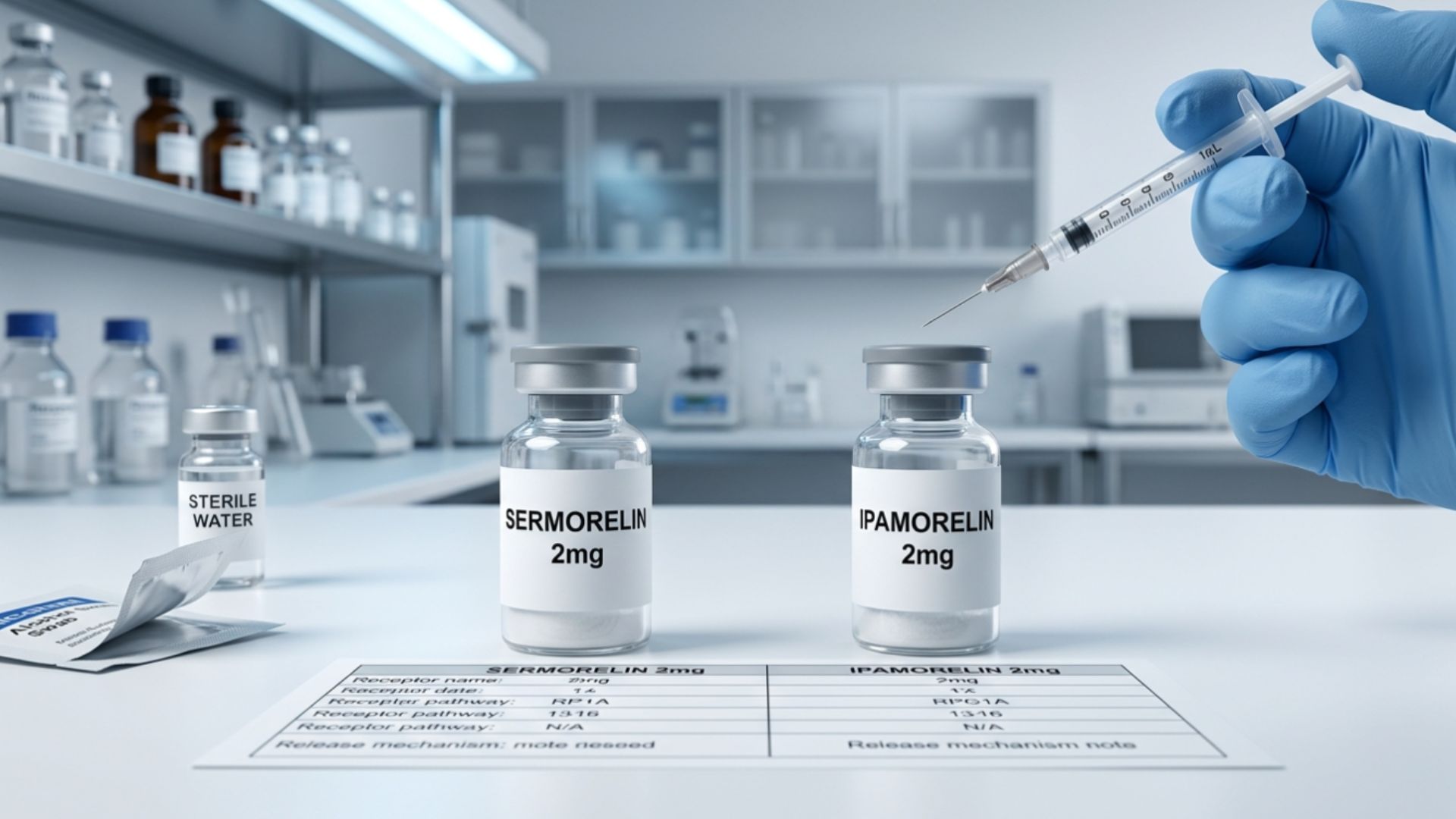
If you’ve ever looked into growth hormone-releasing peptides, you’ve probably heard of two names: sermorelin and ipamorelin. These two names are often mentioned together; sometimes they’re even written with a comma or a slash between them, and I think they’re practically the same thing. However, there is a difference between them, and it’s much greater than it seems at first glance.
You mentioned that both molecules are of research interest precisely because they affect the growth hormone axis differently, by engaging distinct receptor pathways. Understanding this difference helps explain why scientists continue to study both. Sermorelin, however, holds a special place: it has a clinical history of use, unlike ipamorelin. This nuance is important, and we will return to it later.
⚠️ This material is intended for research purposes; it is not medical advice and is not intended to help you choose between them. The decision to use either peptide is made solely by the treating physician based on the individual clinical picture.
What Is Sermorelin?
Sermorelin peptide is a synthetic analog of the endogenous growth hormone-releasing hormone (GHRH). Sermorelin consists of the 29 amino acids of the N-terminal fragment of native human GHRH, which contains 44 amino acids. This truncated fragment is sufficient to bind to the GHRH receptor in the pituitary gland and stimulate the synthesis and secretion of growth hormone.
What is important here from a biological perspective is that sermorelin works through a physiological pathway. It does not introduce exogenous GH but signals the pituitary to release its own GH. This distinction is fundamental for researchers and for people (because people do not want “something extra” in their bodies; they want their bodies to start working).
The regulatory status deserves a separate mention. Sermorelin has a documented clinical history: a drug based on it (Geref) was approved by the FDA for use in pediatric practice to diagnose and treat growth hormone deficiency. HOWEVER, the drug was subsequently discontinued not for safety reasons, but for commercial ones. This makes it not a typical “gray market” research compound, but a molecule with a real clinical background.
Sermorelin vs. Ipamorelin: How They Differ
Now let’s move on to the most interesting part: a comparison of the two compounds. Sermorelin vs. Ipamorelin is not just a comparison of two peptides with similar effects. It is a comparison of two fundamentally different mechanisms that lead to the same result – increased GH secretion. As we mentioned above, they are compared because they lead to the same result, but they achieve this result through completely different pathways.
Sermorelin is an analog of GHRH. It binds to the GHRH receptor on pituitary somatotrophs and directly activates it. Ipamorelin is a completely different story. It belongs to the class of GH secretagogues and is a ghrelin receptor agonist (GHSR-1a). Ghrelin and GHRH are different signaling molecules; their receptors are located in different cellular systems, and their activation triggers slightly different intracellular cascades.
As for regulatory status, while sermorelin has a clinical track record, ipamorelin remains an investigational compound with no approved clinical use. This is a factual difference that is important to consider when analyzing the literature. In an ipamorelin vs sermorelin comparison, both act at the pituitary level, but their entry points differ, which is precisely what makes the comparison scientifically significant.
Mechanism Differences That Matter in Research
Why are researchers interested in this difference at all? Different receptor pathways provide different tools for studying GH axis regulation.
GHRH receptor activation (e.g., with sermorelin) mimics a physiological signal from the hypothalamus. Activation of GHSR-1a (ipamorelin) is a signal that mimics ghrelin. Under normal physiological conditions, both pathways act together and synergistically. In a research context, the ability to influence them separately is a valuable tool: it allows us to isolate each pathway’s contribution to final GH secretion.
This is precisely why, when comparing sermorelin vs ipamorelin, scientists most often discuss the choice of model rather than the “best” compound.

Does Sermorelin Work? What Research Shows
The honest answer to the question “does sermorelin work” is this: it depends on what exactly is meant by “works.”
At the mechanistic level – yes, it has been confirmed. Sermorelin binds to the GHRH receptor and stimulates GH secretion. This has been demonstrated in numerous studies, including Walker’s work, which examines its use in the decline of age-related GH secretion in detail.
At the level of clinical effects, the picture is slightly more complex. In pediatric trials for GH deficiency, changes in growth parameters were observed; adult studies demonstrated changes in hormonal markers. But it is important not to extrapolate these data to broader effects without corresponding trials. A study by Sigalos and Pastuszak (2018) in Sexual Medicine Reviews (SMR, 2018) analyzes the class of GH secretagogues as a whole and honestly outlines the limits of the evidence base, serving as a starting point for understanding the available data.
Sermorelin benefits are discussed in the scientific literature in relation to specific measurable parameters in specific populations. Extrapolating them to any individual without clinical evaluation is methodologically incorrect.
“Before and After” Searches: What They Mean
The search query sermorelin before and after is one of the most common in this topic. It’s clear why: people want to see concrete results. The problem is that anecdotal before-and-after reports, of which there are many online, are not evidence. A multitude of factors determines individual results:
- baseline hormonal status
- age
- body composition
- lifestyle
- comorbid conditions
What happened to one person does not predict what will happen to another, even under identical conditions of use. This is a fundamental limitation of any data, and it does not disappear just because the photos look convincing.
If you are seriously researching this topic, look first and foremost at controlled trials with clearly defined populations and endpoints, rather than forum reports.
Benefits Discussed and Safety Considerations
In the literature on sermorelin, the studied effects include changes in GH and IGF-1 secretion, body composition parameters in specific cohorts, and certain metabolic markers. Note: “studied” is not the same as “proven for everyone.” This is a description of what was observed under the specific conditions of specific studies.
Regarding the safety profile, the clinical history of sermorelin includes adverse events at the injection site, headache, facial flushing, and dizziness. Serious adverse events were rare. This, however, does not imply automatic safety for any individual in any context of use.
There is significantly less data on ipamorelin, which is logical given the lack of approved clinical use. The study by Raun et al. in EJE, 1998, describes it as a selective GH secretagogue with a relatively limited effect on cortisol and prolactin compared to earlier molecules in this class, which became the basis for its research interest. But “compared to its predecessors,” ≠ “safe for clinical use.”
Any questions regarding applicability, tolerability, interactions, and contraindications should be directed to a licensed physician. The scientific literature provides context, not a personal prognosis.
Key Takeaways
Sermorelin and ipamorelin both stimulate GH secretion, but they do so through different receptor pathways: sermorelin acts via the GHRH receptor, while ipamorelin acts via the ghrelin receptor. This is not a technical detail but a key distinction that determines their value as research tools.
Their regulatory status also differs. Sermorelin has a documented clinical history and completed trials. Ipamorelin remains an investigational compound without approved clinical use. It is important to keep this in mind when reading the literature and even more so when considering any practical applications.
Regarding the data, studies have observed certain effects under specific conditions. To extrapolate them beyond these conditions is to go beyond what science currently supports.In the Grey Research Peptides catalog, both compounds are listed for laboratory use: sermorelin and ipamorelin. All products are intended exclusively for in vitro research by qualified professionals and are not medicinal products.