
People usually search for this


Epithalon vs Pinealon: Two Bioregulator Peptides for Brain and Longevity Research

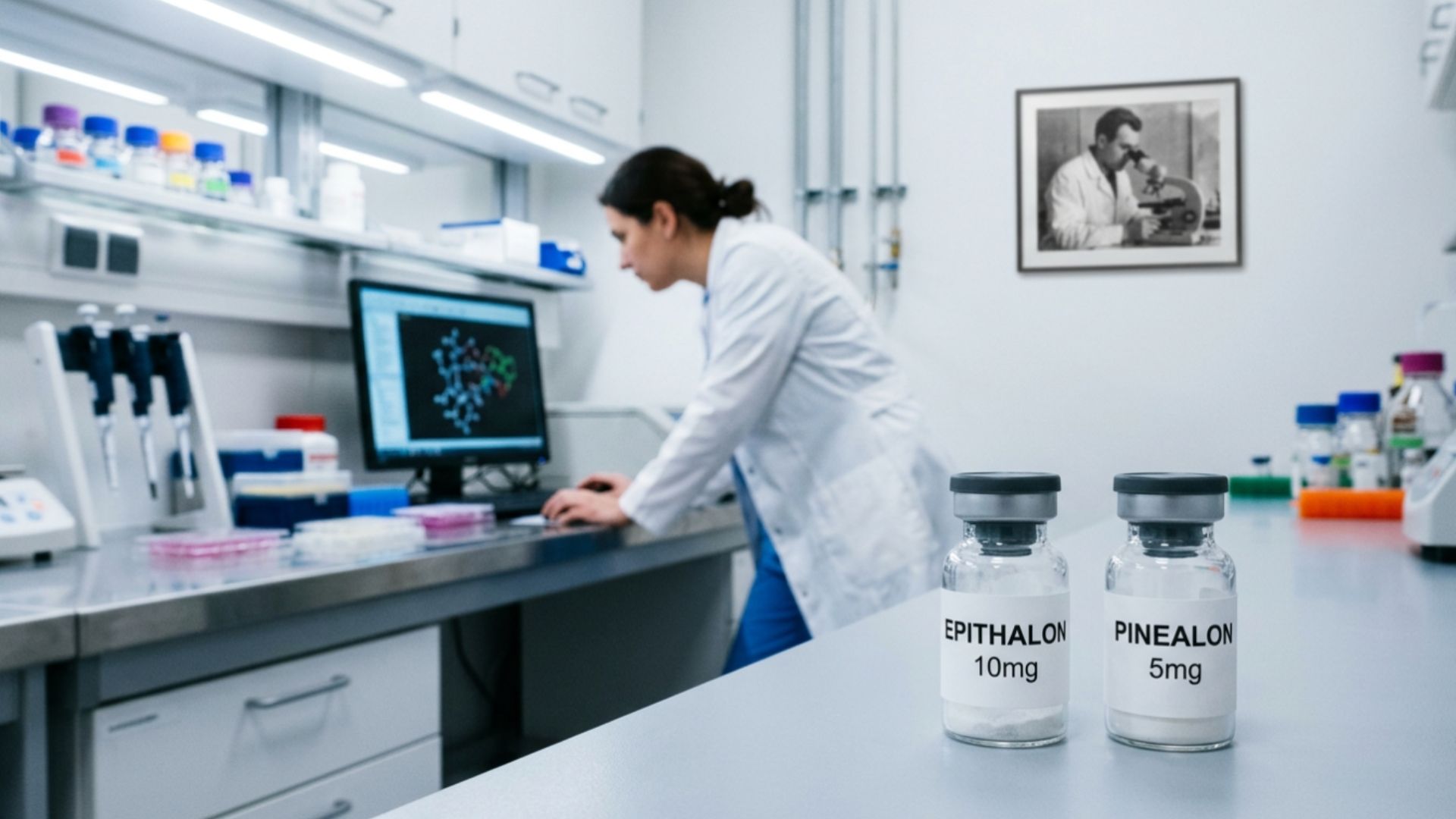
If you are researching bioregulator peptides, you are bound to come across peptides such as Epithalon and Pinealon sooner or later. These peptides were studied as far back as the Soviet-Russian scientific school, and both are associated with the pineal gland. Both peptides are also studied in the context commonly referred to as “longevity research.” But that is where the similarities largely end.
There is confusion surrounding them for several reasons:
- The first is a similar research context.
- The second is the different spellings of the names, which generate searches like “Epithalon vs Epitalon” and create the impression that we’re talking about different molecules.
- The third is marketing, which lumps both peptides into a single “brain and longevity” category without much attention to their mechanisms.
- The fourth is that both compounds were developed as part of the same research program.
This material examines both molecules separately. Epitalon peptide and Pinealon peptide are different compounds with different sequences and different research contexts. Let’s start from the beginning.
⚠️ All materials are for educational purposes only. The compounds mentioned in the text are intended solely for in vitro laboratory research. This is not medical advice. Any practical questions must be discussed with a licensed professional.
What Is Epitalon?
Epitalon peptide is a synthetic tetrapeptide with the amino acid sequence Ala-Glu-Asp-Gly. It was created at the Institute of Bioregulation and Gerontology in St. Petersburg under the leadership of Vladimir Khavinson. Vladimir Khavinson is the man who, in essence, established the entire concept of short bioregulatory peptides as a distinct scientific field not only in the CIS countries but also beyond.
Originally, it was a synthetic analog of Epithalamine, a polypeptide extract from the pineal gland which researchers began studying as early as the 1970s. However, the main focus of interest in the Epithalon peptide emerged later, when researchers shifted their attention to telomeres. In 2003, in the Bulletin of Experimental Biology and Medicine, Khavinson and colleagues reported stimulation of telomerase activity in human somatic cells by Epithalon (Khavinson et al., BEBM, 2003). Why is this important? Because telomerase is normally active in stem and cancer cells but not in somatic cells, the question of what happens when it is specifically activated there became central to further research.
At the same time, researchers studied the connection between melatonin regulation and immune parameters during aging.
As for animal studies, they do exist, including the long-term observation by Anisimov’s group. However, there is very little human data from large-scale controlled trials. You can learn more about the compound in our catalog (for research purposes only).
Epithalon vs Epitalon: Same Peptide, Different Spelling
Now it’s time to sort out Epithalon vs Epitalon – are they different substances? In fact, there is no difference. It is the same molecule, the same tetrapeptide Ala-Glu-Asp-Gly, simply spelled differently.
This widespread confusion around the world stems from a technical error. The fact is that the Russian word “эпиталон” is transliterated differently into English depending on the system and source. This has resulted not in two variants but in three: Epithalon, Epitalon, and Epithalone. The first variant is more common in publications by Khavinson’s group. The second (Epitalon) is more common in Western sources and on suppliers’ websites. As for Epithalone (the third variant), it is very rare, but it does exist. If you see all three names in different articles or on different websites, you should understand that they refer to the same compound.
What Is Pinealon?
Here, however, we are dealing with a different molecule and this is not a matter of spelling, but of chemistry. Pinealon peptide is a tripeptide with the sequence Glu-Asp-Arg (EDR). Three amino acids versus four in Epithalone, a different sequence, and a different target.
Pinealon was developed at the same place, the Khavinson Institute, as part of the same program on bioregulatory peptides. But the research focus is fundamentally different: Pinealon was studied primarily in a neuroprotective context. Most of the research focuses on its interactions with brain cells under conditions of hypoxia and oxidative stress, as well as in neurodegenerative models. The “pineal gland” in its name refers to the field of application of the research, not to the substance’s origin. It is a synthetic peptide; no extract is involved here.
One of the studies frequently cited in this context examines the interaction between short peptides and the chromatin of nervous tissue, exploring the possibility of regulating gene expression through these molecules. This is part of a broader concept of epigenetic regulation via peptide bioregulators – an interesting line of research, although the data remains predominantly preclinical.

Epitalon vs. Pinealon: How They Differ
When you compare these two compounds side by side, the differences become apparent on several levels at once.
Structurally, Epitalon peptide is a tetrapeptide, while Pinealon is a tripeptide. Chain length affects everything: bioavailability, affinity for targets, and cellular metabolism. This is not a cosmetic difference.
In terms of research focus:
- Epitalon has been studied in the context of telomeres, cellular aging, melatonin regulation, and immune changes associated with aging processes.
- Pinealon has been studied from a neuroprotective perspective – the response of nerve cells to stress, apoptosis under hypoxic conditions, and interactions with the brain’s genomic structures.
In terms of data volume, Epitalon has more published studies, including some long-term animal observations. The literature on Pinealon is more limited. This is not a judgment on the quality of the molecules – it is simply a snapshot of what has been accumulated to date.
Research vs. Marketing Claims
Longevity marketing works predictably: an interesting mechanism from preclinical research is translated into a claim about its effect in humans. This happens particularly often with bioregulatory peptides because the concept looks convincing, and the sources are not widely accessible to the general public.
The reality is as follows:
- Most of the data on both peptides was obtained in vitro or in animal studies
- There are no large-scale randomized clinical trials for either of them
- The extrapolation of results from mouse models to humans is a hypothesis, and a rather imprecise one
“Observed in preclinical conditions” is an honest statement. “Proven in humans” is not.
Benefits Discussed in Research
Let’s examine them separately, because it would be incorrect to mix the profiles.
Epitalon peptide benefits mentioned in the scientific literature:
- Activation of telomerase in human somatic cells – observed in vitro
- Possible role in regulating melatonin secretion through interaction with the pineal system
- Changes in oncological and immune parameters in long-term animal experiments – with cautious interpretation
Pinealon peptide benefits and Pinealon benefits are discussed in a research context:
- Neuroprotective potential in cellular stress models
- Study of the effect on neuronal apoptosis under hypoxic conditions
- Possible interaction with gene expression regulation in brain tissue
One caveat applies to both: all of this has been “studied” and is “under discussion,” not “proven to work in humans.” The gap between these formulations is not a mere formality. It is the essence of an honest interpretation of preclinical science.
Key Takeaways
In summary, briefly and to the point:
Epitalon and Pinealon are different molecules with different amino acid sequences and different research histories. They are united by a scientific school and, to some extent, by subject matter, but not by mechanism or context of application in research.
Spelling variations (Epitalon / Epithalon peptide / Epithalone) do not indicate different molecules. This is a single compound with several transliteration variants.
In terms of research progress, both remain at an early stage regarding human data. This does not make them uninteresting – it makes them strictly preclinical research subjects. Any practical questions should be directed exclusively to a physician.In the Grey Research Peptides catalog, both compounds are available for laboratory use: Epithalon 50mg and Pinealon 20mg. For in vitro research by qualified specialists only.