
People usually search for this


Peptides for Sleep and Recovery: DSIP, Epithalon, and What Circadian Research Shows

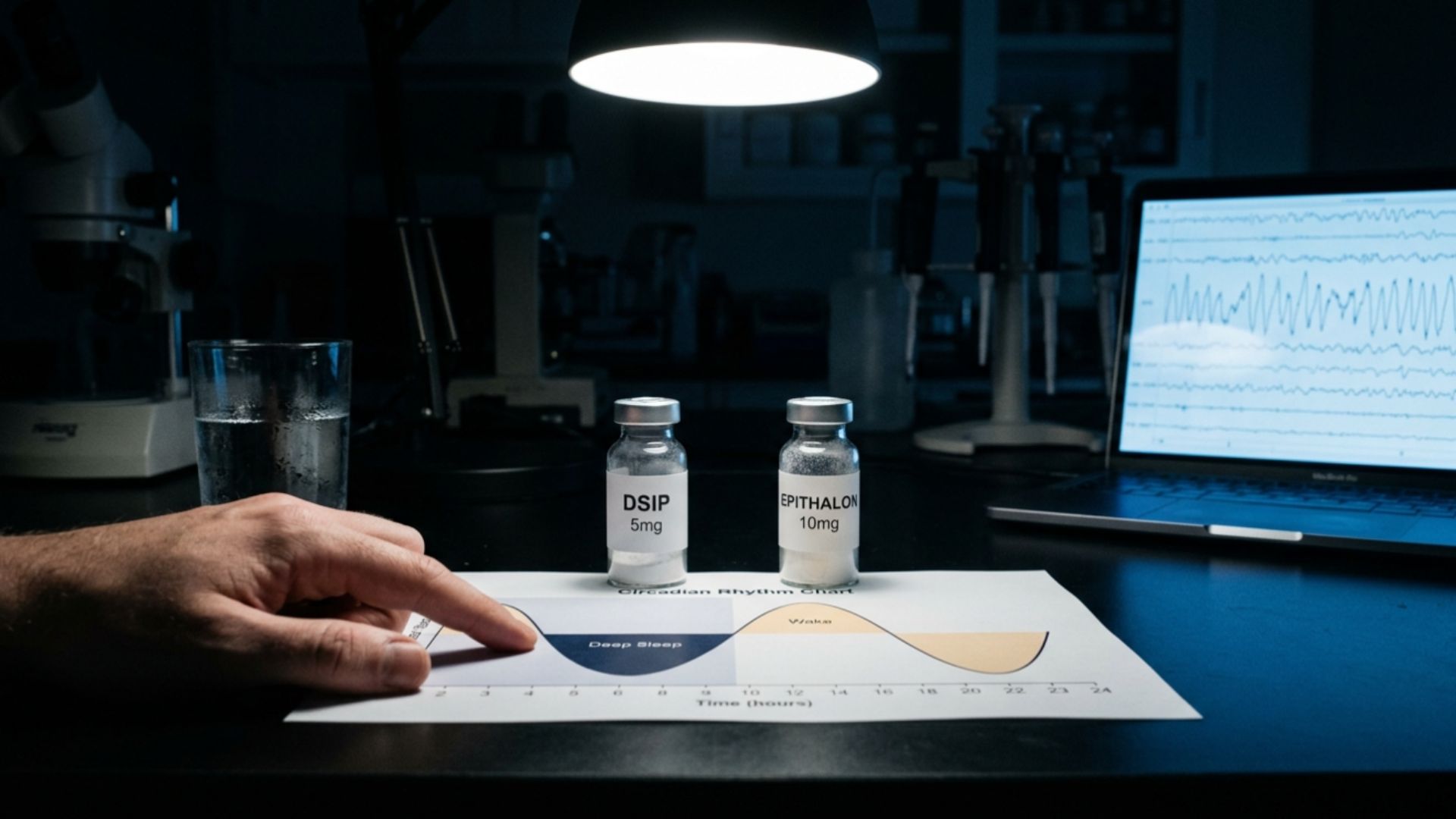
If you’ve ever had trouble sleeping, you’ve probably searched online for ways to solve the problem. One of the most popular options right now is the use of peptides. But this topic is as confusing as it is popular. And it’s not complicated because the molecules are complex, but because a single search for “peptide for sleep” usually mixes several very different things: direct sleep research, indirect links via circadian mechanisms, and, most often, marketing claims that are neither one nor the other.
There are essentially two most popular peptides for sleep: DSIP, whose very name directly points to sleep, and Epithalon, which comes up in discussions in a different context: through the pineal gland and melatonin regulation. These are different molecules with different mechanisms and different research histories. And it’s important to understand how each of them differs
⚠️ This material is prepared solely for educational purposes. All compounds mentioned are research-grade and intended for in vitro laboratory use. This is not a recommendation for treating sleep disorders nor a guide to use. For practical questions regarding sleep, please consult a doctor.
What Is DSIP (Delta Sleep-Inducing Peptide)?
DSIP peptide is a nonapeptide, meaning a chain of nine amino acids. Its full name is delta sleep-inducing peptide, a name derived from the context in which it was first described. In 1977, Swiss researchers Schoenenberger and Monnier isolated this compound from the cerebral venous blood of a rabbit during sleep induced by electrical stimulation of the thalamus. They demonstrated that administration of the purified substance to recipient animals was associated with increased delta activity on the EEG (Schoenenberger & Monnier, PNAS, 1977). This is where the name comes from.
An important nuance that is often overlooked: DSIP is not a sleep-inducing agent in the traditional sense. It is a neuropeptide that has been studied in relation to sleep modulation, stress responses, and neuroendocrine processes. It is found not only in the blood but also in various regions of the brain and in peripheral tissues. This in itself suggests that its biological role is likely broader than simply “inducing sleep.”
DSIP and Sleep: What the Research Explores
The main line of research surrounding DSIP centers on the question: exactly how does this peptide regulate sleep? And does it participate as an independent agent or as part of a broader neurochemical system?
Early studies focused on electrophysiological effects. In 1984, Graf and Schoenenberger published data on the effect of DSIP on cortical neuronal activity in anesthetized rats, which added to the emerging picture of potential neuromodulatory mechanisms.
What exactly was investigated in subsequent studies:
- The relationship between circadian rhythms and diurnal fluctuations in plasma peptide levels
- Interaction with the stress response – several studies examined the potential influence on corticotropin-releasing hormone levels
- Neuroprotective potential in various models of neuronal stress
- Antioxidant properties (a relatively new line of research)
However, it is also important to note that a significant portion of the data was obtained specifically from animal models. Studies involving human subjects, on the other hand, are very few. This does not make the topic uninteresting, but it does, frankly, make it preliminary. DSIP peptide is available in our catalog as DSIP 10mg for laboratory use.
Research vs. Anecdotal Evidence on Sleep Effects
We need to be clear here, because the internet is full of claims regarding DSIP peptide benefits.
Anecdotal reports of subjective sleep improvement exist, and they are predictably colorful. The problem is that an anecdote is not proof, especially when it comes to sleep, where the placebo effect is well-documented and significant. A subjective claim of “I started sleeping better” without a control group or a double-blind protocol says nothing about the mechanism, let alone the reproducibility of the effect.
What science supports is the study of DSIP as a neuropeptide that may play a role in sleep modulation under specific experimental conditions. What science does not support is the direct translation of this data into a recommendation. Recommendations can only be given by your treating physician and only based on multi-level studies involving humans.

Epithalon and Circadian Research
Epithalon comes up in discussions about sleep peptides for another reason – not through direct sleep studies, but through the pineal gland.
The pineal gland is the organ responsible for secreting melatonin, the primary regulator of circadian rhythms. Epithalon, a synthetic analog of epithalamine (a peptide extract from the pineal gland), has been studied, among other things, for its potential effects on pineal function and melatonin secretion. A series of studies by the Khavinson and Anisimov group examined how the administration of pineal peptides affects circadian patterns in aging animals, in the context of declining pineal function and decreasing nighttime melatonin secretion with age.
This is the research hook: if a peptide is studied in connection with pineal function, and pineal function is linked to melatonin and circadian rhythms, it ends up in the orbit of “sleep-related” discussions, albeit indirectly.
Important: Epithalon is a different molecule with a different mechanism. You can learn more about it on the Epithalon page in our catalog.
Different Peptides, Different Sleep-Related Mechanisms
In short, DSIP and Epithalon fall under the search term “sleep peptide” for different reasons, and conflating their mechanisms is a mistake.
DSIP has been studied directly in the context of sleep – EEG activity, neuromodulation, and stress responses. Its connection to sleep is literally the very reason it was isolated.
Epithalon fits into this context differently: through the pineal gland and circadian biology. It is not a “sleep peptide” in the same sense – it is a research compound being studied in relation to pineal function, and sleep turns out to be one of the consequences of this broader system.
Two different paths to the same search query. But understanding the difference means reading the literature on the topic correctly.
“Best Peptide for Sleep” Searches: What People Mean
The search query “best peptide for sleep” is one of the most telling examples of how research interest translates into consumer search. Let’s break down what’s happening here.
People who search for this typically want one of two things: either they suffer from sleep disorders and are looking for alternatives to traditional sleeping pills, or they are interested in optimization – that is, improving the quality of recovery and nighttime rest as part of a longevity approach. This is an understandable motivation.
The problem is that neither DSIP, nor Epithalon, nor any other research peptide is an approved treatment for sleep disorders. These are research compounds. “The best peptide for sleep” is a question that science has not yet answered, and it is certainly not the kind of answer you should be looking for online.
If a person has actual sleep disorders – insomnia, circadian rhythm disorders, apnea – these are clinical issues that require clinical evaluation. The choice of any substance, including research peptides, in this context is solely the decision of the treating physician, not a consequence of reading review articles.
Key Takeaways and Safety
Let’s summarize:
DSIP is a nonapeptide with a history of study in the context of sleep and neuromodulation dating back to the 1970s. The mechanism is interesting, but the data are primarily preclinical or from early trials. Epithalon fits into this topic via the pineal gland and circadian biology – it has a different mechanism and a different research history.
A few things to keep in mind:
- None of the compounds mentioned is an approved treatment for sleep disorders.
- There is insufficient data from large randomized human trials on either peptide to conclude clinical efficacy.
- Marketing claims in this niche far outpace the evidence base – this is a systemic problem, not a characteristic of a specific compound.
- Sleep disorders are medical issues and should be addressed accordingly.
For researchers studying neuropeptide regulation of sleep or circadian biology, both compounds are available in the Grey Research Peptides catalog: DSIP 10mg and Epithalon 50mg. For in vitro laboratory use only by qualified professionals. Not for use in humans or animals.