
People usually search for this


GH-Releasing Peptide Research: Sermorelin, Ipamorelin, Hexarelin, and CJC-1295 Compared

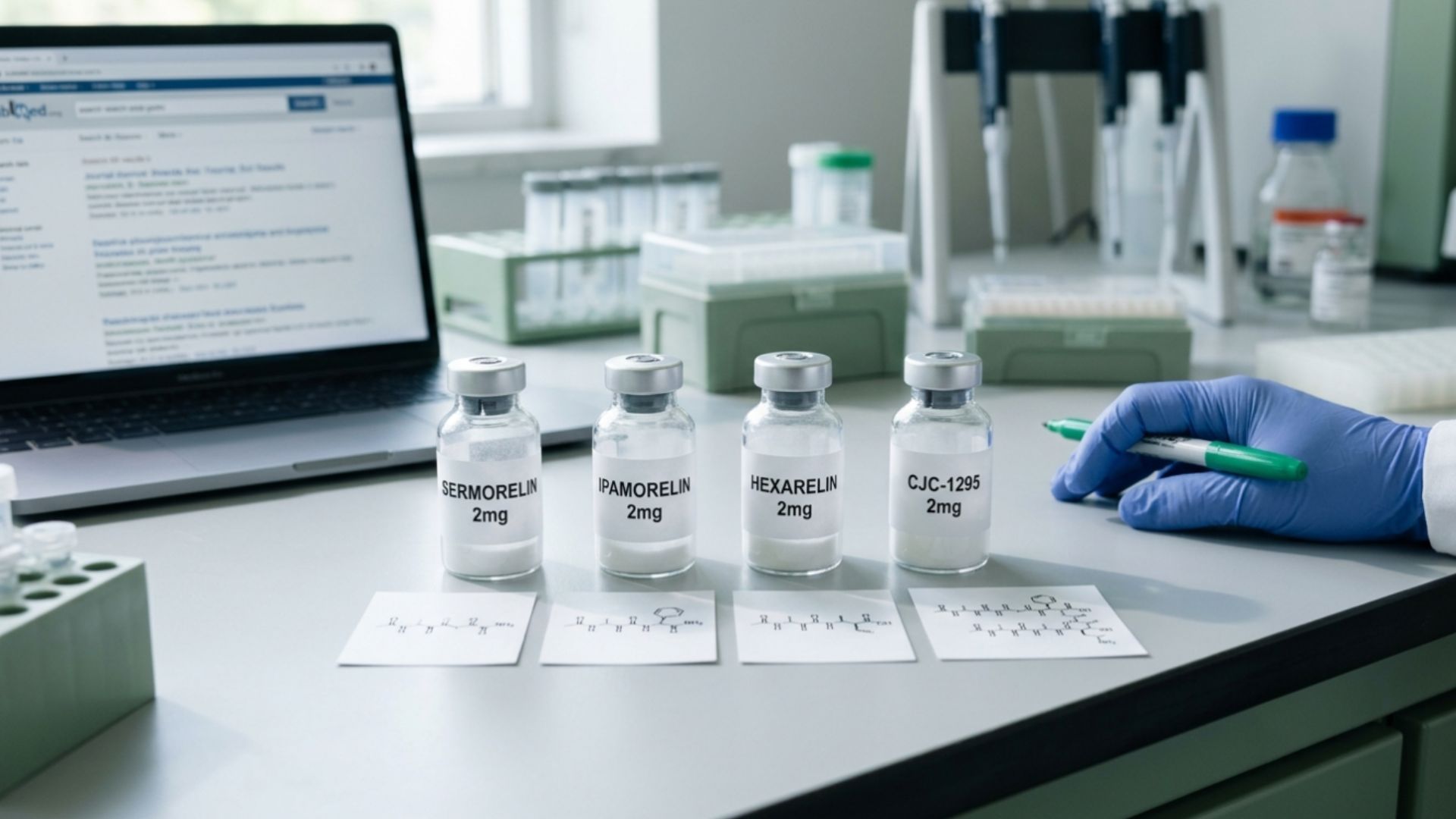
After age 30, our bodies switch to a slow energy-saving mode. Every 10 years, natural growth hormone (HGH) production drops by about 14%. By the time we reach forty, we begin to recover more slowly, have a harder time coping with sleep deprivation, and gain weight “out of nowhere” more quickly.
For a long time, scientists tried to address this with injections of synthetic growth hormone, until they realized: an adult’s pituitary gland can still produce significant amounts of HGH; it just needs the right signal. Secretagogue peptides provide this signal. And if you’ve heard of this even once, you’ve likely also come across names like Sermorelin, Ipamorelin, Hexarelin, and CJC-1295. In fact, they’re often mentioned together as interchangeable options. But this is a big mistake, and in this article, we’ll break down why and exactly how each of them works in your body.
⚠️ This material is for educational purposes only. All compounds mentioned are research peptides for in vitro laboratory use. Nothing here constitutes medical advice. For any practical questions, consult a licensed physician.
Two Classes: GHRH Analogs vs. GH Secretagogues
The first class consists of GHRH (growth hormone-releasing hormone) analogs. These molecules act through the GHRH receptor in the pituitary gland, mimicking the signal from the hypothalamus. Essentially, they replicate the physiological pathway: “the hypothalamus tells the pituitary to release growth hormone.” This class includes sermorelin, CJC-1295, and tesamorelin.
The second class is growth hormone secretagogues (GHS). They work differently: through the ghrelin receptor (GHSR-1a), which is a completely separate system. These molecules do not mimic GHRH, but they activate a different receptor pathway. This class includes ipamorelin and hexarelin.
But why is it important to distinguish between these two pathways? Because they are completely different, with different effects and different research questions. And if you mix molecules from two different classes, they are not the same thing.
The GHRH Analogs: Sermorelin and CJC-1295
Let’s start with GHRH analogs:
- Sermorelin. This is a 29-amino acid fragment of native human GHRH. It is perhaps the most studied molecule in this group: Sermorelin has a documented clinical history, including the approval of the drug Geref for pediatric use in GH deficiency (later discontinued for commercial, not safety, reasons). In 2006, Walker provided a detailed analysis of its pharmacology and application in the context of age-related decline in GH secretion in Clinical Interventions in Aging (Walker RF, CIA, 2006).
- CJC 1295. This is also a GHRH analog, but a modified one. It exists in two forms: with DAC (Drug Affinity Complex) and without. The DAC version is designed for a significantly longer half-life due to binding to plasma albumin. The non-DAC version is a shorter-acting form with a different profile. These are different research tools, even if their names are nearly identical.
Tesamorelin vs. Sermorelin
Now, about Tesamorelin. We want to discuss it separately, as this particular peptide is often compared with sermorelin. Tesamorelin vs. sermorelin is not just a comparison of two GHRH analogs. Tesamorelin is the only molecule in this group with active FDA approval. It is approved under the brand name Egrifta for the treatment of lipodystrophy in HIV-positive patients receiving antiretroviral therapy. Clinical data on it have been obtained in randomized controlled trials, including a large study by Falutz et al. in the NEJM (Falutz et al., NEJM, 2007).
Sermorelin is a different story: there is a clinical history, but no current approval for the drug. This is a factual difference in regulatory status that is important to consider when reading any literature on the subject.

The Secretagogues: Ipamorelin and Hexarelin
Now is a good time to discuss the second pathway and the peptides involved in it:
- Ipamorelin. This is a pentapeptide, a ghrelin receptor agonist. It is often characterized as a “selective” secretagogue: compared with earlier molecules in the same class, it has a weaker effect on cortisol and prolactin. Raun et al. described this specific profile as a distinguishing feature of ipamorelin in the European Journal of Endocrinology (EJE, 1998). This made it an interesting subject for further study.
- Hexarelin. This is another secretagogue of the same class, but with a broader activity profile. Studies have demonstrated a more pronounced effect on cortisol and prolactin levels compared to ipamorelin. Additionally, hexarelin has been studied in a cardiological context (several studies examined its interaction with receptors in cardiac tissue). This makes it a significant subject in preclinical research.
Both compounds are investigational and lack clinical approval. Data on them are predominantly preclinical or from early-phase trials.
Sermorelin vs. Ipamorelin: Across the Two Classes
This comparison clearly illustrates everything we discussed above.
Sermorelin vs. Ipamorelin is not simply “two peptides for GH.” They are representatives of two different classes with fundamentally different points of entry: sermorelin activates the GHRH receptor, while ipamorelin activates the ghrelin receptor.
In normal physiology, both pathways work together and reinforce each other. This is precisely why, in a research context, the ability to influence them separately is a valuable tool: it allows us to isolate each pathway’s contribution to final GH secretion and study them independently.
Why CJC-1295 and Ipamorelin Are Often Discussed Together
The search term “CJC 1295 ipamorelin” is among the most common in the context of GH peptides. Why have these two compounds from different classes become so closely linked in discussions?
The logic is simple, and it stems from physiology. The GHRH and ghrelin pathways normally act simultaneously. Their joint activation under experimental conditions produces a more pronounced GH secretion response than either pathway alone. This has been demonstrated in several studies, including a review by Sigalos and Pastuszak, which systematically examines data on GH secretagogues and their combinations (Sigalos & Pastuszak, Sexual Medicine Reviews, 2018).
CJC-1295 (without DAC) and ipamorelin act on different receptors, which is precisely why they have come under the same research umbrella. Important caveat: research interest in combining two mechanisms is not the same as clinical data on the safety and efficacy of such a combination in humans. Here, the gap between preclinical observations and substantiated conclusions remains significant.
Key Takeaways and Safety
To summarize the above into a working framework:
- GHRH analogs (sermorelin, CJC-1295, tesamorelin) act via the GHRH receptor, mimicking the hypothalamus’s physiological signal.
- GH secretagogues (ipamorelin, hexarelin) act via the ghrelin receptor, another pathway to the same goal.
- Their regulatory statuses differ: tesamorelin is an approved drug with an indication; sermorelin has a clinical history but no current approval; the others are investigational compounds.
Regarding safety, data from large controlled human trials are insufficient to determine the safety profile of investigational peptides beyond specific experimental conditions. This is an important limitation that an honest interpretation of the literature does not ignore.
Any questions regarding use, selection, regimen, or appropriateness should be directed exclusively to a licensed physician.
The Grey Research Peptides catalog for laboratory use includes: Sermorelin 10mg, Ipamorelin 5mg, Hexarelin 5mg, and Tesamorelin 10mg. For in vitro research use only by qualified professionals. Not for use in humans or animals.