
People usually search for this


Vilon Peptide – Immune Benefits, Mechanism & Dosage Guide

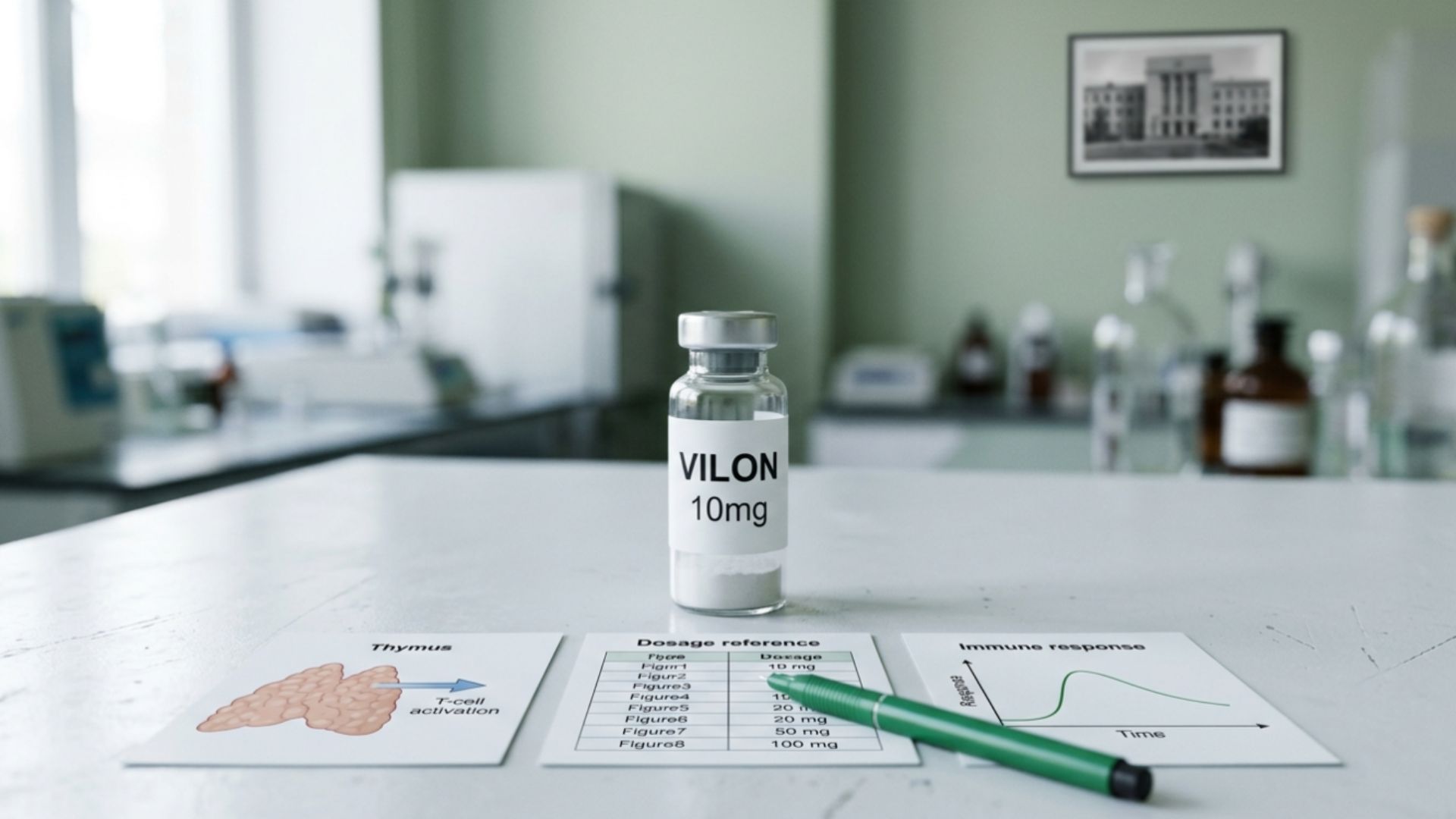
FDA Compliance Notice: Vilon is an investigational research compound not approved by the FDA or EMA for human use. For the full legal and medical regulatory disclaimer, please refer to the bottom of this article.
TL;DR: Vilon (Lys-Glu) is an ultra-short dipeptide bioregulator derived from thymus research, hypothesized to interact directly with chromatin to modulate immune-related gene expression. Preclinical studies show potential for restoring T-cell function and reducing inflammatory cytokines, though independent human clinical trials are lacking. This guide covers its unique cellular mechanism, reconstitution math, safety guidelines, and how it directly compares to other Khavinson peptide fractions.
“Vilon sits at an interesting crossroads in peptide science – it’s one of the shortest bioregulators ever characterized, yet the depth of preclinical work behind it spans decades. What draws our attention is the mechanism: a two-amino-acid sequence that appears to interact directly with chromatin and modulate gene expression. That’s not something you see with most peptides in the research supply chain. We’ve made it a priority to provide researchers with high-purity Vilon precisely because the science, while still largely preclinical, raises questions worth investigating rigorously.” – Dr. Alexander Isaacs, Grey Research Peptides
Updated: October 2025
Table of Contents
- What Is Vilon Peptide and Where Does It Come From
- Evidence Level Summary: Assessing the Research Base
- From Thymalin to Vilon – How Short Bioregulators Evolved
- Vilon Peptide Mechanism of Action
- Immune System Benefits
- Beyond Immunity: Aging, Tumors, and Tissue Repair
- Vilon Compared to Thymalin, Thymogen, and Epitalon
- Dosage, Reconstitution, and Storage
- Side Effects and Safety Considerations
- Frequently Asked Questions
- Where to Source High-Purity Vilon with Verified COA
What Is Vilon Peptide and Where Does It Come From
Vilon is a synthetic dipeptide composed of two amino acids – lysine and glutamic acid (Lys-Glu, abbreviated KE) – classified as a short peptide bioregulator within the Khavinson bioregulator class. It originated from research conducted at the St. Petersburg Institute of Bioregulation and Gerontology under the direction of Professor Vladimir Khavinson.
The compound’s lineage traces back to thymus extract peptide fractions. In the 1970s and 1980s, Khavinson’s team isolated crude thymic preparations and progressively identified shorter active sequences responsible for immunomodulatory effects. Vilon represents the endpoint of that reductionist approach – the smallest peptide fragment shown to retain biological activity on the immune system in experimental models.
Evidence Level Summary: The Reality of Current Data
- Stage: Preclinical (primarily in vitro cell cultures and rodent models).
- Source Origin: The vast majority of data stems from a single research group. Independent third-party replication in Western literature remains scarce.
- Human Clinical Trials: Zero large-scale, randomized controlled human trials (RCTs) operating under international regulatory oversight (FDA, EMA).
- Current Verdict: Highly promising for exploratory genetic and immunological research models, but remains strictly an investigational bioregulator.
From Thymalin to Vilon – How Short Bioregulators Evolved
- Thymalin: A complex polypeptide extract from calf thymus developed in the 1970s.
- Thymogen (Glu-Trp): A two-amino-acid fragment isolated from thymalin that retained immunostimulatory properties.
- Vilon (Lys-Glu): Characterized as a distinct dipeptide with a different mechanism: rather than mimicking thymic hormones directly, it appeared to interact at the chromatin level with gene expression machinery.
Vilon Peptide Mechanism of Action – How the KE Dipeptide Works
Vilon’s proposed mechanism of action bypasses traditional receptor-ligand binding. Instead, research suggests the KE dipeptide interacts directly with chromatin – the DNA-protein complex inside the cell nucleus – to modulate gene expression at the epigenetic level.
Chromatin Binding and Epigenetic Gene Regulation
The central hypothesis involves direct physical interaction between the KE dipeptide and specific regions of chromatin. Research from the Khavinson laboratory has proposed that short peptides can penetrate the cell membrane, enter the nucleus, and bind to complementary DNA sequences within gene promoter regions.
Cytokine Signaling and Interleukin-2 Pathways
Vilon’s effects on IL-2 production represent the most functionally relevant downstream consequence. IL-2 is the primary growth factor for T-lymphocytes. In cell culture models, KE dipeptide treatment has been associated with increased IL-2 mRNA transcription and modulation of broader cytokine profiles.
Immune System Benefits
The primary research finding associated with vilon is the restoration of T-cell proliferation capacity in aged immune system models. Published preclinical data suggest the KE dipeptide can partially reverse age-related declines in lymphocyte function.
T-Cell Proliferation and Lymphocyte Differentiation
Experiments using lymphocytes from aged donors produced measurable increases in proliferative response to standard mitogens. Observations include increased expression of CD4 surface markers, suggesting enhanced helper T-cell maturation.
Aged Immune Reactivation – Findings From Animal Models
Rodent model studies have reported:
- Partial reversal of thymic involution markers.
- Shifts in lymphocyte subpopulations toward increased CD4+/CD8+ ratios.
- Improved antibody responses to standardized antigenic challenges.
Beyond Immunity – Aging, Tumor Biology, and Tissue Repair
- Lifespan Extension: Rodent longevity studies reported 12–25% increases in mean lifespan.
- Tumor Cell Research: Some studies showed reduced spontaneous tumor occurrence in vilon-treated aged controls.
- Tissue Regeneration: Preliminary findings suggest enhanced mucosal regeneration in the GI tract and improved retinal cell function markers.
Vilon Compared to Thymalin, Thymogen, and Epitalon
| Parameter | Vilon | Thymalin | Thymogen | Epitalon |
| Sequence | Lys-Glu (KE) | Complex mixture | Glu-Trp (EW) | Ala-Glu-Asp-Gly |
| Primary Target | Immune (Genes) | Immune (Broad) | Immune (T-cells) | Neuroendocrine |
| Mechanism | Chromatin binding | Multi-pathway | Hormone mimicry | Telomerase/Melatonin |
| Research Dose | 10–100 mcg | 5–10 mg | 100 mcg–1 mg | 10–100 mcg |
Vilon Peptide Dosage, Reconstitution, and Storage
Dosage Ranges and Administration
- Subcutaneous injection: 10–100 mcg per administration, once daily for 10–20 days.
- Intranasal administration: 10–50 mcg per dose, 1–3 times daily.
Reconstitution Mathematics Example
If working with a 5 mg vial of lyophilized vilon and adding 2 mL of bacteriostatic water, the concentration is 2.5 mg/mL (2500 mcg/mL). To pull a standard research dose of 100 mcg, you would draw 0.04 mL (4 units on a standard U-100 insulin syringe).
Storage Requirements
- Lyophilized: 24+ months at -20°C.
- Reconstituted: 21–28 days at 2–8°C (Refrigerated).
Side Effects and Safety Considerations
The reported side effect profile in published research is minimal, but no large-scale human safety trials exist. Theoretical risks include:
- Autoimmune contexts: Enhanced T-cell activity could theoretically exacerbate existing autoimmune conditions.
- Gene Activation: Potential theoretical questions about unintended gene activation in pre-malignant cells.
Frequently Asked Questions
What Is Vilon Peptide Made Of?
Vilon is composed of two amino acids – L-Lysine and L-Glutamic acid – joined by a single peptide bond. It is one of the smallest peptides classified as biologically active.
Can Vilon Be Combined With Other Bioregulator Peptides?
Yes. Published protocols frequently pair vilon with epitalon for complementary immune and neuroendocrine targeting. The “rotation protocol” concept (sequential cycles) is commonly referenced.
How Long Does Vilon Take to Produce Observable Effects?
In cell culture, changes are observed within 24–72 hours. In rodent models, immune marker changes become apparent within a 10–20 day protocol window.
Is Vilon legal to buy?
Yes, Vilon is legal to purchase and possess explicitly as an experimental laboratory research compound not intended for human consumption.
How do I verify the COA is real?
Authentic COAs should feature verifiable batch numbers, HPLC purity readouts, and contact details for an independent third-party analytical lab.
What if my reconstituted Vilon was left at room temperature?
If left out for 8–12 hours, the risk is minor. If left out for several days, the structural integrity cannot be guaranteed, and it should be discarded.
References
- Khavinson VH. “Short peptides regulate gene expression.” Neuroendocrinology Letters, 2002.
- Anisimov VN, et al. “Effect of peptide bioregulators and melatonin on biomarkers of aging…” Biogerontology, 2001.
- Lezhava T, et al. “Bioregulator Vilon-induced reactivation of chromatin…” Biogerontology, 2004.
Important Medical and Legal Disclaimer: Vilon is a research compound, not an FDA-approved medication. This information does not constitute medical advice. This compound is sold for research use only and is not intended for human consumption.