
People usually search for this


Peptide Blends: The Research Rationale for Combining Multiple Peptides

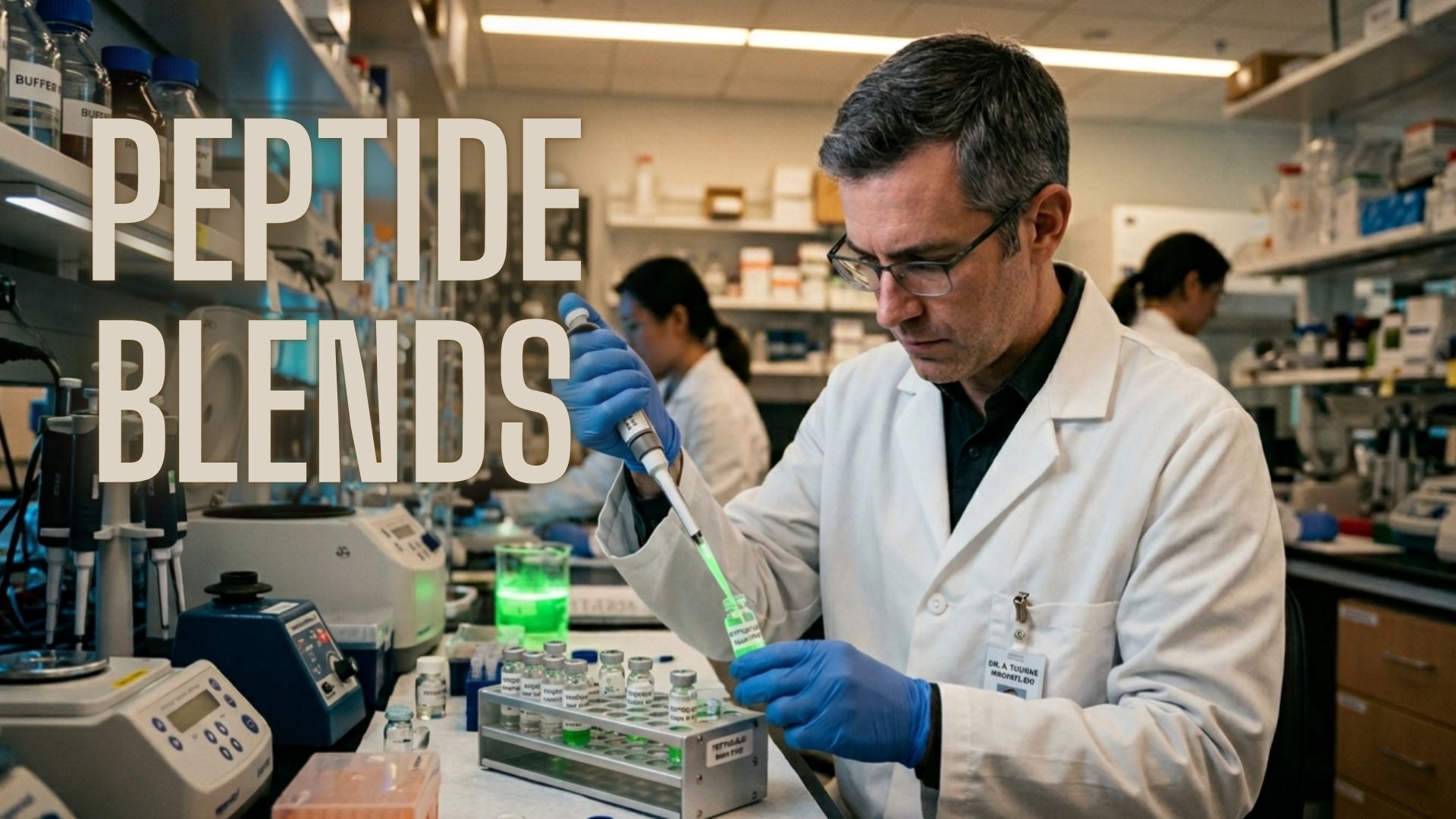
Something has shifted in how serious researchers approach peptide protocols. Where single compounds once dominated experimental design, the field is increasingly moving toward deliberate combinations – peptide blends engineered to engage multiple biological pathways at once. This isn’t trend-chasing, but a logical progression: individual peptides have a ceiling, and the limits of a single signaling mechanism often set that ceiling.
Peptides are short amino acid chains that act as molecular signals – binding receptors, triggering cascades, and modulating processes from tissue repair to hormone secretion. Their specificity is both a strength and a constraint. A molecule optimized for one pathway typically leaves others untouched. That’s where stacking peptides enters the picture.
Combining a growth hormone secretagogue with a repair-focused peptide and a collagen-supporting compound enables parallel targeting of muscle growth, recovery, and structural tissue integrity. Stacks like the Wolverine peptide stack – oriented toward recovery and performance – or the GLOW stack peptide – focused on skin quality and anti-aging – represent the practical expression of this multi-pathway logic.
At Grey Research Peptides, we’ve been supplying the compounds used in these protocols since 2016. So our article breaks down the science behind strategic combinations, explores goal-specific approaches, and explains what actually separates the best peptide stack for muscle growth from a random assortment of vials.
Why Peptide Blends Work Better Than Single Compounds
The most straightforward case for peptide blends is biological: the body doesn’t operate through isolated pathways. Muscle tissue growth, for instance, involves growth hormone secretion, IGF-1 signaling, local repair, satellite cell activation, and nutrient utilization – all simultaneously. A single peptide, however well-characterized, engages one or two of these nodes at best.
Combining compounds means layered engagement. One peptide stimulates GH release; another accelerates the clearance of inflammatory mediators in damaged tissue; a third supports extracellular matrix integrity. Instead of a narrow intervention, you get a coordinated one.
There’s also the plateau problem. Continuous stimulation of a single receptor pathway tends to produce diminishing downstream signaling over time – a well-documented issue in pharmacological research. Blends, by distributing signals across different receptors and cascades, tend to produce more sustained and balanced outcomes. That’s why stacking peptides has become the preferred methodology in advanced research contexts – not a shortcut, but a strategy.
Popular Peptide Stacks and Their Targeted Benefits
Not all stacks are created equal. The most studied combinations emerged from specific research questions: What does tissue recovery look like when BPC-157 and TB-500 are used together? How does collagen synthesis change when GHK-Cu is added to the equation?
The Wolverine stack peptide, typically built around BPC-157 and TB-500, is one of the most discussed combinations in recovery-focused research. BPC-157 has been studied in the context of angiogenesis and tendon healing, while TB-500 (Thymosin Beta-4) promotes actin polymerization and cell migration in damaged tissue. Together, they cover complementary phases of the repair process.
The GLOW stack peptide takes a different direction: skin quality, collagen architecture, and cellular longevity. GHK-Cu, a copper-binding tripeptide, has been shown in vitro to upregulate collagen and elastin synthesis and modulate inflammatory gene expression. Combined with BPC-157 for tissue-level support, it represents a research-backed approach to dermal and connective tissue health.
For metabolic research, a peptide stack for weight loss typically centers on GLP-1 receptor agonists like Semaglutide or Retatrutide – compounds that influence appetite regulation and energy metabolism at the receptor level – potentially paired with peptides that support lean mass retention during caloric restriction.
How Synergy Enhances Results in Peptide Stacking
Synergy in this context has a precise meaning: two compounds producing a combined effect greater than either would achieve alone, through mechanistically distinct but compatible actions.
A straightforward example: CJC-1295 stimulates GHRH receptors, increasing pulsatile GH secretion. Ipamorelin activates ghrelin receptors in the pituitary, amplifying that secretion through a separate mechanism. Used together, they engage two independent amplification points in the same GH axis – without simply doubling the dose of one compound. Research on GHRH/GHRP combinations has demonstrated this additive dynamic in animal models, with GH pulse amplitude significantly greater in combination protocols than in either monotherapy arm.
This is what distinguishes strategic stacking peptides from random combinations: the compounds are selected because their mechanisms are complementary, not redundant. One peptide increases growth hormone output; another improves the cellular environment that makes that output useful. The result is a protocol greater than the sum of its parts.
Best Peptide Stack for Muscle Growth and Performance

Hypertrophy research consistently points to three underlying requirements: sufficient GH/IGF-1 signaling, efficient recovery between loading cycles, and an intact protein synthesis machinery. The best peptide stack for muscle growth addresses all three rather than optimizing one at the expense of others.
A well-designed growth-focused stack typically combines a GHRH analog (such as CJC-1295 or Sermorelin) with a selective GHRP (Ipamorelin or Hexarelin) to maximize GH pulse amplitude, then adds a repair-oriented compound – BPC-157 or TB-500 – to accelerate connective tissue and muscle fiber recovery between sessions. IGF-1 LR3, which acts downstream of GH and directly stimulates satellite cell proliferation, represents a further layer for protocols specifically focused on myofibrillar hypertrophy.
The best peptide stack for muscle growth and fat loss extends this logic: GHRH/GHRP combinations naturally support lipolysis as a secondary effect of elevated GH, and pairing them with a GLP-1 receptor agonist can address appetite regulation at the same time. This dual-axis approach – anabolic signaling plus metabolic efficiency – is precisely why body recomposition protocols have moved toward multi-compound designs rather than sequential single-compound phases.
A 2006 study published in the Journal of Clinical Endocrinology & Metabolism demonstrated that combined GHRH and GHRP administration produced significantly greater GH secretion than either peptide alone, supporting the mechanistic rationale for this stack.
Peptide Stack for Weight Loss and Fat Optimization
A peptide stack for weight loss operates through a different primary mechanism: shifting the metabolic set point rather than simply increasing energy expenditure. GLP-1 receptor agonists like Semaglutide reduce appetite via central hypothalamic pathways and slow gastric emptying, producing a sustained caloric deficit without the compensatory hunger that typically accompanies restriction. Retatrutide – a triple GIP/GLP-1/glucagon receptor agonist – adds a glucagon-mediated lipolytic component, making it particularly relevant for fat oxidation research.
The best peptide stack for weight loss doesn’t stop at appetite regulation. Preserving lean mass during a caloric deficit is a critical variable, and this is where a GH secretagogue component adds meaningful research value. Elevated GH during energy restriction supports preferential fat mobilization while attenuating muscle protein catabolism – a dynamic process well-documented in the GH-deficiency and obesity literature.
A 2022 clinical trial on Semaglutide published in the New England Journal of Medicine reported substantial body weight reduction in participants with obesity, with a favorable effect on body composition that distinguished it from caloric restriction alone.
Choosing the Right Peptide Blend for Your Goals
The honest answer to “which stack is best” is: it depends on what you’re actually trying to study. That’s not a deflection – it’s the only scientifically defensible position.
If the research question centers on tissue repair and recovery kinetics, a BPC-157/TB-500 combination is the logical starting point. If the focus is on GH axis modulation and body composition, a GHRH/GHRP stack – potentially extended with IGF-1 LR3 – is better suited. For metabolic and appetite research, GLP-1 agonists, with or without GH-axis support, represent the current frontier.
Experience level with compound protocols also matters. Simpler two-peptide stacks are easier to interpret experimentally – fewer variables, cleaner signal. More advanced multi-compound designs offer broader coverage but require more careful experimental control to distinguish individual contributions.
What doesn’t vary across any of these contexts is the importance of compound quality. A stack built on impure or misidentified peptides doesn’t produce meaningful data – it produces noise. At Grey Research Peptides, every batch is verified by HPLC purity analysis and mass spectrometry identity confirmation, with third-party COA documentation available. The compounds we supply meet ?98% purity standards precisely because reproducible research depends on knowing what’s actually in the vial.
Choosing the right peptide blends starts with a clear research question. It ends with compounds you can actually trust.
A 2019 review in the Peptides journal examined BPC-157’s pleiotropic tissue-protective effects across multiple organ systems, reinforcing the mechanistic basis for its inclusion in recovery-focused stacks.
Frequently Asked Questions
What's the scientific rationale for combining peptides in research?
Most physiological pathways involve multiple regulatory inputs operating simultaneously. Combining peptides that target complementary mechanisms allows research models to mimic this natural complexity rather than studying single signals in isolation. The rationale is that mechanism complementarity, not just additive dosing, drives the value of well-designed peptide blends in research protocols.
What are the most extensively studied peptide blend categories?
Major blend categories include GH secretagogue stacks (CJC-1295 + Ipamorelin combining GHRH and ghrelin pathways), tissue repair blends (BPC-157 + TB-500 combining angiogenesis and cell migration), multi-peptide repair formulas like GLOW (BPC-157, TB-500, GHK-Cu) and KLOW (adding KPV), and metabolic blends like Cagrilintide + Semaglutide pairing amylin and GLP-1 signaling.
What's the difference between dose-sparing and additive blend effects?
Dose-sparing means two peptides at sub-effective individual doses produce a strong combined response — a hallmark of true synergy. Additive means combined doses produce effects equal to the sum of individual contributions. Blends designed around synergistic mechanisms (different pathways converging on the same outcome) typically show dose-sparing; blends combining similar mechanisms more commonly show additive effects.
What stability considerations apply when peptides are blended in the same vial?
Co-formulated blends must be tested for chemical compatibility — some peptides degrade faster in proximity to others due to pH effects, enzymatic activity, or aggregation. Pre-blended commercial products like GLOW and KLOW are co-lyophilized in stoichiometric ratios, ensuring uniform reconstitution. Researchers blending peptides themselves after reconstitution should verify stability data exists for the specific combination before use in protocols.