
People usually search for this


Hexarelin Long-Term Research: GH Effects Beyond Short-Term Data

Updated: May 2026
Written by Dr. Alexander Isaacs, Lead Researcher
Disclaimer: This information is for educational purposes only, not medical advice. Hexarelin is an investigational research peptide that has not been approved by the FDA, EMA, or any regulatory body for human clinical use. The content here is not intended to diagnose, treat, cure, or prevent any disease. All references to dosing, effects, and outcomes are drawn from preclinical and early-phase clinical studies. Products discussed are for laboratory/research use only, not for human consumption. If you are considering any peptide protocol, consult a qualified healthcare professional and monitor the HPA axis.
TL;DR / Executive Summary
Hexarelin is a highly potent synthetic growth hormone-releasing peptide (GHRP) that triggers massive acute GH spikes – but its long-term profile tells a different story. Rapid receptor desensitization causes GH output to drop up to 70% within 8 weeks of continuous dosing. Despite fading endocrine effects, hexarelin maintains a parallel, GH-independent cardioprotective pathway via the CD36 receptor, reducing cardiac fibrosis and improving ischemia recovery in preclinical models. Chronic use also creates an asymmetric side-effect profile: elevations in cortisol and prolactin persist even after the GH response has attenuated. For researchers, maximizing hexarelin’s utility requires strategic cycling protocols and a clear understanding of how it compares to alternatives like MK-677, ipamorelin, or synergistic analogs like CJC-1295.
Most conversations about hexarelin start and end with the same data point: it triggers a powerful, acute growth hormone spike. That finding is real, reproducible, and – frankly – incomplete. The short-term GH burst is the opening chapter of a much longer story, one involving receptor desensitization, a surprisingly independent cardiac protection pathway, and a side-effect profile that diverges meaningfully from more selective secretagogues.
So what actually happens when you extend hexarelin research beyond the initial spike?
“Hexarelin’s short-term GH data gets repeated endlessly, but the compounds that teach us the most are the ones we study beyond their initial spike. The desensitization curve, the CD36 cardiac binding, the cortisol and prolactin trade-offs – that’s where hexarelin research gets genuinely instructive.” – Dr. Alexander Isaacs, Grey Research Peptides (2026).
This article examines what long-term hexarelin research has actually revealed – the mechanisms that persist after GH output fades, the hormonal costs that accumulate with chronic dosing, and why this GHRP hexapeptide analogue remains a reference compound for cardiovascular and endocrine researchers alike.
What Is Hexarelin and How It Works as a Growth Hormone Secretagogue
Hexarelin is a synthetic hexapeptide classified as a growth hormone-releasing peptide (GHRP) and a structural analogue of GHRP-6 with enhanced metabolic stability. In plain terms: it’s a lab-made six-amino-acid chain designed to tell your pituitary gland to release growth hormone – and it does so aggressively.
The hexarelin peptide stimulates growth hormone secretion by acting as a potent ghrelin receptor GHS-R1a agonist on somatotroph cells in the anterior pituitary, producing a pulsatile GH release pattern that mimics but amplifies the body’s endogenous rhythm.
What sets hexarelin apart from other members of the GHRP family is its dual receptor engagement. Beyond GHS-R1a, hexarelin binds the CD36 scavenger receptor in cardiac tissue. Its pharmacokinetic profile is straightforward: subcutaneous bioavailability around 70%, and a half-life of roughly 1-2 hours.
In early human studies, intravenous hexarelin produced a 5- to 10-fold increase in serum GH levels. Chronic administration at 2 mg/day subcutaneously for 16 weeks elevated serum IGF-1 by 20-50%. These numbers established hexarelin as one of the strongest GHRP-class secretagogues tested in humans. They also set the stage for the desensitization problem that defines its long-term profile.
GHS-R1a Receptor Binding and Pituitary GH Release Mechanism
Hexarelin activates GH secretion through direct binding to the GHS-R1a receptor on pituitary somatotrophs. This binding triggers phospholipase C activation and intracellular calcium mobilization, which in turn stimulates the release of stored GH.
In short-term studies, this produces a distinct spike peaking at 15-30 minutes post-injection and returning to baseline within 2-4 hours. This pulsatility is physiologically relevant, as it preferentially activates hepatic IGF-1 production. Hexarelin’s pulsatile character is precisely what makes it behave differently from sustained-release compounds; a single sharp pulse and a 24-hour drip activate different downstream gene expression profiles.
Hexarelin vs Ipamorelin: Receptor Selectivity and Scope of Action
Hexarelin is a broader-acting compound; ipamorelin is a narrower one. Ipamorelin binds GHS-R1a selectively with no meaningful affinity for CD36 or other off-target receptors. While hexarelin produces higher GH levels, it also elevates cortisol and prolactin, whereas ipamorelin produces no significant change in either.
Extended Secretagogue Comparison Matrix
- Hexarelin: GHRP Hexapeptide; GHS-R1a & CD36 receptors; Massive acute spike; Fast desensitization; High cortisol/prolactin elevation. Key Trait: CD36 cardiac inotropy.
- Ipamorelin: GHRP Pentapeptide; GHS-R1a selective; Moderate acute spike; Slow desensitization; Minimal/No cortisol/prolactin. Key Trait: Clean side-effect profile.
- MK-677: Non-peptide; GHS-R1a selective; Sustained elevation; Minimal desensitization; Mild/Transient cortisol/prolactin. Key Trait: Oral bioavailability.
- CJC-1295: GHRH Analogue; GHRH Receptor; Amplifies natural pulse; Minimal desensitization; No cortisol/prolactin. Key Trait: Synergistic with GHRPs.
Short-Term Hexarelin Benefits Established in Early Research
Early research established a powerful acute GH response, measurable IGF-1 elevation, and direct cardioprotection during ischemia-reperfusion injury. Beyond endocrine metrics, it impacts feeding behavior as a ghrelin analog, notably increasing food intake without causing disproportionate fat storage in early trials.
The most surprising early discovery was ischemia-reperfusion myocardial protection. In preclinical rat models, hexarelin reduced infarct size by 30-40% even at short treatment durations.
Long-Term GH Axis Findings: Desensitization and Tachyphylaxis
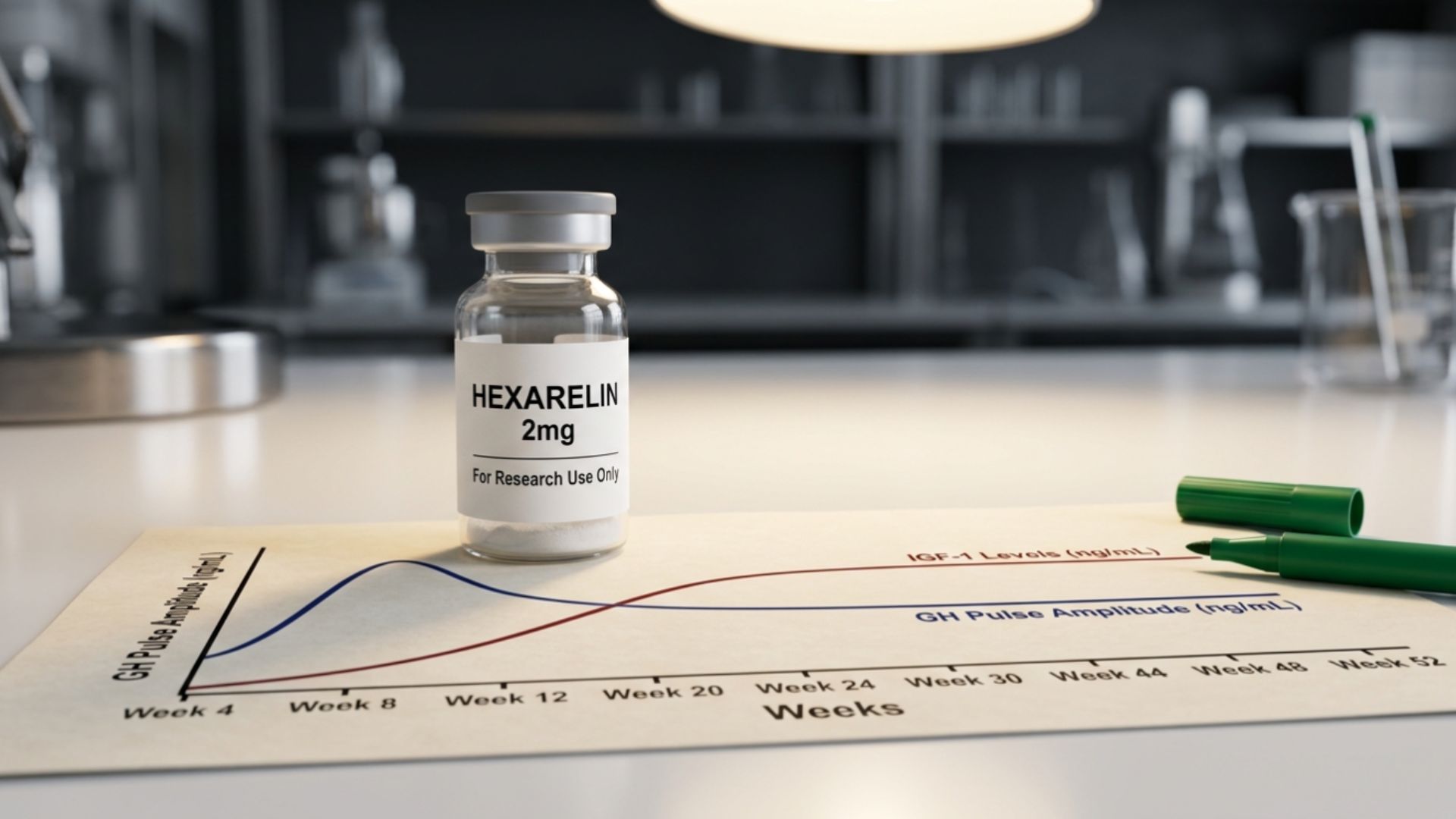
The defining limitation of hexarelin as a sustained GH-elevating agent is receptor desensitization. The magnitude of the GH response begins declining within the first week and reaches a 50-70% reduction by weeks 2-4.
The mechanism involves downregulation and internalization of GHS-R1a receptors. With repeated exposure, cells reduce surface receptor density, effectively pulling the receptors inside the cell where hexarelin can’t reach them.
Timeline of GH Response Attenuation
In a 16-week protocol, the GH response drops approximately 50% by week 2 and 70% by week 8. For comparison, GHRP-6 shows a slower decline (roughly 40% by week 8). However, desensitization is reversible; a 2-week washout period has been shown to restore 60-80% of baseline responsiveness.
Cycling Strategies Based on Desensitization Data
- Standard Washout (2 Weeks ON / 2 Weeks OFF): Most evidence-backed cycle for preventing permanent receptor downregulation.
- The Micro-Cycle (5 Days ON / 2 Days OFF): Mimics natural physiological recovery over weekends, maintaining a higher average GH peak.
- Low-Dose Pulsatile (Once Daily / Pre-bed): Avoids multiple daily spikes, stretching viability to possibly 4-6 weeks before a mandatory off-cycle.
Cardioprotective Effects Independent of GH Release
Hexarelin protects cardiac tissue through the CD36 scavenger receptor. Cardiac benefits continue even when GH output has plateaued due to desensitization.
In cardiomyocytes, engagement with the CD36 receptor activates survival pathways and inhibits cell death. Hexarelin treatment significantly reduces cardiac fibrosis by decreasing collagen deposition. This highlights that compounds binding CD36 may offer cardiac research applications completely divorced from growth hormone therapies.
Hexarelin Side Effects: Hormonal Elevations and HPA Axis Activation
Hexarelin produces dose-dependent elevations in cortisol (20-50%) and prolactin (30-100%) within 30-60 minutes of administration.
A major problem for long-term use is “desensitization asymmetry.” While the GH response drops rapidly with chronic dosing, prolactin and cortisol elevations persist. Over time, a subject experiences diminishing GH returns alongside a persistent hormonal burden. In contrast, ipamorelin produces no such elevations.
Research Limitations & Data Gaps
Current literature has substantial limitations. No new comprehensive human trials have been published in recent years, leaving the dataset “temporally static” (mostly from the late 90s and early 2000s).
- Clinical Trial Failures: A human Phase II heart failure trial in 2005 failed to meet primary efficacy endpoints, stalling clinical development.
- Preclinical Dominance: Most data regarding CD36 binding and fibrosis reduction stems exclusively from rodent models.
- Investigational Status: There is no 5-year safety data or large-cohort adverse event databases for humans.
Key Takeaways for Future Development
- Desensitization is schedule-dependent: Washout periods prove tachyphylaxis is an adaptable feature, not a permanent flaw.
- CD36 represents a separate axis: Future molecules could be engineered specifically for cardiac protection without endocrine side effects.
- Selectivity is key: Narrower receptor focus (like Ipamorelin) eliminates HPA-axis activation.
Frequently Asked Questions
Does Hexarelin Affect Feeding Behavior in Long-Term Use?
Yes. It maintains significant appetite-stimulating action throughout chronic treatment, though this typically does not result in disproportionate body weight gain.
How Does Dosage Influence the Balance Between GH Release and Side Effects?
The relationship is linear. GH release, cortisol, and prolactin all scale proportionally with the dose. There is no “sweet spot” dose; researchers must choose between intensity and side effects, making cycling the primary strategy for management.
Can Cardioprotective Effects Occur Without GH Elevation?
Yes. The CD36 pathway operates on a separate receptor system in cardiomyocytes, independent of pituitary function. Benefits persist even when the GH axis is exhausted or in models where GH is physiologically absent.