
People usually search for this


CJC-1295 Research: What Studies Show About the GHRH Analog

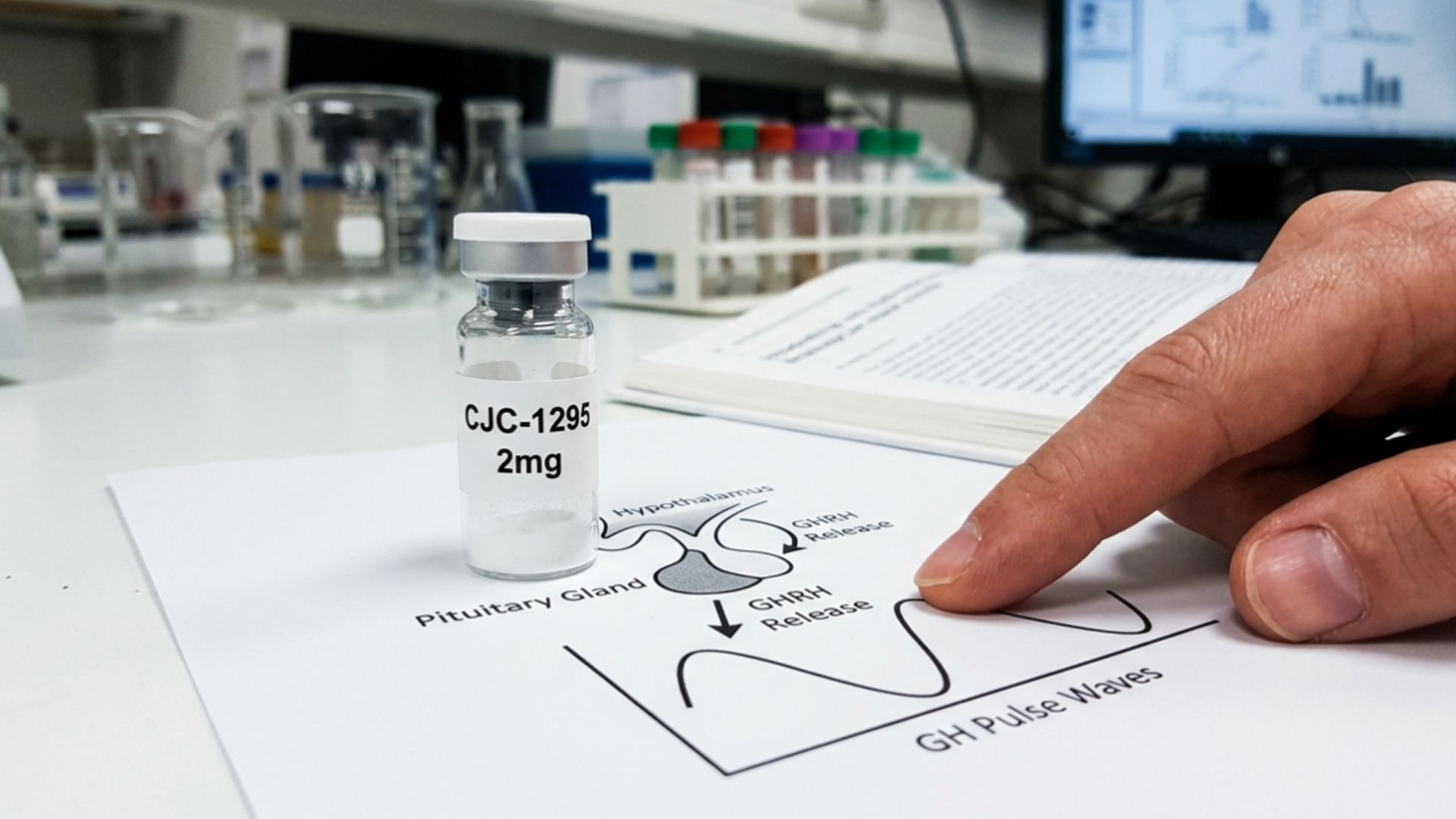
Among GHRH analogs, CJC-1295 holds a special place. Why this one and not the dozens of other peptides? Because, unlike most peptides currently being studied, this one already has clinical data published in peer-reviewed journals. And these are real studies with participants, results, and honest limitations documented in randomized trials from the early 2000s.
CJC-1295 is a synthetic analog of growth hormone-releasing hormone (GHRH). So let’s take a closer look at what the studies actually showed: the mechanism of action, the differences between the two forms of the molecule, trial data, and the adverse event profile. Is this peptide really that good compared to all the others?
⚠️ This material is provided for educational purposes only. CJC-1295 is an investigational compound not approved for use in humans. This is not medical advice or a guide to use. Please consult a licensed physician with any practical questions.
What Is CJC-1295?
To understand the CJC-1295 peptide, you need to start with GHRH – an endogenous hormone produced by the hypothalamus that signals the anterior pituitary gland to release growth hormone. Native GHRH has a fundamental pharmacokinetic drawback: it is rapidly degraded by dipeptidyl peptidase IV (DPP-IV) and other proteases, with a half-life of minutes.
CJC-1295 was developed by ConjuChem Biotechnologies to address this very problem. It is a modified fragment of GHRH(1-29) with four amino acid substitutions that make the molecule significantly more resistant to enzymatic degradation. In addition, in the DAC-conjugated version, a chemical group is attached to the molecule, enabling covalent binding to endogenous plasma albumin, which radically alters its pharmacokinetics.
CJC-1295 acts through the same receptor as native GHRH: the GHRH receptor on somatotrophs in the anterior pituitary. Activation of this receptor triggers the synthesis of cyclic AMP, which ultimately leads to the secretion of growth hormone.
CJC-1295 With DAC vs. No DAC
This distinction is one of the most fundamental in the entire discussion of the molecule, and it is often oversimplified to the point of inaccuracy.
CJC-1295 with DAC is the full-length molecule with a Drug Affinity Complex (DAC). DAC is a chemical group that covalently binds the peptide to plasma albumin after injection. Since human albumin has a half-life of about 19 days, this prolongation is dramatic: CJC-1295 DAC has a half-life of approximately 6-8 days. This means that a single injection produces a sustained “basal” increase in GH and IGF-1 levels over several days.
CJC-1295, without DAC, is the same base peptide without the DAC group and is often referred to in the literature as Modified GRF(1-29). Without binding to albumin, its half-life is significantly shorter, approximately 30 minutes. This results in a different GH stimulation profile: more acute and short-lived, closer to the physiological pulsatile secretion pattern.
It is important to note that these are not two variants of essentially the same product with different “durations.” These are two fundamentally different pharmacokinetic models that may have distinct effects on the GH/IGF-1 axis.
Why the DAC Distinction Matters in Research
In a research context, the difference between formulations with and without CJC-1295 DAC is significant precisely because it enables the study of distinct patterns of GH-releasing hormone (GHRH) receptor stimulation.
Physiologically, growth hormone secretion is pulsatile: high peaks at night and relatively low basal levels during the day. The form without DAC more closely mimics this pattern. The DAC-containing form creates sustained basal stimulation, which is of independent research interest: what happens to the GH axis under prolonged, continuous GHRH receptor exposure?

What the Research Has Examined
Here we turn to what the published scientific literature has actually documented.
The key clinical study is the randomized, placebo-controlled trial by Teichmann et al. in the Journal of Clinical Endocrinology & Metabolism (2006). It included healthy adults who received CJC-1295 at several doses. Key findings: Participants receiving the active compound exhibited a dose-dependent increase in GH and IGF-1 levels, which persisted for several days after administration. At the same time, the physiological pulsatile nature of GH secretion was generally preserved. This was an important finding: prolonged stimulation of the GHRH receptor did not suppress the normal pulsatile pattern (at least within the observation period of this trial).
There are also data from animal models. Alba and colleagues in the American Journal of Physiology (2006) showed that daily administration of CJC-1295 normalized growth in mice with a GHRH gene deletion (the GHRHKO model). In contrast, less frequent administration produced a significantly smaller effect.
Two important and honest limitations to these data:
- Teichmann’s clinical study primarily examined hormonal biomarkers (GH and IGF-1 levels). However, it did not examine clinically significant outcomes such as body composition, physical function, or long-term effects.
- Animal data provide a mechanistic context but do not translate directly to humans. Further clinical data still needs to be investigated.
Research vs. Marketing Claims
A great many claims have accumulated online regarding the CJC-1295 peptide that go far beyond what the published data actually support.
What is documented: increased plasma GH and IGF-1 levels in controlled study settings in healthy adults and normalized growth in a GHRH-deficient mouse model. What is not supported by the data: Increased biomarker levels do not equate to clinically significant outcomes. This is an important distinction that is regularly lost in marketing descriptions.
- Specific claims regarding body composition, muscle mass, or body fat in humans (these outcomes have not been studied in sufficiently robust clinical trials)
- Any claims of “optimization” in healthy individuals without GH deficiency (data obtained in other contexts)
- Claims that the DAC-containing formulation is “better” or “stronger” than the non-DAC formulation (these represent different pharmacokinetic profiles, not a hierarchy of efficacy)
CJC-1295 Side Effects and Safety Considerations
Any discussion of CJC-1295 side effects must begin with an honest acknowledgment. Despite the existence of actual studies, there is simply not enough long-term safety data in humans. Clinical trials were short-term and had few participants. This is insufficient to characterize rare or delayed adverse events.
Among the adverse events reported in published trials: The regulatory context is a separate issue. In 2024, the FDA added CJC-1295 to the list of compounds that cannot be used in compounded medications, citing insufficient safety data for such use. This directly reflects the fact that the available human safety data is insufficient.
- Injection-site reactions such as redness, itching, and swelling
- Transient symptoms characteristic of GH-mediated effects: headache, swelling, numbness in the extremities
- Changes in appetite
Any decision regarding the use of this compound (including issues of contraindications, interactions with other substances, and individual risks) falls solely within the physician’s purview.
Key Takeaways
If we were to synthesize what is actually known about CJC-1295 and what remains unclear.
This is a synthetic GHRH analog with a documented ability to increase GH and IGF-1 levels under the controlled conditions of clinical trials. It has two fundamentally different pharmacokinetic profiles (with and without DAC), meaning they are not interchangeable but rather distinct research subjects. Data exist, but their scope and applicability are limited: small trials, biomarker endpoints, and a lack of long-term data on safety and clinically significant outcomes.
Here are a few key points that honestly reflect the current state of affairs:
- CJC-1295 has been studied in randomized controlled trials in humans – this sets it apart from most investigational peptides in this niche
- Data on hormonal biomarkers are not equivalent to data on clinical outcomes.
- The long-term safety profile in humans has not been established
- In 2024, the FDA removed the compound from the list of substances approved for compounding
In the Grey Research Peptides catalog, CJC-1295 is available as blend CJC-1295 (no DAC) with Ipamorelin 5+5mg for laboratory use, exclusively for in vitro research by qualified professionals. Not for use in humans or animals.