
People usually search for this


The mTOR Pathway in Peptide Research: Growth, Aging, and Cellular Signaling

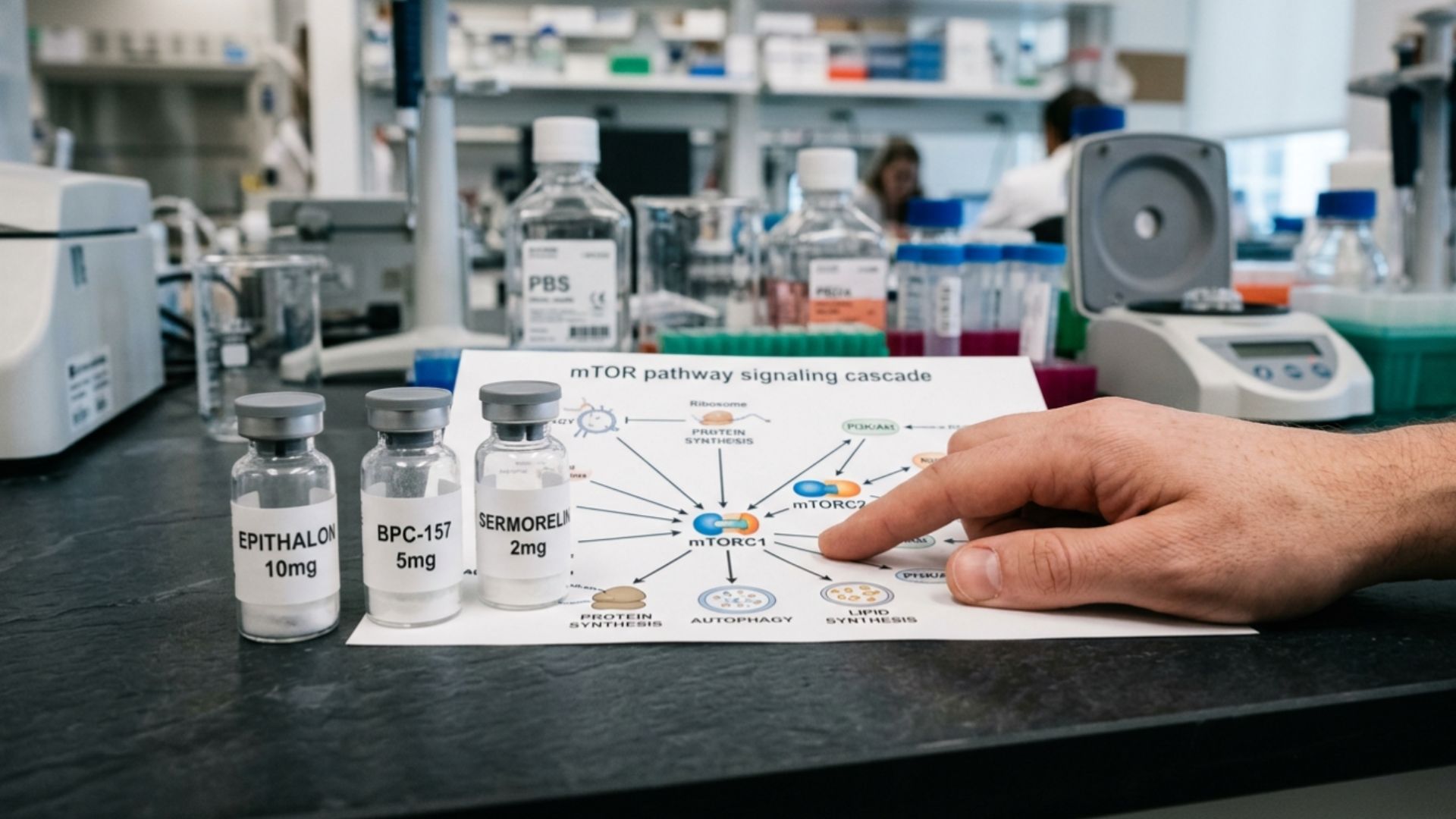
There are molecular switches that cells use to decide whether to grow or conserve resources literally. mTOR is one of them and perhaps the most well-studied. In simple terms, it can be described as a kind of “barometer” that reads signals about nutrient levels, energy, and growth factors, and then instructs the cell to synthesize proteins and divide.
This is precisely why the mTOR pathway has become the focus of several research areas at once: from the study of aging processes to metabolism and muscle biology. So let’s take a closer look at what is actually known from published studies and why mTOR signaling has become one of the most active topics in modern cell biology.
⚠️ This material is intended solely for educational purposes. It is not medical advice, a guide to the use of any compounds, or clinical counsel. For any practical questions, please consult a licensed professional.
What Is the mTOR Pathway?
The answer to the question of what the mTOR pathway is begins with deciphering the acronym. mTOR stands for mechanistic target of rapamycin. The name has historical origins: rapamycin was identified as a compound that blocks cell growth, and the search for its target led to the discovery of this kinase.
mTOR is a serine/threonine protein kinase that exists within the cell as part of two functionally distinct complexes: mTORC1 and mTORC2. It is mTORC1 that serves as the primary regulator of what is commonly referred to as the cell’s “anabolic” state: protein synthesis, suppression of autophagy, and regulation of cell growth. mTORC2 is involved in other processes, including cytoskeletal regulation and cell survival, and is significantly less sensitive to rapamycin.
A review by Laplante and Sabatini in Cell (2012), which remains one of the most cited papers in this field to this day, systematized the functions of the mTOR pathway in the regulation of growth and disease.
How mTOR Signaling Actually Works
mTOR signaling integrates signals from multiple sources simultaneously. It is not a linear switch, but rather a point of convergence for a multitude of incoming signals.
The main activating inputs for mTORC1 include: Upon activation, the mTOR signaling pathway initiates several key processes. Phosphorylation of S6K1 (ribosomal protein S6 kinase 1) accelerates the translation of ribosomal proteins. Phosphorylation of 4E-BP1 removes the brake on translation initiation. Together, these events signal one thing: the cell shifts into protein synthesis mode.
- Amino acids, especially leucine, which is sensed via the Ragulator/Rag-GTPase lysosomal complex
- Growth factors (including insulin and IGF-1), via the PI3K/AKT pathway
- The cell’s energy status, via the ATP/AMP ratio, which AMPK senses
When opposing signals are received (nutrient deprivation, energy stress), mTORC1 is suppressed, and autophagy is activated: a process in which the cell breaks down its own components to maintain viability. This “growth vs. maintenance” balance is one of the central themes in the biology of aging.
The AKT–mTOR Connection
The AKT-mTOR pathway is one of the most well-characterized regulatory modules in cell biology. AKT (protein kinase B) is a key mediator between growth factor receptors on the cell surface and mTORC1 inside the cell.
The pathway is simple in structure but complex in regulation:
- Growth factors activate the receptor
- The receptor activates PI3K
- PI3K produces PIP3
- PIP3 activates AKT
- AKT phosphorylates and inhibits TSC2 (tumor suppressor complex)
- Rheb GTPase is de-repressed
- mTORC1 is activated
It is precisely this cascade that explains why compounds that affect IGF-1 or insulin-like growth factor levels can influence mTOR activity. And it is precisely this cascade that makes the AKT-mTOR connection a subject of interest in various research contexts, from oncology to metabolic studies.

mTOR and Aging: Why Researchers Care
mTOR and aging is a distinct and fascinating topic that received strong experimental support in 2009, when Harrison and colleagues published in Nature their findings showing that rapamycin extended the lifespan of genetically heterogeneous mice even when administration began at 600 days of age, which corresponds to approximately 50 human years.
The biological logic underlying this relationship revolves around the concept of “growth versus maintenance.” In a young organism, high mTOR activity drives cell growth and proliferation. However, as the organism ages, chronically active mTOR is associated with cellular damage, including impaired autophagy, accumulation of “junk” proteins, and mitochondrial dysfunction.
mTOR and aging are studied in the research context precisely through this lens: whether age-related mTOR hyperactivation is a cause or a consequence of aging-related processes. A review by Liu and Sabatini in Nature Reviews Molecular Cell Biology (2020) summarized the accumulated data. They identified mTOR as one of the key integrators of signals related to nutrition, growth, and aging.
This does not mean, however, that “turning off mTOR means not aging.” Biology is more complex: mTOR is essential for normal tissue function, and its complete suppression leads to serious disorders.
mTOR and Muscle Growth
The link between the mTOR pathway and muscle growth is well documented at the mechanistic level. Activation of mTORC1 in skeletal muscle accelerates protein synthesis via the S6K1 and 4E-BP1 pathways described above, which is an essential component of muscle hypertrophy.
A seminal study by Bodine and colleagues in Nature Cell Biology (2001) showed that the AKT/mTOR pathway is a key regulator of skeletal muscle hypertrophy in vivo, and that inhibition of mTOR by rapamycin prevented muscle growth following functional overload in rodents.
This is precisely why mTOR is of research interest in the context of peptides that potentially influence growth factor signaling pathways. This is a mechanistic level of understanding, but it does not yet constitute a claim that any specific peptide reliably promotes muscle growth in humans.
Why mTOR Matters in Peptide Research
mTOR is not a target that peptides act upon directly in most cases. Its significance for peptide research is rather indirect, but no less fundamental for that.
Many research peptides are studied for their effects on signaling pathways that converge on mTOR. Growth hormone secretagogues and GHRH analogs, for example, are studied in part because GH and IGF-1 are known activators of the mTOR pathway via AKT. Understanding what occurs further down the signaling cascade – that is, exactly what mTOR regulates within the cell – is essential for the correct interpretation of data on any compound that affects the levels of these factors.
In addition, the mTOR signaling pathway is studied in the context of tissue repair: mTORC1 activation is involved in cellular responses to damage. This is yet another angle through which the signaling pathway appears in peptide research, as a mechanistic context for understanding what happens within the cell.
Key Takeaways
mTOR is not just a single protein. It is an organizing principle of cellular physiology through which the cell coordinates signals from nutrients, growth factors, and energy status with decisions regarding growth, autophagy, and metabolism.
A few key points to keep in mind:
- mTORC1 and mTORC2 are two functionally distinct complexes; most studies in the context of growth and aging pertain to mTORC1.
- The link between mTOR and lifespan has been established in model organisms; its relevance to humans is the subject of ongoing research.
- In muscle biology, mTOR is a well-documented regulator of protein synthesis; this is a mechanistic fact, not a clinical claim about any specific compound.
- mTOR and aging. This is an active area of research where data are accumulating, but there are no simple answers yet.
This text is an educational analysis of biology, not a guide to the use of any substance. Peptides studied in connection with mTOR pathways are discussed in separate articles on this website. Any questions regarding the practical application of these compounds should be directed exclusively to a physician.