
People usually search for this


Ipamorelin: What Research Shows About Selective GH Secretion

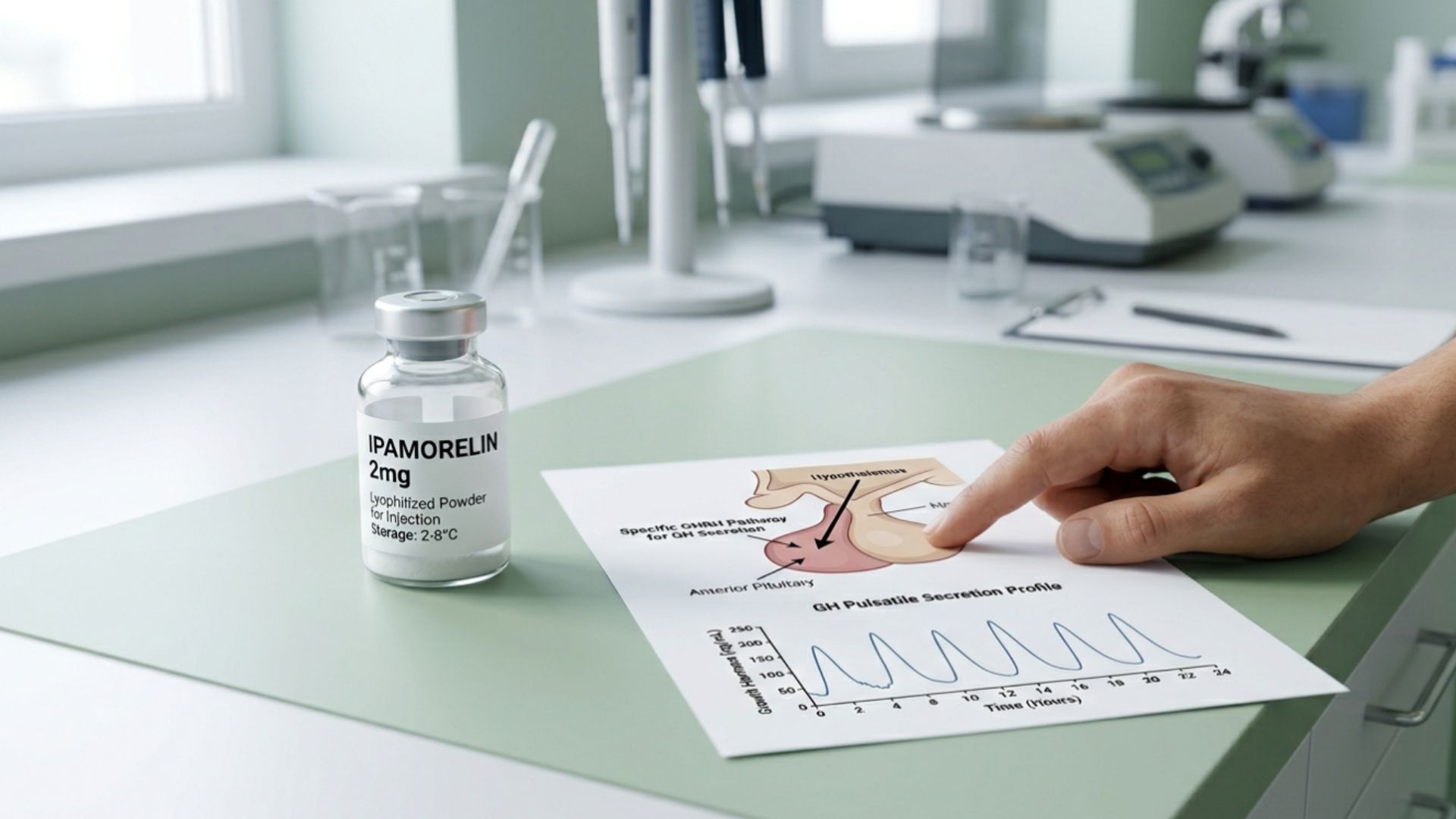
Among growth hormone secretagogues, ipamorelin has one characteristic that has made it the subject of particular attention, as documented in the scientific literature. When Raun and colleagues published a characterization of this compound in 1998, they called it “the first GHRP receptor agonist with a selectivity profile similar to that of GHRH,” that is, the first in its class to stimulate GH secretion without a significant increase in cortisol and ACTH.
It is precisely this distinction that explains the ongoing research interest. So let’s take a look at what the published data tell us. However, it’s important to remember that the ipamorelin peptide remains an investigational compound without approved clinical use, and any claims about it should be viewed within this context.
⚠️ This material is provided for educational purposes only. Ipamorelin is an investigational compound not approved for use in humans. This is not medical advice. For any practical questions, consult a licensed physician.
What Is Ipamorelin?
Ipamorelin is a synthetic pentapeptide with the amino acid sequence Aib-His-D-2-Nal-D-Phe-Lys-NH₂. Novo Nordisk developed it as part of a program to identify growth hormone secretagogues with an improved selectivity profile compared to predecessors in the same class.
In terms of its mechanism of action, the ipamorelin peptide is an agonist at the growth hormone secretagogue receptor type 1a (GHS-R1a), also known as the ghrelin receptor. This distinguishes it from GHRH analogs (such as sermorelin or CJC-1295), which act through a fundamentally different receptor on the same pituitary somatotrophs.
Historically, ipamorelin was derived from work on modifying GHRP-1: removing the central dipeptide Ala-Trp from the GHRP-1 sequence resulted in a compound that retained its potency to stimulate GH but lost its activity on the hypothalamic-pituitary-adrenal axis. It was this observation that served as the starting point for the 1998 publication.
Ipamorelin’s Mechanism of Action
Ipamorelin’s mechanism of action is mediated by binding to GHS-R1a, a G protein-coupled receptor expressed primarily on somatotrophs in the anterior pituitary. Activation of this receptor triggers an intracellular calcium signaling cascade that ultimately leads to the release of growth hormone from somatotroph secretory granules.
A key finding reported in the study by Raun and colleagues (European Journal of Endocrinology, 1998) is that ipamorelin had no significant effect on ACTH, cortisol, prolactin, FSH, LH, or TSH levels. Moreover, this effect was not observed even at doses more than 200 times higher than the ED50 for GH secretion. By comparison, GHRP-6 and GHRP-2 increased ACTH and cortisol levels in a dose-dependent manner during GH stimulation. This distinction is fundamental from a research perspective and formed the basis for characterizing ipamorelin as the “first selective GH secretagogue.”
What “Selective” GH Secretion Means
The concept of “selectivity” as it applies to the ipamorelin mechanism of action warrants a more precise explanation, as it is often oversimplified in popular descriptions.
Early GH secretagogues (GHRP-2, GHRP-6, hexarelin) activated not only GHS-R1a but also other receptor pathways, including CD36 and receptors in the adrenal glands and hypothalamus. This led to concomitant stimulation of the HPA axis, with increased cortisol and ACTH levels. In a research context, this created “noise”: it was difficult to isolate GH-specific effects from cortisol-mediated effects.
According to data from 1998, ipamorelin lacks this drawback, at least in animal models. This makes it a potentially more precise tool for the isolated study of GH/IGF-1-mediated effects. However, it is crucial to note that the data are more reliable in experiments on rodents and pigs. No large-scale studies on human responses have been conducted, so human responses may vary.

How Ipamorelin Compares: Sermorelin and Tesamorelin
The discussion of ipamorelin vs. sermorelin concerns two fundamentally different mechanisms, not two versions of the same approach.
Sermorelin is a GHRH analog that acts via the GHRH receptor. Ipamorelin is a GHS-R1a agonist. These are different receptor systems that work together in normal physiology: this is precisely why their combination is of independent research interest. In terms of regulatory status, neither compound has approved clinical use, and both remain investigational.
The situation is somewhat different when comparing tesamorelin vs. ipamorelin. Tesamorelin is also a GHRH analog, but with a fundamental difference in regulatory status: it is FDA-approved under the brand name Egrifta for a specific indication – the treatment of lipodystrophy in HIV-positive patients on antiretroviral therapy.
It is an approved drug with completed clinical trials. Ipamorelin, despite the promise of its preclinical profile, does not have this status.
Another significant difference is that tesamorelin and sermorelin support the physiological pulsatile pattern of GH secretion. Ipamorelin also stimulates pulsatile secretion, albeit through a different pathway, and it is precisely this combination of the two mechanisms that is being investigated for potential compatibility.
Research vs. Marketing Claims
The honest picture of ipamorelin benefits in the scientific literature looks like this.
What has been documented in published studies:
- Stimulation of GH release without a significant increase in ACTH, cortisol, and prolactin, in animal models, data from Raun et al. (1998).
- A dose-dependent increase in the rate of longitudinal bone growth in rats, Johansen PB et al.
- Changes in body composition (decrease in fat mass while maintaining lean mass) in rodent models.
What is not supported by the data:
- Specific claims regarding body composition, strength, or recovery in humans; clinical trials with such endpoints have not been conducted on a sufficient scale.
- Extrapolation of data from animal models to humans without corresponding controlled trials.
- The only completed human trial with an RCT design failed to meet its primary endpoint, a fact that is regularly omitted from marketing descriptions.
Ipamorelin Side Effects and Safety Considerations
When discussing ipamorelin side effects, one must start with the key fact: there is insufficient long-term safety data in humans. This is a fundamental limitation that determines how any claims regarding the safety profile of this compound should be interpreted.
Based on what has been reported in descriptions of adverse events in research settings:
- Transient reactions at the injection site
- Headache and mild dizziness
- Transient flushing
- Drowsiness or, conversely, sleep disturbances
Regarding the regulatory context: In 2023-2024, the FDA took action on compounded medications containing ipamorelin, removing it from the list of compounds permitted for compounding. This directly reflects the regulator’s position regarding the lack of a sufficient evidence base for safety.
A separate issue concerns theoretical considerations related to the mechanism of action. Any compound that chronically stimulates GH secretion can affect the IGF-1 axis, insulin sensitivity, and other physiological processes that are sensitive to GH. The long-term consequences of such stimulation in healthy adults have not been sufficiently studied for either ipamorelin or most similar compounds. Any questions regarding applicability, risks, and contraindications should be discussed exclusively with a physician.
Key Takeaways
To provide an honest summary of what science knows and does not know about ipamorelin.
Ipamorelin is a synthetic pentapeptide GHS-R1a agonist with a documented profile of hormonal selectivity in preclinical studies. It is the first compound of its class in which stimulation of GH secretion has been demonstrated without a significant concomitant increase in cortisol and ACTH in animal models. This is a genuine scientific finding, significant in a research context.
A few key takeaways to keep in mind:
- The research base for ipamorelin is predominantly preclinical: data from pigs, rats, and cell cultures.
- The only known RCT involving humans failed to meet its primary endpoints
- Compared to tesamorelin (an approved drug with completed trials), ipamorelin occupies a fundamentally different position in terms of the level of evidence
- The long-term safety profile in humans has not been established
In the Grey Research Peptides catalog, Ipamorelin 5mg is available for laboratory use, exclusively for in vitro research by qualified specialists. Not for use in humans or animals.