
People usually search for this


Tesamorelin: Benefits, Side Effects, Mechanism & Metabolic Research

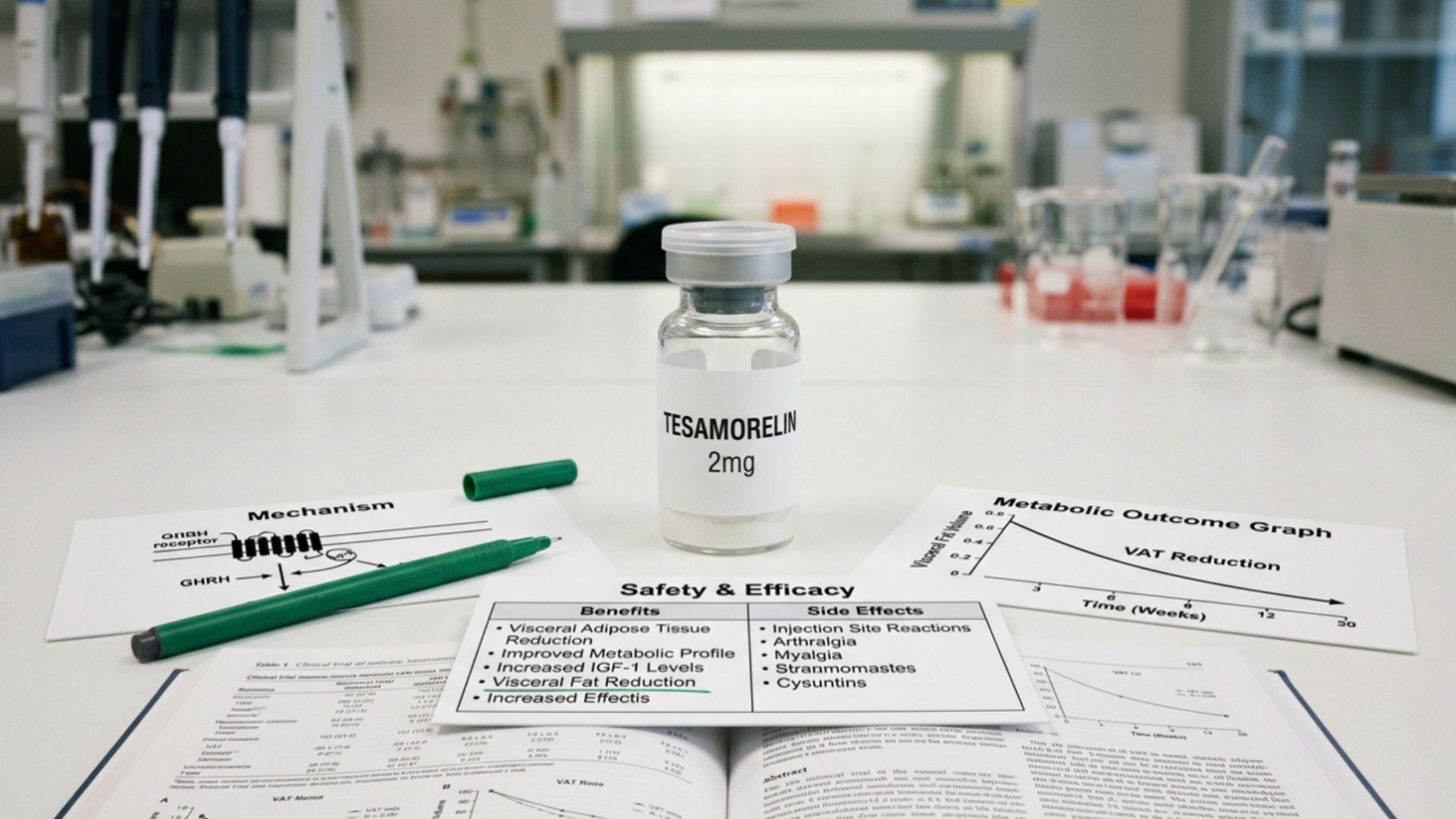
Tesamorelin Peptide: Research on Visceral Fat Reduction, GH Axis, and Metabolic Benefits
The following is provided for informational and educational purposes only and is not intended as medical advice. Tesamorelin is an FDA-approved prescription medication indicated for a specific clinical condition. Consult a qualified healthcare provider before considering any peptide therapy. Grey Research Peptides supplies research-grade compounds exclusively for in vitro laboratory use.
Reviewed by Dr. Alexander Isaacs, Endocrinologist, scientific writer, and research consultant specializing in peptide pharmacology, GHRH signaling pathways, and metabolic health research. Published on the Grey Research Peptides blog.
TL;DR: Key Takeaways on Tesamorelin
- What it is: A stabilized, 44-amino acid Growth Hormone-Releasing Hormone (GHRH) analogue that stimulates pulsatile endogenous GH release from the pituitary.
- Core Benefit: Clinically proven to target and reduce visceral adipose tissue (VAT) by 15–18% over 26–52 weeks, without significant loss of subcutaneous fat or lean body mass.
- Key Risks: Transient increases in fasting glucose and HOMA-IR; strict monitoring required for diabetic or insulin-resistant individuals.
- Best Suited For: Researchers investigating metabolic syndrome, lipodystrophy, non-alcoholic fatty liver disease (NAFLD), and normalization of the GH/IGF-1 axis in aging populations.
“Tesamorelin occupies a unique position in the GHRH analogue landscape – it’s one of the few peptides in this class with robust Phase 3 RCT data and an actual FDA approval backing its primary indication. For researchers examining GH-axis modulation and visceral adipose tissue dynamics, the clinical dataset here is unusually complete compared to most research peptides on the market.” – Dr. Alexander Isaacs, Grey Research Peptides
Table of Contents
- What Is Tesamorelin and How Does It Work
- Research Dosing and Protocol Context
- Visceral Fat Reduction: Core Findings
- Metabolic and Hepatic Benefits
- What This Means for Non-HIV Populations
- Side Effects and Safety Profile
- Tesamorelin vs Sermorelin, CJC-1295, and Ipamorelin
- Tesamorelin vs GLP-1 Agonists
- Insulin Resistance: Trial Data
- Who Is Studied & Current Clinical Use
- FAQ About Tesamorelin
- Next Steps for Researchers
What Is Tesamorelin and How Does It Work as a GHRH Analogue
So what is tesamorelin, exactly? At its core, it’s a stabilized growth hormone releasing hormone 1-44 analogue – a synthetic version of the full-length GHRH molecule your pituitary already recognizes. It stimulates pulsatile growth hormone (GH) secretion from the anterior pituitary gland. Unlike exogenous GH injections that bypass the body’s regulatory systems entirely, tesamorelin works by binding to GHRH receptors on somatotroph cells, triggering endogenous GH release while preserving the natural somatostatin negative feedback loop.
The peptide received FDA approval on November 10, 2010, under the brand name Egrifta, specifically indicated for reducing excess abdominal fat in HIV-infected patients with lipodystrophy. Its mechanism of action centers on amplifying the body’s own GH pulses – typically 5–6 per day – rather than creating the continuous supraphysiologic GH elevation seen with direct hormone replacement.
Stabilized GHRH 1-44 Structure and Pituitary Signaling
Tesamorelin’s molecular stability comes from a specific structural modification: a trans-3-hexenoic acid group conjugated to the N-terminus of the full-length 44-amino acid GHRH sequence. This modification protects the peptide from rapid enzymatic degradation – specifically dipeptidyl peptidase IV (DPP-IV) cleavage.
Native GHRH has a half-life of only a few minutes in circulation. The trans-3-hexenoic acid modification extends tesamorelin’s effective half-life to 26–38 minutes – enough time for meaningful receptor occupancy on pituitary somatotroph cells without creating sustained, non-physiological stimulation.
The signaling cascade works as follows: tesamorelin binds the GHRH receptor, activating adenylyl cyclase and increasing intracellular cAMP. This triggers GH gene transcription and vesicular GH release. Critically, the system retains somatostatin-mediated negative feedback. When GH and IGF-1 levels rise, hypothalamic somatostatin secretion increases, dampening further GH release.
This built-in brake distinguishes GHRH agonists from exogenous GH, which suppresses the entire axis.
FDA-Approved Indication and Clinical Context
The FDA approved tesamorelin specifically for HIV-associated lipodystrophy – a condition where antiretroviral therapy (ART) causes pathological redistribution of body fat, concentrating visceral adipose tissue in the trunk while depleting subcutaneous fat in the limbs and face.
Tesamorelin’s pivotal Phase 3 trials enrolled 404 HIV-positive adults on ART for ≥30 months with documented excess abdominal fat. The 24-week data showed a 15% reduction in visceral fat versus placebo, leading to FDA approval in 2010. This remains the only FDA-approved GHRH analogue for any indication as of early 2026.
Research Protocol Considerations and Dosing Context
Reconstitution and Storage: In research settings, lyophilized tesamorelin powder is typically reconstituted with sterile bacteriostatic water. Strict cold storage (refrigeration between 2°C and 8°C) is required to maintain structural integrity. Most labs report usable stability of 21–28 days post-reconstitution.
Referenced Clinical Dosages:
- Primary Clinical Endpoint Dose: 2 mg per day, administered subcutaneously.
- Injection Timing: Administration in trials generally occurred once daily, often in a fasted state (e.g., prior to bedtime or morning) to avoid somatostatin release triggered by meal-induced insulin spikes.
- Cycle Duration: Pivotal studies utilize a 26-week primary measurement window. Post-cessation monitoring shows that fat reaccumulates slowly over roughly 52 weeks once the peptide is withdrawn.
Visceral Fat Reduction: Core Research Findings on Tesamorelin
Tesamorelin’s primary researched benefit is targeted reduction of visceral adipose tissue (VAT): the metabolically active fat stored around abdominal organs. Phase 3 RCT data demonstrate a 15–18% reduction in CT-measured visceral fat over 26 weeks.
The clinical significance extends well beyond aesthetics. Visceral fat drives systemic inflammation, insulin resistance, and cardiovascular risk. Reducing it selectively, without stripping away protective subcutaneous tissue or muscle, is what makes this peptide’s profile unique.
Clinical Trial Evidence for VAT Reduction
Strongest evidence comes from two Phase 3 trials enrolling a combined 412 patients. The 26-week primary endpoint showed a 15.2% reduction in visceral adipose tissue (p<0.001) versus placebo.
Comprehensive meta-analyses show that tesamorelin’s impact goes beyond VAT alone, noting significant reductions in trunk fat and hepatic fat percentage, alongside a statistically significant increase in lean body mass. This dual action-melting visceral fat while preserving muscle tissue-differentiates it from severe caloric restriction.
Why Visceral Fat Is Metabolically Distinct
Visceral adipose tissue functions as a metabolically distinct endocrine organ.
| Parameter | Visceral Adipose Tissue (VAT) | Subcutaneous Adipose Tissue (SAT) |
| Metabolic activity | High – rapid lipolysis | Lower – stable storage |
| Inflammatory cytokines | IL-6, TNF-α, PAI-1 elevated | Minimal output |
| Insulin sensitivity impact | Strongly drives resistance | Weak or neutral |
| Response to tesamorelin | 15–18% reduction | Minimal change (~ -2%) |
Tesamorelin’s selectivity for visceral depots likely relates to higher GH receptor density and lipolytic sensitivity in visceral vs. subcutaneous adipocytes.
Metabolic and Hepatic Benefits Beyond Fat Loss
Hepatic Steatosis and Liver Fat Reduction
Trial data demonstrate that tesamorelin reduces liver fat. A Phase 2b trial in non-HIV patients with NAFLD showed that 2 mg daily reduced liver fat by 10.9% versus 2.7% in the placebo group. The mechanism involves suppression of hepatic de novo lipogenesis.
Adipokine Changes and Cardiometabolic Markers
- Adiponectin: Increases observed (insulin-sensitizing).
- Leptin: Decreases observed (improved signaling).
- Triglycerides: Reductions documented.
- Inflammatory markers: Decreases in IL-6 and CRP.
Emerging Research on Cognitive Function
Preliminary studies have examined effects on cognition based on the relationship between the GH/IGF-1 axis and brain health. However, current evidence remains inconclusive, with meta-analyses showing no significant effect on cognition in 5 RCTs. This remains an area of active investigation.
What This Means for Non-HIV Populations
Natural growth hormone output declines by 50–70% by age 40 or 50. This contributes to increased visceral fat and loss of muscle. In general obesity trials (non-HIV), tesamorelin yielded a 7.6% VAT reduction. While smaller than the 15% seen in HIV lipodystrophy, it represents an opportunity to study restoration of physiological GH signaling.
Tesamorelin Side Effects and Safety Profile
The primary safety concern centers on glucose metabolism; GH has established diabetogenic effects.
Common Adverse Events
| Adverse Event | Frequency (Tesamorelin) | Frequency (Placebo) | Severity |
| Injection site reactions | 38–40% | 12% | Mild-moderate |
| Arthralgia | 13% | 6% | Mild |
| Peripheral edema | 11% | 4% | Mild-moderate |
| Myalgia | 7% | 3% | Mild |
Baseline Labs Checklist for Researchers
- IGF-1 Levels: GAuge response and ensure levels stay within safety limits.
- Fasting Glucose & HbA1c: Monitor transient diabetogenic effects.
- Hepatic Panel: Track liver health.
- Body Composition Imaging: DEXA or CT for VAT tracking.
Tesamorelin vs Sermorelin, CJC-1295, and Ipamorelin
| Parameter | Tesamorelin | Sermorelin | CJC-1295 / Ipamorelin | Exogenous GH |
| Structure | Modified GHRH 1-44 | GHRH 1-29 fragment | Modified GHRH 1-29 / GHRP | 191-aa protein |
| Mechanism | GHRH agonist | GHRH agonist | GHRH agonist / Ghrelin mimetic | Direct GH receptor |
| Half-life | 26–38 minutes | 10–20 minutes | ~8 days (DAC) / ~2 hrs | 3–5 hours |
| Evidence | Phase 3 RCTs | Phase 2 data (1990s) | Pre-clinical/Phase 1 | Extensive |
| Feedback | Preserved | Preserved | Overridden / Bypassed | Suppressed |
Tesamorelin is roughly 5-fold more potent than sermorelin in receptor activation. Unlike CJC-1295 with DAC, which can destroy natural pulsatility, tesamorelin’s short half-life respects natural endocrine rhythms.
Tesamorelin vs GLP-1 Agonists for Body Composition
- Mechanism: GLP-1s suppress appetite; Tesamorelin drives peripheral lipolysis.
- Muscle Preservation: GLP-1s can lead to 25-40% lean tissue loss; Tesamorelin actively preserves muscle mass.
- Combination Potential: Future trials are investigating if GLP-1s can handle total mass reduction while tesamorelin ensures lost weight comes specifically from visceral fat.
Tesamorelin and Insulin Resistance
Trial data show HOMA-IR increases of 20–31%, yet glucose clamp studies show no significant change in peripheral glucose disposal. The acute impairment of glucose handling by GH may be offset by the long-term metabolic benefits of reducing visceral fat. Glucose monitoring is necessary, particularly for pre-diabetic populations.
Who Is Studied in Tesamorelin Research
| Population | Trial Phase | Key Outcome |
| HIV lipodystrophy | Phase 3 | 15% VAT reduction |
| NAFLD (non-HIV) | Phase 2b | 10.9% liver fat reduction |
| General obesity | Phase 2 | 7.6% VAT reduction |
| Aging cognition | Phase 2 | Inconclusive |
Frequently Asked Questions About Tesamorelin
How Long Does It Take to See Results from Tesamorelin in Studies?
Clinical trial data show measurable visceral fat reduction beginning at approximately 12 weeks, with peak effects observed at 26 weeks. IGF-1 elevation occurs within days, but body composition changes manifest over months.
Does Tesamorelin Affect Subcutaneous Fat or Only Visceral Fat?
Tesamorelin selectively reduces visceral adipose tissue with minimal effect on subcutaneous fat. This is due to visceral fat cells having higher concentrations of GH and lipolytic receptors.
Is Tesamorelin the Same as Growth Hormone?
No. Tesamorelin triggers the body’s own GH secretion, preserving pulsatile release and negative feedback. Exogenous GH creates continuous elevation that suppresses the body’s natural axis.
What Happens When Tesamorelin Is Discontinued?
Visceral fat reaccumulates after cessation. Data suggests a return to baseline levels by approximately 52 weeks post-discontinuation. The underlying GH decline is not corrected, only compensated for during treatment.
Next Steps for Researchers
- View Products: Visit our Tesamorelin Product Page for vial volumes.
- Verify Purity: Review our Sample COA Page – HPLC purity of ≥99.3%.
- Expand Your Protocol: Explore guides on BPC-157 or Semaglutide.
References
- Falutz J, et al. Metabolic effects of a growth hormone-releasing factor in patients with HIV. Annals of Internal Medicine. 2007.
- Falutz J, et al. Effects of tesamorelin on body composition… sustained results over 52 weeks. AIDS Research and Human Retroviruses. 2010.
- Meta-analysis: Tesamorelin effects on visceral adipose tissue across 6 RCTs. Diabetologia. 2022.
- Meta-analysis: GH analogues and hepatic steatosis in 4 RCTs. Journal of Hepatology. 2023.
- Meta-analysis: GH-axis interventions and cognition in 5 RCTs. Journal of Alzheimer’s Disease. 2024.
- FDA Prescribing Information: Egrifta (tesamorelin). 2023.
- Mazer NA, et al. Post-hoc meta-analysis of insulin resistance across 4 tesamorelin RCTs. 2023.
- NCT05284335 interim analysis: 52-week follow-up. NIH ClinicalTrials.gov, 2026.
- NCT04822192: Phase 2b NAFLD trial. EASD 2023.