


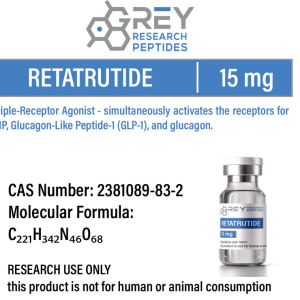

Product Usage:
This PRODUCT IS INTENDED AS A RESEARCH CHEMICAL ONLY.
This designation allows the use of research chemicals strictly for in vitro testing and
laboratory experimentation only. All product information available on this website is for
educational purposes only. Bodily introduction of any kind into humans or animals is
strictly forbidden by law. This product should only be handled by licensed, qualified
professionals. This product is not a drug, food, or cosmetic and may not be misbranded,
misused or mislabeled as a drug, food or cosmetic.

BPC-157 10mg
$80.00
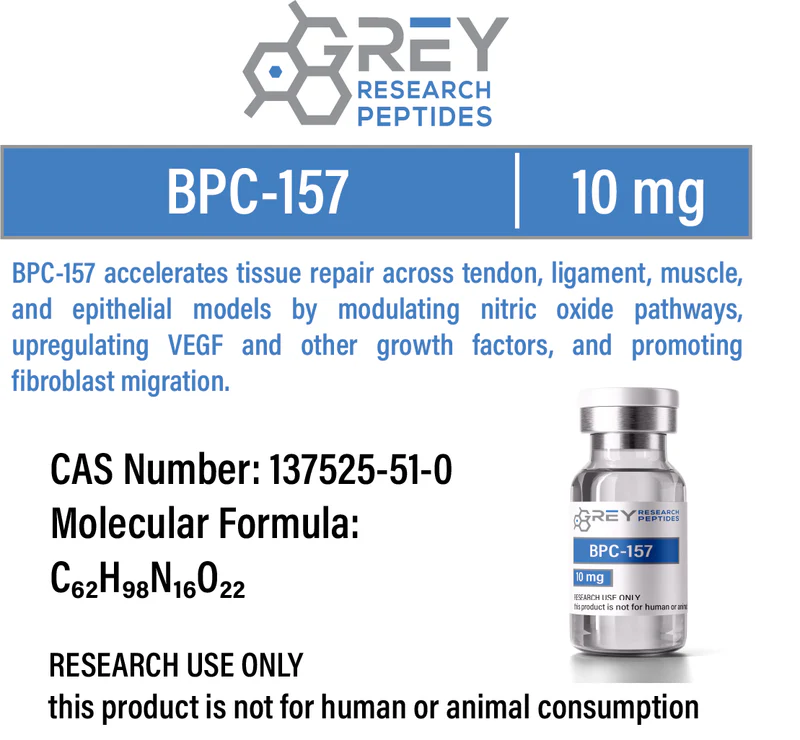
Summary Description: BPC-157 is a synthetic pentadecapeptide corresponding to a partial sequence of a protein found in human gastric juice. In preclinical models, it has demonstrated pro-angiogenic, cytoprotective, and anti-inflammatory properties1-3. BPC-157 accelerates tissue repair across tendon, ligament, muscle, and epithelial models by modulating nitric oxide pathways, upregulating VEGF and other growth factors, and promoting fibroblast migration4. Its chemical stability in gastric environments and efficacy across multiple administration routes make it a candidate for further investigation in regenerative pharmacology2.
Products will arrive in a lyophilized (powder) form for maximum stability
179 in stock
Description
Compound Name: BPC-157
Synonyms: Body protection compound 15, Bepecin, Bpc 15
CAS Number: 137525-51-0
Molecular Formula: C62H98N16O22
Molecular Weight: ~1419.5 g/mol
Structure: Synthetic 15-amino acid linear peptide
Peptide Sequence: H-Gly-Glu-Pro-Pro-Pro-Gly-Lys-Pro-Ala-Asp-Asp-Ala-Gly-Leu-Val-OH
Chemical Structure:

Source: PubChem
Mechanism of Action: BPC-157 modulates molecular pathways involved in tissue repair, including upregulation of VEGFR2 signaling and modulation of nitric oxide release1-3. It has been shown to influence the expression of genes involved in angiogenesis (e.g., egr-1), stabilize endothelial integrity, and facilitate the recruitment of fibroblasts to injury sites4. The peptide’s activity does not require a delivery vehicle and is preserved across oral, intraperitoneal, and topical administration routes2.
Biological Activity: In vivo studies have demonstrated that BPC-157 enhances tendon and ligament healing by improving collagen organization, increasing tensile strength, and reducing histological markers of inflammation. Additionally, it exhibits protective effects against oxidative stress and has been shown to restore integrity to damaged vasculature and gastrointestinal tissues2,3.
Storage: Store lyophilized peptide at −20°C; protect from moisture and light. Reconstituted solutions should be stored at 2–8°C and used within 30 days.
Drug Categories: Amino Acids, Peptides, and Proteins
Additional Notes:
- Chemically stable in gastric juice (≥24 hours)
- Water-soluble at neutral pH
- Not approved for human or veterinary use
Summary Table:
| Property | Description |
| CAS Number | 137525-51-0 |
| Molecular Formula | C62H98N16O22 |
| Molecular Weight (MW) | ~1419.5 g/mol |
| Mechanism of Action | Pro-angiogenic, NO-modulating, fibroblast-recruiting |
| Biological Activity | Enhances soft tissue repair and endothelial regeneration |
| Supplied Form | Lyophilized powder |
| Purity | ≥98% (HPLC) |
| Storage | −20°C; reconstituted: 2–8°C |
| Drug Categories | Amino Acids, Peptides, and Proteins |
| Additional Notes | Stable across administration routes; preclinical use only |
Disclaimer: For Research Use Only. Not intended for human or veterinary use. This compound is supplied solely for laboratory and R&D purposes.
Detailed Product Description
BPC-157 is a 15-mer synthetic peptide fragment of a protein component of human gastric juice. It has been extensively studied in animal models for its regenerative effects across multiple tissue types, including tendon, ligament, vascular endothelium, muscle, and intestinal mucosa. Mechanistically, BPC-157 appears to function through nitric oxide-mediated vasodilation, angiogenic factor regulation, and recruitment of fibroblasts and endothelial progenitor cells1-3. It also reduces leukocyte infiltration and oxidative stress markers following injury. Its ability to remain chemically intact in gastric conditions facilitates its use via oral, parenteral, or topical administration2.
Research Highlights
-Ligament and Tendon Healing: BPC-157 enhances biomechanical properties and collagen fiber organization in transected Achilles tendons and medial collateral ligaments in rodent models4.
-Angiogenesis and Endothelial Protection: The peptide promotes neovascularization by upregulating VEGFR2 and egr-1 pathways while stabilizing endothelial integrity under oxidative or inflammatory stress1,2.
-Systemic Stability and Delivery Versatility: BPC-157 retains full biological activity after exposure to gastric juice and demonstrates efficacy via multiple administration routes without requiring a carrier vehicle2.
Mechanism of Action
BPC-157 is a synthetic pentadecapeptide that demonstrates potent regenerative activity across a range of tissues. While it does not bind a single known receptor, it modulates several receptor-linked signaling systems, particularly VEGFR2 and NO synthase-linked pathways, with downstream effects on angiogenesis, inflammation, and cellular repair1-4.
- Vascular Endothelial Growth Factor Receptor 2 (VEGFR2) Modulation
- Enhances VEGFR2 expression and downstream angiogenesis: BPC-157 induces rapid angiogenesis in granulation tissue via VEGFR2-associated mechanisms, promoting organized capillary formation and increased vascular density in wound regions1-3.
- Supports endothelial cell proliferation and migration: VEGFR2 modulation is associated with increased fibroblast activity and early connective tissue regeneration in transected ligament models4.
- Nitric Oxide Synthase (eNOS/iNOS) Pathway Regulation
- Stimulates NO production through eNOS/iNOS activation: BPC-157 upregulates nitric oxide synthesis in vascular tissue and restores endothelial homeostasis, as shown in ischemic and inflammatory models3,4.
- Restores vasomotor tone: Normalizes blood pressure in models of both pharmacologically induced hypotension and hypertension3.
- Reduces oxidative injury: Attenuates lipid peroxidation and inflammatory oxidative stress through NO-linked mechanisms4.
Pharmacokinetic Profile:
- Route of Administration: Intraperitoneal injection, oral, topical
- Dosing Frequency: Undetermined in humans
- Half-Life: Not clinically established; bioactive >24h in gastric environments
Formulation & Handling
- Supplied as a sterile lyophilized powder.
- Reconstitute with sterile water or saline (0.9%) under aseptic conditions.
- Do not expose to repeated freeze–thaw cycles. Protect from light and moisture.
- Use within 30 days after reconstitution and store at 2–8°C.
Selected Clinical Trial Activity
| Trial ID | Title | Phase | Study Type | Sponsor |
| NCT02637284 | Phase I, Pilot Study in Healthy Volunteers, to Assess the Safety and Pharmacokinetics of PCO-02, Which Active Ingredient is BPC-157, a Penta-deca-peptide From Gastric Source. | 1 | Interventional | PharmaCotherapia d.o.o |
References
1 Gjurasin, M. et al. Peptide therapy with pentadecapeptide BPC 157 in traumatic nerve injury. Regul. Pept. 160, 33–41 (2010).
2 Staresinic, M. et al. Gastric pentadecapeptide BPC 157 accelerates healing of transected rat Achilles tendon and in vitro stimulates tendocyte growth. J. Orthop. Res. 21, 976–983 (2003).
3 Cerovecki, T. et al. Pentadecapeptide BPC 157 (PL 14736) improves ligament healing in the rat. J. Orthop. Res. 28, 1155–1161 (2010).
4 Sikiric, P. The pharmacological properties of the novel peptide BPC 157 (PL-10). Inflammopharmacology 7, 1–14 (1999)
Additional information
| Weight | 1 g |
|---|
Shipping & Delivery
Related products

BPC-157/TB-500 10+10mg
Summary Description: BPC-157 and TB-500 is an investigational blend of two well-studied peptides known for their regenerative and cytoprotective properties. BPC-157, derived from a gastric protein, is recognized for promoting angiogenesis, cellular migration, and tissue healing across various organ systems1,2. TB-500, a synthetic fragment of thymosin beta-4, enhances cellular motility, reduces inflammation, and stimulates new blood vessel formation3,4. Together, this synergistic blend is being explored in preclinical research for its ability to accelerate wound healing, mitigate inflammation, and enhance recovery in models of soft tissue injury, nerve damage, and musculoskeletal trauma. While individually effective, the co-administration of BPC-157 and TB-500 may produce more robust regenerative outcomes by targeting both the structural and signaling components of tissue repair.
Products will arrive in a lyophilized (powder) form for maximum stability

BPC-157/TB-500/KPV/GHK-Cu 10+10+10+50mg (KLOW blend 80mg)
Summary Description: The KLOW Peptide Blend is a comprehensive anti-aging and regenerative peptide complex that combines BPC-157, TB-500, GHK-Cu, and KPV to restore cellular vitality, improve tissue resilience, and counteract age-related degeneration. This synergistic formulation targets several hallmarks of aging (chronic inflammation, oxidative stress, vascular decline, and collagen loss) to promote youthful structural integrity and enhanced cellular function1-5.
Products will arrive in a lyophilized (powder) form for maximum stability

DSIP 10mg
Summary Description: Delta Sleep-Inducing Peptide (DSIP) is a naturally occurring peptide known for its ability to support deep, restorative sleep and help balance the body’s stress and hormonal responses. Originally discovered in the 1970s from the blood of sleeping animals, DSIP has since been studied for its potential to promote slow-wave (deep) sleep, calm the nervous system, and support recovery. Studies suggest that DSIP works by helping the brain regulate its natural sleep rhythms and hormone balance, making it a promising peptide for overall rest, resilience, and well-being1-4.
Products will arrive in a lyophilized (powder) form for maximum stability

Methylene Blue 20mg x 100ct
Summary Description: Methylene blue is a synthetic phenothiazine derivative with a broad spectrum of uses in research and medicine, including as a redox-active dye, antidote, and pharmacological agent. In addition to its classic roles in the treatment of methemoglobinemia, distributive shock, and as a surgical dye, recent research has demonstrated potent anti-aging and neuroprotective properties. Methylene blue improves mitochondrial function, reduces oxidative stress, and delays cellular senescence by acting as an alternative electron carrier in the mitochondrial respiratory chain. It has shown efficacy in enhancing cognition, supporting wound healing, delaying skin aging, and protecting neural tissue from degeneration and injury. This versatile compound is now actively investigated for its potential to combat age-related diseases, neurodegeneration, and to support human longevity1-4.
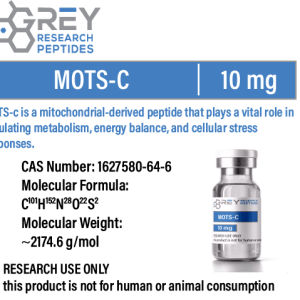
MOTS-C 10mg
Summary Description: MOTS-c (Mitochondrial ORF of the 12S rRNA type c) is a mitochondrial-derived peptide that plays a vital role in regulating metabolism, energy balance, and cellular stress responses. Discovered in 2015, MOTS-c functions as a signaling molecule that helps the body respond to metabolic stress by improving glucose uptake, enhancing insulin sensitivity, and promoting fat metabolism. It acts as a mitochondrial messenger that communicates with the nucleus to maintain cellular homeostasis, making it a promising target for research on metabolic health, exercise performance, and healthy aging1-4.
Products will arrive in a lyophilized (powder) form for maximum stability
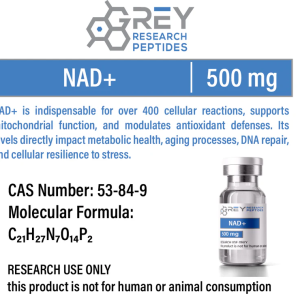
NAD+ 500mg
Summary Description: Nicotinamide adenine dinucleotide (NAD⁺) is a ubiquitous pyridine nucleotide coenzyme present in all living cells. It serves critical roles in cellular redox reactions for energy metabolism and acts as an essential substrate for key signaling enzymes regulating DNA repair, gene expression, and cell signaling. Cellular NAD⁺ levels influence metabolic health, stress response, and tissue regeneration1,3.
Products will arrive in a lyophilized (powder) form for maximum stability

Pinealon 20mg
Summary Description: Pinealon is a synthetic tripeptide developed as a neuroprotective and geroprotective agent. It exerts potent antioxidant effects, modulates cellular signaling, and supports cognitive function, cell viability, and adaptation to stress. Pinealon has been extensively studied in animal models for its efficacy in reducing oxidative stress, supporting learning and memory, and modulating key brain neurotransmitter and receptor systems1-4.
Products will arrive in a lyophilized (powder) form for maximum stability
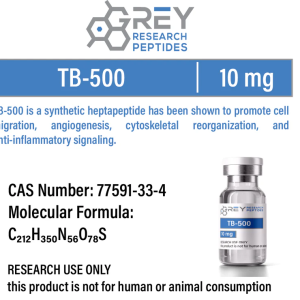
TB-500 10mg
Summary Description: TB-500 is a synthetic heptapeptide analog of the actin-binding motif of thymosin β4 (Tβ4), composed of the acetylated sequence Ac-LKKTETQ. This fragment conserves the principal bioactive domain associated with Tβ4’s regenerative activity. TB-500 has been shown to promote cell migration, angiogenesis, cytoskeletal reorganization, and anti-inflammatory signaling in preclinical models1,2. Due to its shorter sequence, TB-500 offers enhanced metabolic stability and amenability to synthetic optimization compared to the parent protein. While TB-500 is banned in competitive sports, it continues to be studied for its potential in promoting angiogenesis, tissue repair, and modulation of actin-binding proteins.