



Product Usage:
This PRODUCT IS INTENDED AS A RESEARCH CHEMICAL ONLY.
This designation allows the use of research chemicals strictly for in vitro testing and
laboratory experimentation only. All product information available on this website is for
educational purposes only. Bodily introduction of any kind into humans or animals is
strictly forbidden by law. This product should only be handled by licensed, qualified
professionals. This product is not a drug, food, or cosmetic and may not be misbranded,
misused or mislabeled as a drug, food or cosmetic.
Hexarelin 5mg
$50.00
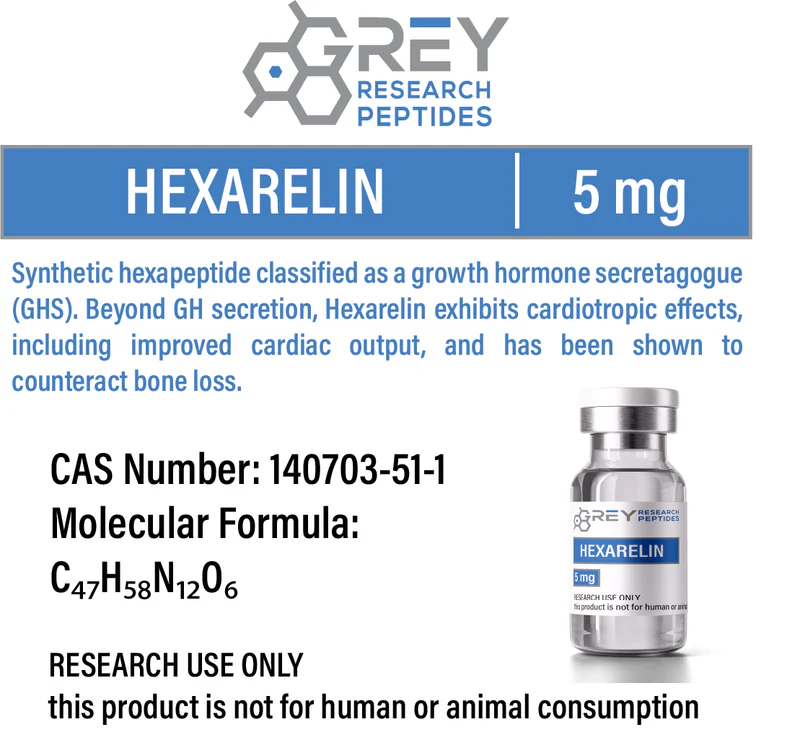
Summary Description: Hexarelin is a synthetic hexapeptide classified as a growth hormone secretagogue (GHS). It acts as a potent agonist of the ghrelin receptor (GHS-R1a), promoting robust stimulation of endogenous growth hormone (GH) release. Unlike endogenous GHRH, Hexarelin has a distinct structure and dual-site activity, acting at both the hypothalamus and pituitary. Beyond GH secretion, Hexarelin exhibits cardiotropic effects, including improved cardiac output, and has been shown to counteract bone loss in preclinical models. Its enhanced stability and resistance to enzymatic degradation make it a preferred research tool for investigating GH-related physiology and GH-independent mechanisms1.
Products will arrive in a lyophilized (powder) form for maximum stability
59 in stock
Description
Compound Name: Hexarelin
Synonyms: Examorelin, HEX, GHRP-6 analog
CAS Number: 140703-51-1
Molecular Formula: C₄₇H₅₈N₁₂O₆
Molecular Weight: 887.04 g/mol
Structure: Synthetic hexapeptide
Peptide Sequence: His-D-2-Me-Trp-Ala-Trp-D-Phe-Lys-NH₂
Chemical Structure:
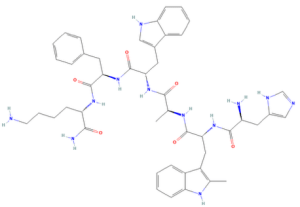
Source: PubChem
Mechanism of Action: Hexarelin is a potent agonist at the ghrelin receptor (GHS-R1a). It stimulates growth hormone secretion through both pituitary and hypothalamic actions, independent of GHRH pathways. When co-administered with GHRH, Hexarelin exhibits synergistic GH-releasing effects. It also shows activity at peripheral GHS receptors, notably in cardiac tissue, contributing to GH-independent cardiotropic actions3.
Biological Activity: Hexarelin acts as a potent stimulator of growth hormone (GH) secretion by activating the ghrelin receptor (GHS-R1a) in both the pituitary and hypothalamus. It promotes the release of GH in a dose-dependent manner, leading to elevated circulating GH levels. In addition to its GH-releasing properties, Hexarelin exerts cardioprotective effects by enhancing cardiac contractility and supporting myocardial function, independent of its hormonal actions. It also contributes to skeletal health by reducing bone resorption and helping to maintain bone mineral density. Hexarelin exhibits a selective endocrine profile, mildly stimulating prolactin and cortisol secretion while having minimal impact on other hormones such as IGF-I, LH, FSH, and TSH1,4.
Storage:
- Store at −20°C, protect from light and moisture.
- Reconstitute in sterile saline or PBS (pH ~7.4).
- Avoid repeated freeze-thaw cycles.
Drug Categories: Amino Acids, Peptides, and Proteins; Endocrine Modulators
Additional Notes:
- Improved stability over GHRP-6 due to methylation
- Used in models of GH deficiency, cardiovascular dysfunction, and osteoporosis
- Exhibits synergistic effects when co-administered with GHRH2
- Suitable for both in vitro and in vivo research applications
Summary Table:
| Property | Description |
| CAS Number | 140703-51-1 |
| Molecular Formula | C₄₇H₅₈N₁₂O₆ |
| Molecular Weight (MW) | 887.04 g/mol |
| Mechanism of Action | Ghrelin receptor agonist; stimulates GH release from hypothalamus and pituitary |
| Biological Activity | GH-releasing, cardioprotective, bone-protective |
| Supplied Form | Lyophilized powder |
| Purity | ≥98% (HPLC) |
| Storage |
−20°C, protect from light and moisture |
| Drug Categories | Peptides; Endocrine Modulator |
| Additional Notes | GH-independent cardioprotective and osteoprotective effects |
Disclaimer: For Research Use Only. Not intended for human or veterinary use. This compound is supplied solely for laboratory and R&D purposes.
Detailed Product Description
Hexarelin is a synthetic hexapeptide designed to mimic the action of endogenous ghrelin by activating the growth hormone secretagogue receptor (GHS-R1a). Unlike GHRH, Hexarelin operates via a separate receptor system, stimulating growth hormone release through hypothalamic and pituitary pathways. The peptide has been chemically modified for enhanced metabolic stability, particularly through the methylation of D-tryptophan, which resists proteolytic degradation1. Hexarelin has been investigated across diverse preclinical and clinical contexts for its ability to stimulate GH, modulate cardiac function, and influence skeletal remodeling. Its activity is short-acting but highly potent, characterized by rapid onset of GH release and quick systemic clearance. Beyond GH secretion, Hexarelin exerts direct effects on cardiac tissue by increasing left ventricular ejection fraction (LVEF) and improving myocardial performance. It also reduces bone resorption, making it a candidate for research on bone preservation in hormone-deficient states4.
Research Highlights
- Stimulates Endogenous GH Release: Binds to pituitary GHS-R1a receptors and rapidly induces growth hormone secretion through calcium-mediated exocytosis2.
- Improves Cardiac Function: Increases cardiac output and left ventricular function independently of GH, likely through myocardial GHS-R1a activation3.
- Reduces Bone Resorption: Lowers bone turnover markers and helps preserve bone mineral density in androgen-deficient states4.
- Selective Hormonal Profile: Minimal effects on IGF-I, TSH, FSH, LH; modest increases in prolactin and cortisol levels1.
Mechanism of Action
Hexarelin functions as a synthetic peptide agonist of the growth hormone secretagogue receptor type 1a (GHS-R1a), also known as the ghrelin receptor. By binding to this receptor in the hypothalamus and anterior pituitary, hexarelin stimulates the endogenous release of growth hormone (GH) through a pathway independent of GHRH. In doing so, it initiates downstream anabolic and metabolic processes traditionally linked to the GH–IGF-1 axis, while also exerting GH-independent effects in peripheral tissues such as the heart and bone1-4.
- GHS-R1a (Ghrelin Receptor) Agonism
- Stimulates pulsatile GH secretion: Hexarelin binds to GHS-R1a on pituitary somatotrophs, activating G-protein signaling pathways that mobilize intracellular calcium and stimulate GH exocytosis. This pathway is independent of the GHRH receptor and supports physiologic, feedback-regulated GH secretion1,2.
- Synergizes with GHRH: When administered alongside GHRH, hexarelin produces an amplified GH response, indicating that the two act via complementary but distinct receptors2.
- Enhances cardiac function: GHS-R1a is also expressed in myocardial tissue. Hexarelin activation of cardiac receptors improves left ventricular ejection fraction (LVEF) and myocardial contractility, independently of GH or IGF-1 levels3.
- Reduces bone resorption: Hexarelin exhibits bone-protective effects in androgen-deficient models, decreasing markers of bone resorption and preserving bone mineral density. These effects appear to result from direct receptor-mediated signaling in skeletal tissue4.
- Hexarelin has high-affinity for the GHS-R1a receptor (EC50, Human ~0.39 nM)1.
Pharmacokinetic Profile:
- Route of Administration: IV or SC (preclinical models)
- Dosing Frequency: Multiple daily or episodic
- Half-Life: GH response: ~55 minutes
Formulation & Handling
- Reconstitute in sterile saline or PBS (pH ~7.4) for in vivo/in vitro use
- Store at −20°C, protect from light and repeated freeze-thaw cycles
- Shelf-stable for 12 months under proper conditions
Clinical Trial Activity
Hexarelin is a research-grade compound that has been studied in laboratory and early-stage human settings but has not undergone full clinical development. It is not approved for therapeutic use in humans, and no large-scale clinical trials have been conducted to evaluate its safety or efficacy as a medication. Hexarelin is supplied strictly for laboratory research and investigational purposes only.
References
1Ghigo, E. et al. Growth hormone-releasing activity of hexarelin, a new synthetic hexapeptide, in man. Eur. J. Endocrinol. 133, 448–454 (1995).
2Ciccarelli, E. et al. Hexarelin, a synthetic growth hormone releasing peptide, stimulates growth hormone secretion in normal men and acts synergistically with growth hormone releasing hormone. Clin. Endocrinol. 44, 601–606 (1996).
3Bisi, G. et al. Cardiovascular effects of hexarelin in humans. J. Endocrinol. Invest. 25, RC11–RC14 (2002).
4Locatelli, V. et al. Growth hormone-independent cardioprotective effects of hexarelin in the rat. Life Sci. 58, PL287–PL294 (1996).
Additional information
| Weight | 1 g |
|---|
Shipping & Delivery
Related products

CJC-1295 (No DAC)/Ipamorelin Blend 5+5mg
Summary Description: The CJC-1295 (no DAC) + Ipamorelin peptide blend merges two potent growth hormone secretagogues to synergistically enhance physiologic GH pulsatility. This research-only combination stimulates both GHRH and ghrelin receptor pathways, yielding amplified and sustained GH release while maintaining endocrine feedback sensitivity.
Products will arrive in a lyophilized (powder) form for maximum stability
Ipamorelin 5mg
Summary Description: Ipamorelin is a synthetic pentapeptide and selective agonist of the growth hormone secretagogue receptor (GHS-R1a), developed to stimulate natural growth hormone (GH) secretion while minimizing off-target effects. Unlike earlier GH secretagogues, ipamorelin exhibits high selectivity, minimal activity at other hormonal axes (ACTH, cortisol, or prolactin), and potent GH release in both animals and humans.
Products will arrive in a lyophilized (powder) form for maximum stability

Sermorelin 10mg
Summary Description: Sermorelin is a synthetic peptide analog of growth hormone-releasing hormone (GHRH), designed to stimulate endogenous growth hormone (GH) secretion through physiologic activation of the hypothalamic-pituitary axis. Structurally identical to the biologically active 1–29 N-terminal amino acids of native GHRH, Sermorelin preserves full receptor agonist activity. It was previously approved by the FDA for diagnostic evaluation and treatment of pediatric GH deficiency and is now widely used off-label in research and clinical settings to address adult-onset GH insufficiency and age-related hormonal decline.
Products will arrive in a lyophilized (powder) form for maximum stability

Tesamorelin 10mg
Summary Description: Tesamorelin is a synthetic peptide analogue of growth hormone-releasing hormone (GHRH), developed for the reduction of excess abdominal fat in HIV-associated lipodystrophy. It stimulates endogenous growth hormone (GH) secretion, thereby increasing insulin-like growth factor-1 (IGF-1) levels and promoting lipolysis. Tesamorelin selectively reduces visceral adipose tissue (VAT) without significant effects on subcutaneous fat and improves body image parameters. Its stability-enhancing N-terminal modification allows for effective subcutaneous administration, and it is FDA-approved for HIV-related lipodystrophy.
Products will arrive in a lyophilized (powder) form for maximum stability

Tesamorelin 20mg
Summary Description: Tesamorelin is a synthetic peptide analogue of growth hormone-releasing hormone (GHRH), developed for the reduction of excess abdominal fat in HIV-associated lipodystrophy. It stimulates endogenous growth hormone (GH) secretion, thereby increasing insulin-like growth factor-1 (IGF-1) levels and promoting lipolysis. Tesamorelin selectively reduces visceral adipose tissue (VAT) without significant effects on subcutaneous fat and improves body image parameters. Its stability-enhancing N-terminal modification allows for effective subcutaneous administration, and it is FDA-approved for HIV-related lipodystrophy.