



Product Usage:
This PRODUCT IS INTENDED AS A RESEARCH CHEMICAL ONLY.
This designation allows the use of research chemicals strictly for in vitro testing and
laboratory experimentation only. All product information available on this website is for
educational purposes only. Bodily introduction of any kind into humans or animals is
strictly forbidden by law. This product should only be handled by licensed, qualified
professionals. This product is not a drug, food, or cosmetic and may not be misbranded,
misused or mislabeled as a drug, food or cosmetic.

Ipamorelin 5mg
$50.00
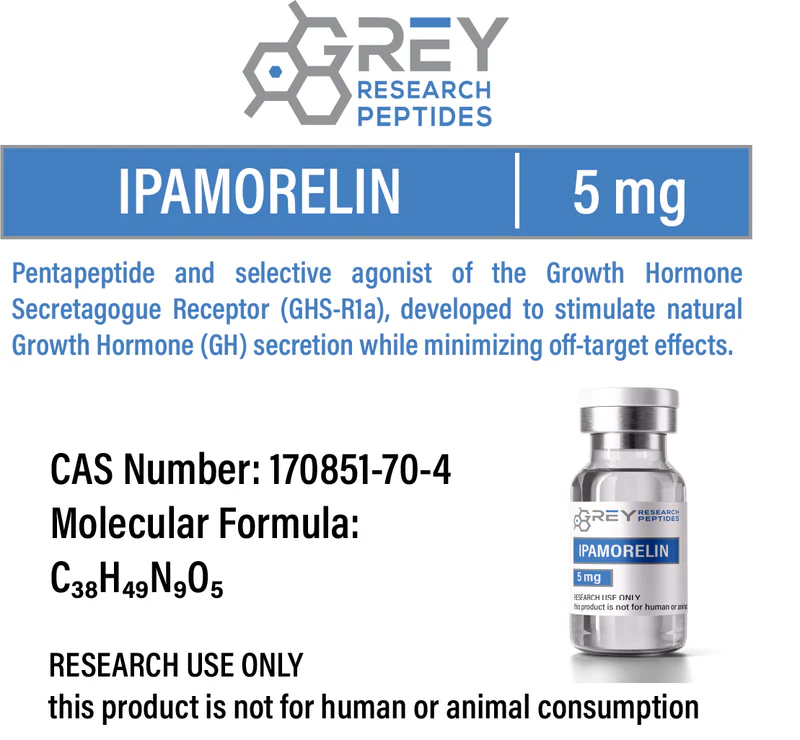
Summary Description: Ipamorelin is a synthetic pentapeptide and selective agonist of the growth hormone secretagogue receptor (GHS-R1a), developed to stimulate natural growth hormone (GH) secretion while minimizing off-target effects. Unlike earlier GH secretagogues, ipamorelin exhibits high selectivity, minimal activity at other hormonal axes (ACTH, cortisol, or prolactin), and potent GH release in both animals and humans.
Products will arrive in a lyophilized (powder) form for maximum stability
31 in stock
Description
Compound Name: Ipamorelin
Synonyms: 170851-70-4, NNC-26-0161, UNII-Y9M3S784Z6
CAS Number: 170851-70-4
Molecular Formula: C38H49N9O5
Molecular Weight: ~711.86 g/mol
Structure: Synthetic pentapeptide
Peptide Sequence: Aib-His-D-2-Nal-D-Phe-Lys-NH₂
Chemical Structure:

Source: PubChem
Mechanism of Action: Ipamorelin is a selective agonist of the ghrelin receptor (GHS-R1a), stimulating the release of endogenous growth hormone (GH) from the anterior pituitary. It mimics the physiologic effects of natural ghrelin without affecting cortisol, prolactin, or ACTH levels. Through targeted activation of GHS-R1a, ipamorelin initiates the GH–IGF-1 axis while preserving natural hormone pulsatility1-4.
Biological Activity: Ipamorelin stimulates a dose-dependent increase in circulating GH and subsequent rise in IGF-1. It demonstrates high in vivo potency in both animal and human models with a well-tolerated safety profile1,4. Ipamorelin shows promise as a motilin agonist in gastrointestinal contexts and has been evaluated for postoperative ileus therapy2.
Storage: Store lyophilized powder at –20°C. Reconstituted solutions should be stored at 2–8°C and used within 30 days.
Drug Categories: Growth Hormone Secretagogue (GHS); Ghrelin Receptor Agonist; Synthetic Peptide; Research Peptide
Additional Notes:
Ipamorelin is supplied for research purposes only and is not approved for therapeutic use. It has shown favorable pharmacokinetics, including reduced desensitization and absence of cortisol stimulation seen in earlier GHRPs.
Summary Table:
| Property | Description |
| CAS Number | 170851-70-4 |
| Molecular Formula | C38H49N9O5 |
| Molecular Weight (MW) | ~711.86 g/mol |
| Mechanism of Action | Selective ghrelin receptor agonist stimulating GH release |
| Biological Activity | Stimulates GH/IGF-1 axis with high specificity and no ACTH/cortisol increase |
| Supplied Form | Lyophilized powder |
| Purity | ≥98% (HPLC) |
| Storage | –20°C (powder); 2–8°C (solution) |
| Drug Categories | GH secretagogue, GHS-R1a agonist |
| Additional Notes | No prolactin or cortisol elevation; selective GH stimulation |
Disclaimer: For Research Use Only. Not intended for human or veterinary use. This compound is supplied solely for laboratory and R&D purposes.
Detailed Product Description
Ipamorelin is a synthetic GHS derived from the pentapeptide class of ghrelin mimetics. It acts as a potent and selective agonist at the GHS-R1a receptor. Unlike traditional GHRPs such as hexarelin and GHRP-6, ipamorelin does not stimulate ACTH, prolactin, or cortisol secretion, thereby reducing off-target hormonal side effects1.It shows strong pharmacodynamic activity, evidenced by marked GH peaks following intravenous administration in both preclinical and human models2. Clinical investigations have demonstrated its tolerability and utility in contexts like growth hormone deficiency, frailty, and gastrointestinal dysmotility. Notably, ipamorelin was evaluated in a randomized trial for management of postoperative ileus, where it showed numerically shorter recovery times for gastrointestinal function4.
Research Highlights
- Selective ghrelin receptor (GHS-R1a) agonist, minimal ACTH or cortisol release1
- Stimulates dose-dependent GH and IGF-1 elevation2
- Exhibits high in vivo potency (ED₅₀ ~2.3 nmol/kg)4
- Maintains physiologic GH pulsatility with minimal desensitization3
- Investigated for prokinetic effects in postoperative ileus (GI-2 improvement in open-laparotomy patients)2
Mechanism of Action
Ipamorelin acts as a selective ghrelin receptor (GHS-R1a) agonist to stimulate the endogenous release of growth hormone (GH) from pituitary somatotrophs1.
GHS-R1a Activation
- Selective endocrine activity: Elevates GH and IGF-1 levels without significantly increasing ACTH, cortisol, or prolactin, a limitation observed in earlier GHSs like GHRP-6 and hexarelin3.
- Gastrointestinal prokinetic effects: In clinical studies, ipamorelin accelerated recovery of upper and lower GI tract function post-surgery, likely through motilin-like agonism and central regulation2.
- Ipamorelin shows high receptor affinity with an ED₅₀ of ~2.3 nmol/kg in pigs4
Pharmacokinetic Profile:
- Route of Administration: Intravenous, subcutaneous (experimental)
- Dosing Frequency: Twice daily
- Half-Life: Short (~2 hours); dependent on route and formulation
- Formulation: Lyophilized powder for reconstitution
Formulation & Handling
- Lyophilized peptide powder, reconstituted in sterile PBS or water.
- Store lyophilized peptide at –20 °C; upon reconstitution, aliquot and freeze at –80 °C to avoid degradation.
- Avoid repeated freeze–thaw cycles.
Selected Clinical Trial Activity
| Trial ID | Title | Phase | Study Type | Sponsor |
| NCT00672074 | Safety and Efficacy of Ipamorelin for Management of Post-Operative Ileus | 2 | Interventional | Helsinn Therapeutics (US), Inc. |
| NCT01280344 | Safety and Efficacy of Ipamorelin Compared to Placebo for the Recovery of Gastrointestinal Function | 2 | Interventional | Helsinn Therapeutics (US), Inc. |
References
1Hansen TK, et al. Highly potent growth hormone secretagogues: hybrids of NN703 and Ipamorelin. Bioorg Med Chem Lett 11 (14):1915–1918 (2001).
2Jogaro VS et al., Pharmacokinetic-pharmacodynamic modeling of ipamorelin, a growth hormone releasing peptide, in human volunteers. Pharm Res. 16(9): 1412-1416 (1999).
3Raun, K. et al. Ipamorelin, the first selective growth hormone secretagogue. Eur. J. Endocrinol. 139, 552–561 (1998).
4Beck, DE, et al. Prospective, randomized, controlled, proof-of-concept study of the ghrelin mimetic ipamorelin for the management of postoperative ileus in bowel resection patients. Int. J. Colorectal Dis. 29, 1527–1534 (2014).
Additional information
| Weight | 1 g |
|---|
Shipping & Delivery
You may also like…

CJC-1295 (No DAC)/Ipamorelin Blend 5+5mg
Summary Description: The CJC-1295 (no DAC) + Ipamorelin peptide blend merges two potent growth hormone secretagogues to synergistically enhance physiologic GH pulsatility. This research-only combination stimulates both GHRH and ghrelin receptor pathways, yielding amplified and sustained GH release while maintaining endocrine feedback sensitivity.
Products will arrive in a lyophilized (powder) form for maximum stability
Related products
Hexarelin 5mg
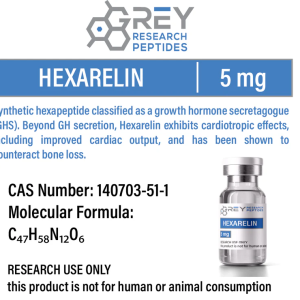
Summary Description: Hexarelin is a synthetic hexapeptide classified as a growth hormone secretagogue (GHS). It acts as a potent agonist of the ghrelin receptor (GHS-R1a), promoting robust stimulation of endogenous growth hormone (GH) release. Unlike endogenous GHRH, Hexarelin has a distinct structure and dual-site activity, acting at both the hypothalamus and pituitary. Beyond GH secretion, Hexarelin exhibits cardiotropic effects, including improved cardiac output, and has been shown to counteract bone loss in preclinical models. Its enhanced stability and resistance to enzymatic degradation make it a preferred research tool for investigating GH-related physiology and GH-independent mechanisms1.
Products will arrive in a lyophilized (powder) form for maximum stability

Sermorelin 10mg
Summary Description: Sermorelin is a synthetic peptide analog of growth hormone-releasing hormone (GHRH), designed to stimulate endogenous growth hormone (GH) secretion through physiologic activation of the hypothalamic-pituitary axis. Structurally identical to the biologically active 1–29 N-terminal amino acids of native GHRH, Sermorelin preserves full receptor agonist activity. It was previously approved by the FDA for diagnostic evaluation and treatment of pediatric GH deficiency and is now widely used off-label in research and clinical settings to address adult-onset GH insufficiency and age-related hormonal decline.
Products will arrive in a lyophilized (powder) form for maximum stability

Tesamorelin 10mg
Summary Description: Tesamorelin is a synthetic peptide analogue of growth hormone-releasing hormone (GHRH), developed for the reduction of excess abdominal fat in HIV-associated lipodystrophy. It stimulates endogenous growth hormone (GH) secretion, thereby increasing insulin-like growth factor-1 (IGF-1) levels and promoting lipolysis. Tesamorelin selectively reduces visceral adipose tissue (VAT) without significant effects on subcutaneous fat and improves body image parameters. Its stability-enhancing N-terminal modification allows for effective subcutaneous administration, and it is FDA-approved for HIV-related lipodystrophy.
Products will arrive in a lyophilized (powder) form for maximum stability

Tesamorelin 20mg
Summary Description: Tesamorelin is a synthetic peptide analogue of growth hormone-releasing hormone (GHRH), developed for the reduction of excess abdominal fat in HIV-associated lipodystrophy. It stimulates endogenous growth hormone (GH) secretion, thereby increasing insulin-like growth factor-1 (IGF-1) levels and promoting lipolysis. Tesamorelin selectively reduces visceral adipose tissue (VAT) without significant effects on subcutaneous fat and improves body image parameters. Its stability-enhancing N-terminal modification allows for effective subcutaneous administration, and it is FDA-approved for HIV-related lipodystrophy.