



Product Usage:
This PRODUCT IS INTENDED AS A RESEARCH CHEMICAL ONLY.
This designation allows the use of research chemicals strictly for in vitro testing and
laboratory experimentation only. All product information available on this website is for
educational purposes only. Bodily introduction of any kind into humans or animals is
strictly forbidden by law. This product should only be handled by licensed, qualified
professionals. This product is not a drug, food, or cosmetic and may not be misbranded,
misused or mislabeled as a drug, food or cosmetic.


SLU-PP-332 250mcg x 100ct
$160.00
Summary Description: SLU-PP-332 is a synthetic pan estrogen receptor-related receptor (ERRα/β/γ) agonist optimized for high potency toward ERRα and engineered with favorable pharmacokinetics for in vivo research. Functioning as a potent “exercise mimetic,” this small-molecule compound enhances mitochondrial function, fatty acid oxidation, and oxidative muscle fiber composition, thereby improving exercise endurance, cardiac metabolic efficiency, and systemic energy expenditure without increasing food intake1-4.
10 in stock
Description
Compound Name: SLU-PP-332
Synonyms: 4-Hydroxy-N-[(Z)-naphthalen-2-ylmethylideneamino]benzamide
CAS Number: 303760-60-3
Molecular Formula: C18H14N2O2
Molecular Weight: ~290.3 g/mol
Structure: Small molecule hydrazone derivative with naphthalene substitution optimized for ERRα binding
Peptide Sequence: N/A; Not a peptide
Chemical Structure:

Source: PubChem
Mechanism of Action: SLU‑PP‑332 directly binds the ligand‑binding domains of ERRα, ERRβ, and ERRγ, stabilizing the active conformation and enhancing transcription of ERR‑regulated metabolic genes. This results in elevated expression of mitochondrial oxidative phosphorylation (OXPHOS) complexes, fatty acid oxidation (FAO) enzymes, and contractile proteins in muscle and heart. ERRα activation drives an acute aerobic exercise gene program, including rapid up‑regulation of Ddit4 and Slc25a25, supporting metabolic remodeling and endurance enhancement1-4.
Biological Activity: SLU‑PP‑332 increases oxidative type IIa muscle fibers, boosts mitochondrial density, raises resting energy expenditure, shifts substrate preference toward lipids, and reduces adiposity in diet‑induced obesity and ob/ob mouse models2,3. In cardiac disease models, it restores contractile function, enhances FAO, attenuates fibrosis, and improves survival without worsening hypertrophy4.
Storage: Store at –20°C. Protect from light.
Drug Categories: Exercise mimetic; metabolic modulator; mitochondrial enhancer; nuclear receptor agonist
Additional Notes:
For research use only. Emerging therapeutic potential for obesity, type 2 diabetes, metabolic syndrome, heart failure, and sarcopenia.
Summary Table:
| Property | Description |
| CAS Number | 303760-60-3 |
| Molecular Formula | C18H14N2O2 |
| Molecular Weight (MW) | 290.3 g/mol |
| Mechanism of Action | Pan‑ERR (α/β/γ) activation drives oxidative metabolism and mitochondrial biogenesis |
| Biological Activity | Improves endurance capacity, mitochondrial function, fatty acid oxidation, and glucose metabolism; reduces fat |
| Supplied Form | Solid powder |
| Purity | ≥98% (HPLC) |
| Storage | –20°C, dessicated, light protected |
| Drug Categories | Nuclear receptor agonist; Metabolic modulator |
| Additional Notes | Induces an acute aerobic exercise gene program in muscle |
Disclaimer: For Research Use Only. Not intended for human or veterinary use. This compound is supplied solely for laboratory and R&D purposes.
Detailed Product Description
SLU‑PP‑332 represents a breakthrough in the development of pharmacological exercise mimetics. Created via structure‑guided optimization of the ERRβ/γ agonist GSK4716, it incorporates a naphthalene group that enables high‑affinity π–π interactions with ERRα, resulting in a ~50‑fold increase in ERRα potency compared with the parent scaffold1. This design confers robust activation of all three ERR isoforms, with the greatest selectivity for ERRα, allowing SLU‑PP‑332 to both mimic and amplify aerobic training–induced adaptations.
In skeletal muscle, SLU‑PP‑332 stimulates an ERRα‑dependent acute aerobic exercise program, rapidly inducing key mitochondrial control genes and shifting fuel utilization toward fatty acids¹². In vivo, treatment enhances endurance performance by ~70% and promotes oxidative fiber remodeling without increasing activity levels1. In obesity models, SLU‑PP‑332 reduces fat gain to near‑zero over four weeks, improves glucose tolerance, and elevates energy expenditure without altering food intake2,3. In heart failure due to pressure overload, it restores ejection fraction, improves mitochondrial ultrastructure, boosts FAO enzymes, and reduces fibrosis4.
Research Highlights
- Exercise Mimetic and Endurance Enhancement: Demonstrated to activate an ERRα‑dependent acute aerobic exercise gene program, increase oxidative type IIa skeletal muscle fibers, upregulate oxidative phosphorylation proteins, and improve mitochondrial content, leading to ~70% longer running time and ~45% greater running distance in preclinical treadmill tests1.
- Mitochondrial Biogenesis and Metabolic Remodeling: Stimulates mitochondrial respiration, increases cytochrome c levels, enhances oxidative phosphorylation complex abundance, and shifts substrate preference toward fatty acid oxidation via upregulation of Pdk4; these changes collectively improve metabolic efficiency in muscle and heart tissue1,3.
- Cardioprotective Effects in Heart Failure: In a pressure‑overload heart failure mouse model, restores fatty acid metabolism, improves mitochondrial function, elevates ejection fraction, reduces fibrosis, and normalizes tricarboxylic acid (TCA) and oxidative phosphorylation intermediates without inducing adverse cardiac hypertrophy3.
- Anti‑Obesity and Metabolic Benefits: In diet‑induced obese mice, reduces body weight by ~12% and limits fat mass gain despite unchanged food intake, through mechanisms involving increased whole‑body energy expenditure, amplified fatty acid oxidation, and ERR‑mediated metabolic pathway activation2.
Mechanism of Action
ERRα Agonism
- Primary driver of acute aerobic exercise genetic program1.
- Induces Ddit4 and Slc25a25 expression, improving mitochondrial efficiency and endurance1,2.
- Promotes fatty acid oxidation via upregulation of Pdk4, reducing carbohydrate reliance1.
- Activates oxidative metabolism pathways, increasing energy efficiency in muscle and heart tissue2.
ERRβ Agonism
- Contributes to cardiac contractile function and oxygen utilization3.
- Less characterized but may support mitochondrial baseline activity and metabolic homeostasis3.
ERRγ Agonism
- Supports increased angiogenesis, mitochondrial density, and endurance adaptation3.
- Major mediator of cardiac oxidative metabolism improvements observed in heart failure3.
Pharmacokinetic Profile:
- Route of Administration: Oral
- Dosing Frequency: Twice daily
- Half‑Life: Short in plasma; sustained tissue exposure noted in muscle
Formulation & Handling
- Solid powder
- Store at –20 °C, protected from light.
Selected Clinical Trial Activity
SLU-PP-332 is a research-grade compound that has been studied in laboratory settings but has not undergone full clinical development. It is not approved for therapeutic use in humans, and no large-scale clinical trials have been conducted to evaluate its safety or efficacy as a medication. SLU-PP-332 is supplied strictly for laboratory research and investigational purposes only.
References
1Billon, C., Sitaula, S., Banerjee, S., Welch, R., Elgendy, B., Hegazy, L., Oh, T. G., Kazantzis, M., Chatterjee, A., Chrivia, J. et al. Synthetic ERRα/β/γ agonist induces an ERRα‑dependent acute aerobic exercise response and enhances exercise capacity. ACS Chem. Biol. 18, 756–771 (2023).
2Nasri, H. New hopes on “SLU‑PP‑332” as an effective agent for weight loss with indirect kidney protection efficacy; a nephrology point of view. J. Ren. Endocrinol. 10, e25143 (2024).
3Xu, W., Billon, C., Li, H., Welch, R., Banerjee, S., Chatterjee, A., Kazantzis, M., Elgendy, B., Hegazy, L., Oh, T. G. et al. Novel pan‑ERR agonists ameliorate heart failure through enhancing cardiac fatty acid metabolism and mitochondrial function. Circulation (2024).
4Billon, C., Schoepke, E., Avdagic, A., Chatterjee, A., Butler, A. A., Elgendy, B., Welch, R., Kazantzis, M., Banerjee, S., Hegazy, L. et al. A synthetic ERR agonist alleviates metabolic syndrome. J. Pharmacol. Exp. Ther. (2023).
Additional information
| Weight | 5 g |
|---|
Shipping & Delivery
Related products

BPC-157/TB-500 10+10mg
Summary Description: BPC-157 and TB-500 is an investigational blend of two well-studied peptides known for their regenerative and cytoprotective properties. BPC-157, derived from a gastric protein, is recognized for promoting angiogenesis, cellular migration, and tissue healing across various organ systems1,2. TB-500, a synthetic fragment of thymosin beta-4, enhances cellular motility, reduces inflammation, and stimulates new blood vessel formation3,4. Together, this synergistic blend is being explored in preclinical research for its ability to accelerate wound healing, mitigate inflammation, and enhance recovery in models of soft tissue injury, nerve damage, and musculoskeletal trauma. While individually effective, the co-administration of BPC-157 and TB-500 may produce more robust regenerative outcomes by targeting both the structural and signaling components of tissue repair.
Products will arrive in a lyophilized (powder) form for maximum stability

BPC-157/TB-500/KPV/GHK-Cu 10+10+10+50mg (KLOW blend 80mg)
Summary Description: The KLOW Peptide Blend is a comprehensive anti-aging and regenerative peptide complex that combines BPC-157, TB-500, GHK-Cu, and KPV to restore cellular vitality, improve tissue resilience, and counteract age-related degeneration. This synergistic formulation targets several hallmarks of aging (chronic inflammation, oxidative stress, vascular decline, and collagen loss) to promote youthful structural integrity and enhanced cellular function1-5.
Products will arrive in a lyophilized (powder) form for maximum stability

Methylene Blue 20mg x 100ct
Summary Description: Methylene blue is a synthetic phenothiazine derivative with a broad spectrum of uses in research and medicine, including as a redox-active dye, antidote, and pharmacological agent. In addition to its classic roles in the treatment of methemoglobinemia, distributive shock, and as a surgical dye, recent research has demonstrated potent anti-aging and neuroprotective properties. Methylene blue improves mitochondrial function, reduces oxidative stress, and delays cellular senescence by acting as an alternative electron carrier in the mitochondrial respiratory chain. It has shown efficacy in enhancing cognition, supporting wound healing, delaying skin aging, and protecting neural tissue from degeneration and injury. This versatile compound is now actively investigated for its potential to combat age-related diseases, neurodegeneration, and to support human longevity1-4.
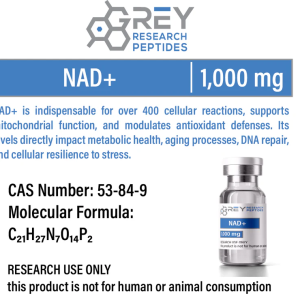
NAD+ 1,000mg
Summary Description: Nicotinamide adenine dinucleotide (NAD⁺) is a ubiquitous pyridine nucleotide coenzyme present in all living cells. It serves critical roles in cellular redox reactions for energy metabolism and acts as an essential substrate for key signaling enzymes regulating DNA repair, gene expression, and cell signaling. Cellular NAD⁺ levels influence metabolic health, stress response, and tissue regeneration1,3.
Products will arrive in a lyophilized (powder) form for maximum stability
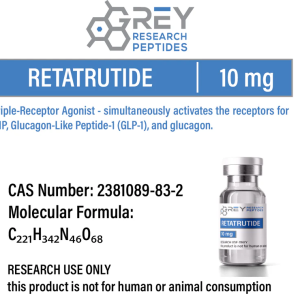
Retatrutide 10mg
Summary Description: Retatrutide is a next-generation investigational medication initially developed for the treatment of obesity and type 2 diabetes, with emerging evidence highlighting its potential multi-system benefits. Retatrutide is a synthetic peptide based on a glucose-dependent insulinotropic polypeptide (GIP) backbone, but uniquely, it functions as a triple agonist. This means it simultaneously activates the receptors for GIP, glucagon-like peptide-1 (GLP-1), and glucagon. Through this triple-receptor agonism, retatrutide not only lowers blood glucose levels and enhances insulin sensitivity but also suppresses appetite, increases energy expenditure, and reduces body weight. Early clinical studies suggest that retatrutide may improve cardiometabolic profiles by reducing blood pressure and improving lipid levels, further underscoring its promise for addressing both metabolic and cardiovascular risk factors in individuals with obesity and diabetes.
Products will arrive in a lyophilized (powder) form for maximum stability

Retatrutide 30mg
Summary Description: Retatrutide is a next-generation investigational medication initially developed for the treatment of obesity and type 2 diabetes, with emerging evidence highlighting its potential multi-system benefits. Retatrutide is a synthetic peptide based on a glucose-dependent insulinotropic polypeptide (GIP) backbone, but uniquely, it functions as a triple agonist. This means it simultaneously activates the receptors for GIP, glucagon-like peptide-1 (GLP-1), and glucagon. Through this triple-receptor agonism, retatrutide not only lowers blood glucose levels and enhances insulin sensitivity but also suppresses appetite, increases energy expenditure, and reduces body weight. Early clinical studies suggest that retatrutide may improve cardiometabolic profiles by reducing blood pressure and improving lipid levels, further underscoring its promise for addressing both metabolic and cardiovascular risk factors in individuals with obesity and diabetes.
Products will arrive in a lyophilized (powder) form for maximum stability
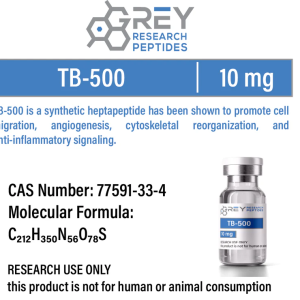
TB-500 10mg
Summary Description: TB-500 is a synthetic heptapeptide analog of the actin-binding motif of thymosin β4 (Tβ4), composed of the acetylated sequence Ac-LKKTETQ. This fragment conserves the principal bioactive domain associated with Tβ4’s regenerative activity. TB-500 has been shown to promote cell migration, angiogenesis, cytoskeletal reorganization, and anti-inflammatory signaling in preclinical models1,2. Due to its shorter sequence, TB-500 offers enhanced metabolic stability and amenability to synthetic optimization compared to the parent protein. While TB-500 is banned in competitive sports, it continues to be studied for its potential in promoting angiogenesis, tissue repair, and modulation of actin-binding proteins.
Products will arrive in a lyophilized (powder) form for maximum stability

Tirzepatide 30mg
Summary Description: Tirzepatide is a novel, dual glucose-dependent insulinotropic polypeptide (GIP) and glucagon-like peptide-1 (GLP-1) receptor agonist designed for the treatment of type 2 diabetes and obesity. Engineered as a synthetic peptide based on the native GIP sequence and modified for extended half-life via fatty acid conjugation, tirzepatide delivers glycemic control, profound weight loss, and cardiometabolic benefits. Its imbalanced receptor affinity and biased signaling provide enhanced insulin secretion and improved metabolic outcomes beyond selective GLP-1 agonism.1,3,4