
People usually search for this


Peptides and Telomere Research: What Epithalon Studies Suggest About Cellular Aging

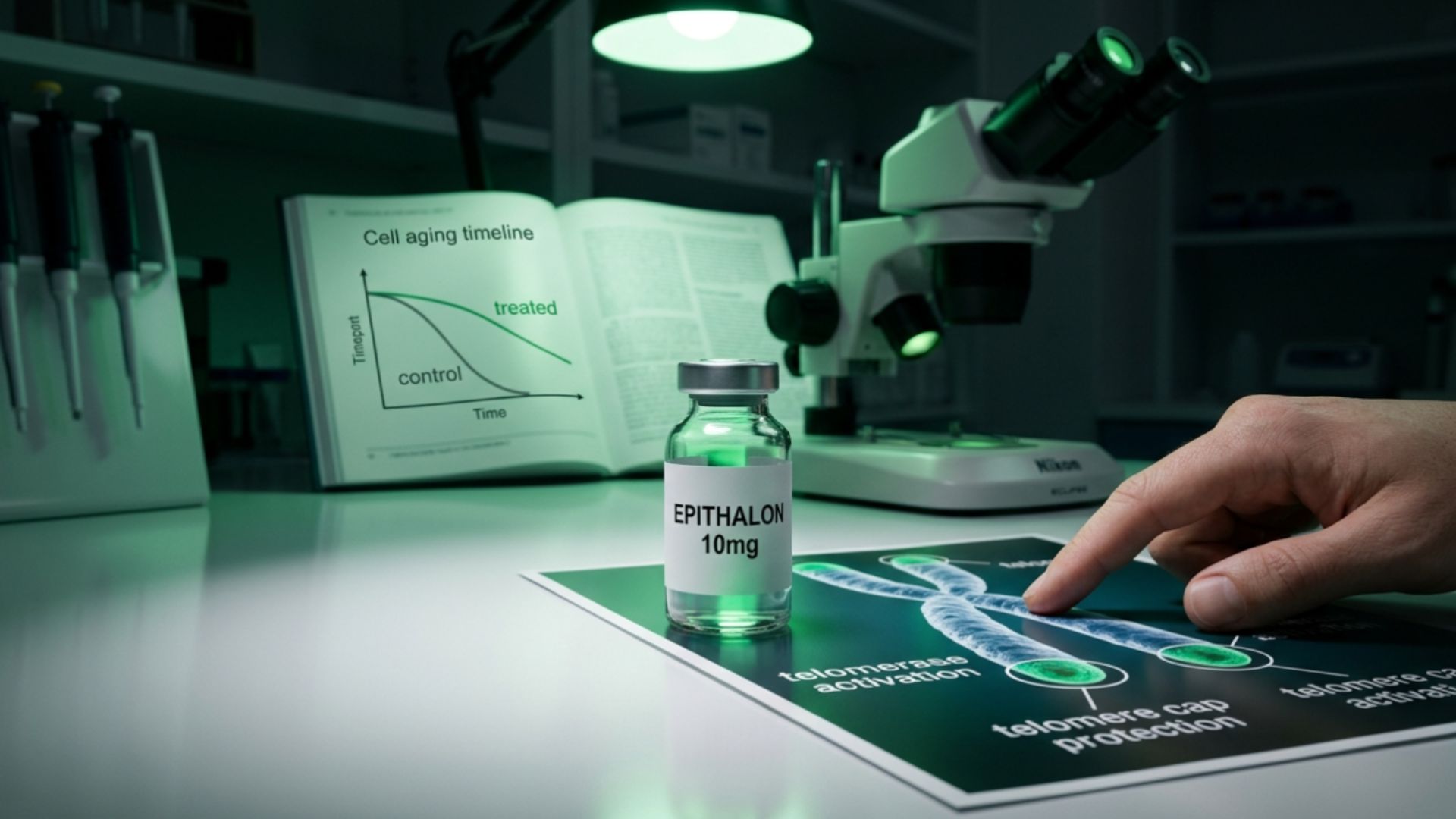
The topic of telomeres and cellular aging has long ceased to be purely academic. As soon as data showing that telomere length correlates with biological age became freely available, interest in molecules that could potentially influence telomerase activity spread far beyond the confines of laboratories. Epitalon has emerged as one of the most discussed compounds in this context.
The problem is that it is discussed in very different ways. On the one hand, there are indeed publications by research groups that have studied it. On the other hand, people make marketing claims that severely misinterpret actual scientific publications. Our task is to sort out what the research actually shows and where a layer of marketing has simply been added.
⚠️ This material is intended for educational purposes. Epitalon is an investigational compound that has not been approved as a drug. Nothing written below constitutes medical advice. For practical questions, please consult a doctor.
What Is Epitalon?
To answer the question, what is the epitalon peptide? Briefly, it is a synthetic tetrapeptide with the sequence Ala-Glu-Asp-Gly, developed at the Institute of Bioregulation and Gerontology in St. Petersburg under the leadership of Vladimir Khavinson. It is a synthetic analog of epitalamin (a polypeptide extract from the pineal gland that was studied as far back as the Soviet era).
A brief clarification on terminology: epithalon peptide and epitalon refer to the same molecule, just in different transliterated forms. The confusion here is purely orthographic, due to differences in language transliteration.
At the heart of the research interest in this compound lies one specific question: can it influence telomerase activity? Most publications revolve around this very topic. For more details about the compound itself, see the Epithalon 50mg page in our catalog; here, we will focus on telomeric mechanisms.
Telomeres, Telomerase, and Cellular Aging
Before moving on to the data on the epitalon peptide, we need to understand what telomeres are and why they are important in the context of aging.
Telomeres are repetitive nucleotide sequences (TTAGGG in humans) at the ends of chromosomes. Their function is to protect chromosomes from degradation during each cell division cycle. The problem is that telomeres shorten slightly with each division. When the telomere reaches a critical length, the cell enters replicative aging or apoptosis.
Telomerase is an enzyme capable of extending telomeric repeats. Normally, it is active in stem and germ cells, but in most somatic cells, its activity is minimal or absent. This is precisely why the progressive shortening of telomeres in somatic cells has become a biological marker of aging.
The research by Blackburn, Greider, and Szostak, for which they received the Nobel Prize in 2009, elucidated the mechanism of telomerase and paved the way for studying the possibility of pharmacological modulation of this system. This became the theoretical framework into which epitalon research was later integrated.
Why Epitalon Is Studied in This Context
The hypothesis that brought the epitalon peptide into telomere research seemed logical: if a synthetic peptide of pineal origin influences the regulation of cellular processes, could it affect telomerase activity in somatic cells?
This is precisely the question Havinson’s group investigated. Not “does epitalon slow aging,” but more specifically: does telomerase activity change under its influence in cell culture? This is an important distinction that is often lost in retellings.
What the Studies Actually Suggest (and Their Limits)
The key study on which most claims about epitalon and telomeres are based is a 2003 paper by Khavinson and colleagues in the Bulletin of Experimental Biology and Medicine. It reported that telomerase was activated in human embryonic fibroblasts upon exposure to epitalon in vitro (Khavinson et al., BEBM, 2003).
This is a genuine finding. However, it must be viewed in context: There are also studies by Anisimov and Khavinson using animal models that examined the long-term effects of pineal peptides on cancer markers and lifespan. The results are certainly interesting, but it’s still worth remembering that a mouse is not a human. And extrapolation here requires caution, which is lacking in most popular accounts.
- The study was conducted in vitro, meaning on cell cultures rather than in a living organism.
- The sample size is limited, and the study is relatively small.
- The results were obtained primarily by a single research group and have hardly been replicated by independent researchers.
- In vitro telomerase activation and a significant change in telomere length in an intact organism are very different things.
Epitalon peptide benefits discussed based on this data include: potential telomerase activity in cells, a possible link to cellular aging mechanisms, and its role in regulating the pineal system. However, once again, these are topics discussed in the literature, but there is still no direct evidence in humans.
Research vs. Marketing Claims
Marketing surrounding epitalon benefits and telomeres works in roughly the same way: a real scientific publication is taken, the most eye-catching result is extracted from it, and it is turned into a claim such as “lengthens telomeres and slows aging.”
That’s not what the data actually says. “Telomerase activation was observed in cell culture” is a cautious and precise statement. “Proven to slow aging in humans” – no. The gap between them is enormous, and it cannot be bridged by marketing language.
Reading the sources and paying attention to the phrasing (“was observed,” “in vitro,” “in animal models”) is the only way to stay on track with this topic.

Epitalon Side Effects and Safety Considerations
The discussion of epitalon side effects boils down to one fundamental problem: there is simply no data from large-scale human clinical trials. This means that the safety profile in humans has not been established to the extent that would allow for confident conclusions.
Published studies do not describe any serious adverse effects. However, this is more a reflection of the limited data available than evidence of safety. Small sample sizes and short observation periods simply do not allow for the detection of rare or long-term adverse events.
Another point to consider: the studies often cited were conducted under specific conditions and with defined protocols. Applying these findings to self-administration outside a clinical setting goes beyond what the data actually support.
Epitalon is not an approved drug in any jurisdiction. It is an investigational compound. Any questions regarding its applicability, risks, and interactions should be directed exclusively to a physician, not to review articles.
Key Takeaways
Studies of telomerase activity have yielded real but limited results: in vitro, within a single research group, and without large-scale independent replication. These are “preliminary data requiring further study,” not a “proven mechanism for slowing aging.”
A few things to keep in mind: Telomere biology is one of the most active fields in gerontology. An epithalon peptide, in this context, is a compound with a genuine research history, just not at the level of evidence often attributed to it.
- Epitalon remains an investigational compound with no approved clinical use.
- The gap between “observed in cell culture” and “works in humans” is not a mere formality, but the essence of the scientific process.
- Marketing claims surrounding telomeres and epitalon significantly exceed what the data actually supports.
In the Grey Research Peptides catalog, Epithalon 50mg is available for laboratory use, exclusively for in vitro research by qualified specialists. Not for use in humans or animals.