
People usually search for this


Skin and Hair Research: GHK-Cu, Glutathione, and Melanin Peptides in One Overview

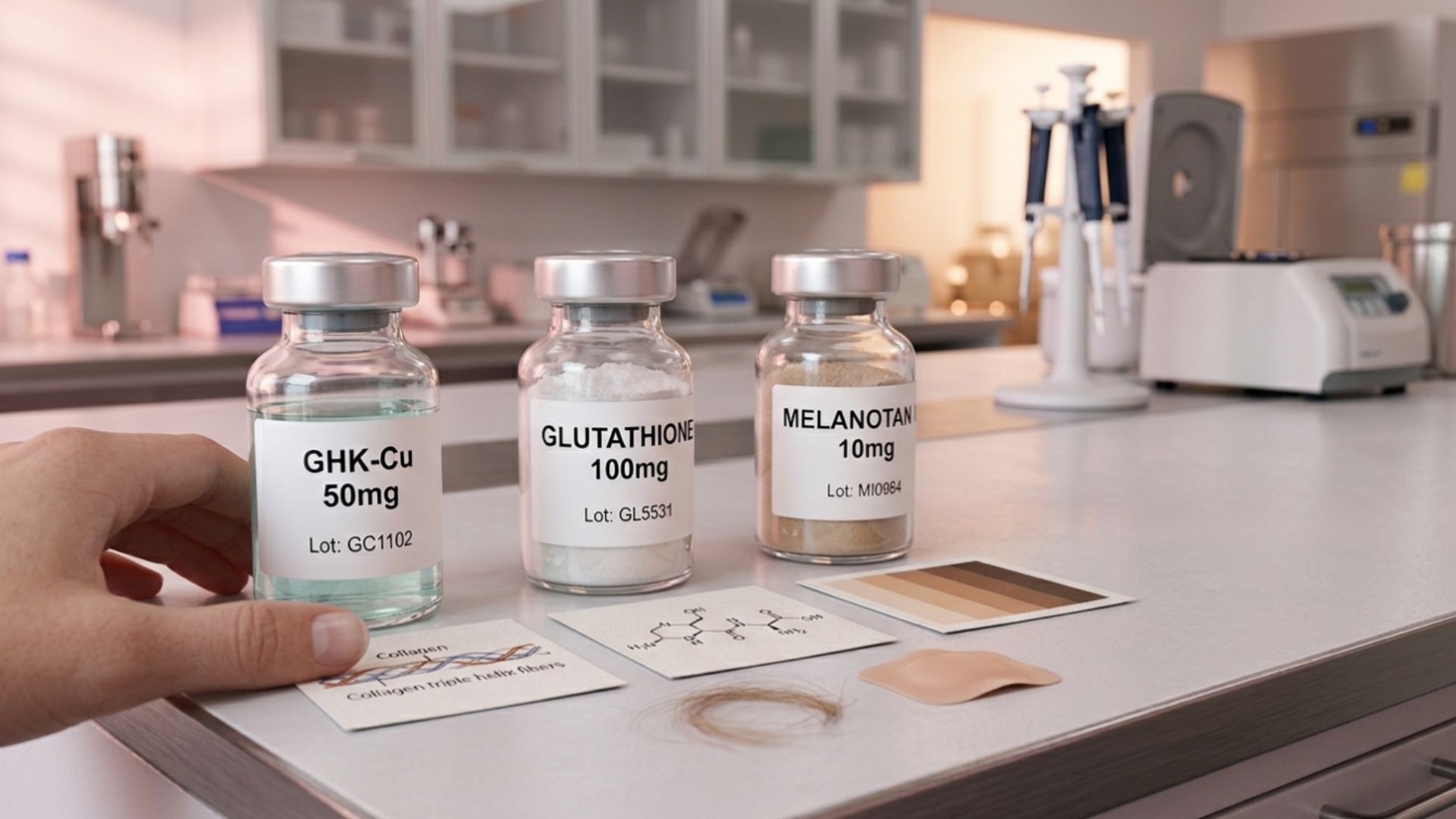
Searches for “skin peptides” have reached a new level. Whereas previously interest was mainly focused on topical cosmetic ingredients, searches are now increasingly directed toward injectable compounds that do not always have the necessary regulatory studies.
However, in this article, we’ve compiled three categories: GHK-Cu as a cosmetic ingredient with a solid research foundation, glutathione in the context of skin, and Melanotan 2 – a separate topic that we’ve intentionally placed in its own section precisely because it would be inappropriate to mix it with cosmetic ingredients.
⚠️ This material is for educational purposes only. The compounds mentioned below vary significantly in their regulatory status (ranging from cosmetic ingredients to unapproved injectable drugs). Nothing in this text constitutes a recommendation for use. Please consult a specialist with any practical questions.
GHK-Cu: The Copper Peptide in Skincare
GHK-Cu peptide is the tripeptide glycyl-L-histidyl-L-lysine complexed with copper. Unlike most of the compounds we discuss on this site, GHK-Cu has long since left the laboratory and exists as a real cosmetic ingredient. Therefore, you’ll most often find it in serums, creams, and other topical skincare products.
Interest in it began as early as the 1970s, when Loren Pickart discovered that this peptide is present in blood plasma and appears to be involved in tissue repair processes. This sparked several decades of research. In 2015, Pickart published a review in the Journal of Aging Research, in which they synthesized data on the mechanisms of action of GHK-Cu: stimulation of collagen and elastin synthesis, antioxidant activity, and effects on tissue remodeling.
In the context of cosmetics, copper peptide serum containing GHK-Cu is marketed as an ingredient that improves skin texture and hair condition. This does not mean “guaranteed results for everyone,” but it is a clear indication that the mechanism has been studied and data exists (albeit with limitations).
It is worth noting the GHK copper peptide specifically in the context of hair follicles: several studies have examined its effects on follicular cell proliferation. Mason’s 1984 study demonstrated the role of GHK in tissue repair processes, which laid the foundation for later cosmetic applications.
GHK-Cu Benefits and “Before and After” Searches
GHK-Cu benefits discussed in scientific and cosmetic literature: The search for GHK-Cu before and after is understandable – people want to see concrete results. The problem is that anecdotal reports and before-and-after photos do not account for many variables: initial skin condition, accompanying skincare, lifestyle, and individual response.
- Stimulation of collagen types I and III synthesis (documented in vitro)
- Effect on the synthesis of elastin and glycosaminoglycans in the dermis
- Antioxidant activity through copper chelation
- Potential role in hair follicle regulation (studied in preclinical models)
Therefore, the main point is this: just because something worked for one person under a specific regimen using a specific product does not mean it will work for you. Controlled studies provide a more reliable picture, and while there are enough such studies on GHK-Cu to discuss its mechanism of action, there are not enough to promise a dramatic transformation.
Glutathione in Skin Research
Glutathione is a tripeptide (glutamate-cysteine-glycine) and one of the body’s main endogenous antioxidants. In the context of the skin, it is primarily discussed in terms of its antioxidant mechanism: neutralizing reactive oxygen species, protecting cells from oxidative stress, and participating in detoxification processes.
Glutathione benefits have been studied in several areas in the dermatological literature. A randomized, double-blind, placebo-controlled study published in Clinical, Cosmetic and Investigational Dermatology in 2017 examined the topical application of glutathione and observed changes in certain skin parameters (Weschawalit et al., CCID, 2017).
What is important to understand: glutathione in a cosmetic context refers to topical formulations with limited bioavailability through the skin, which is itself a subject of debate in the literature. Injectable forms of glutathione exist in clinical practice, but this falls within the realm of medicine, not cosmetics. Any use beyond topical applications warrants consulting a doctor.

Melanin Peptides and Melanotan 2: A Different Category
Melanotan 2 is a synthetic analog of alpha-melanocyte-stimulating hormone (α-MSH). Its mechanism of action involves activation of melanocortin receptors, primarily MC1R and MC4R, which, in theory, stimulates melanogenesis. This explains why it has emerged in the context of tanning at all.
But here’s the crucial point: this is not a cosmetic ingredient. Melanotan 2 is administered by injection, is not approved by either the FDA or the EMA, and is subject to a direct warning from regulatory authorities. As early as 2009, the European Medicines Agency issued a warning about products containing Melanotan, pointing out risks including changes in moles, nausea, priapism, and potential cancer risks associated with uncontrolled activation of melanocytes.
This article includes a section on Melanotan 2 precisely because it often appears in the same search context as GHK-Cu and other “skin peptides.” However, this conflation requires a clear distinction.
Why Melanotan 2 Isn’t a Skincare Product
Melanotan 2 is an injectable compound not approved in any jurisdiction as a drug or cosmetic product. It is not a “more advanced” version of copper serum. It is a fundamentally different class of substance, with a different route of administration, a different mechanism of systemic action, and documented adverse effects.
Regulatory agencies in several countries have explicitly warned of the risks associated with its use. Its appearance in the same search results as cosmetic ingredients is due to search algorithms. By its very structure, this peptide has absolutely nothing to do with skin improvement.
Research vs. Marketing Claims Across These Compounds
If we try to honestly place the three topics of this review on a single evidence scale, the picture will be uneven.
GHK-Cu is the most studied of the three in a cosmetic context. Its mechanisms have been documented in vitro, and clinical studies on topical application exist. However, marketing promises almost always exceed what has actually been confirmed by clinical studies. In other words, the ingredient itself works, but, to put it bluntly, it won’t eliminate your wrinkles in just two days.
Glutathione in dermatological applications is an area of active research interest, but its bioavailability in topical formulations remains limited. GHK-Cu benefits and the effects of glutathione are discussed in different contexts: one through the synthesis of structural skin proteins, the other through antioxidant protection. These are different mechanisms, and they shouldn’t be conflated.
Melanotan 2 is a separate category altogether that doesn’t fit into a discussion of cosmetic ingredients. Neither in terms of status, nor route of administration, nor safety profile.
Key Takeaways and Safety
The main distinctions in this text are topical vs. injectable and approved vs. unapproved.
GHK-Cu and glutathione are used in cosmetics as research-backed ingredients. Their use in topical formulations is in the consumer market, with fairly well-understood mechanisms, although the level of evidence for clinical effects varies.
Melanotan 2 is a completely different story. It is an unapproved injectable compound explicitly flagged by regulators as posing risks. The fact that search algorithms group it with copper serum does not make it an analog of one.
A few things to keep in mind:
- A cosmetic ingredient and a prescription or experimental injectable drug are legally and biologically distinct categories.
- Anecdotal reports and before-and-after photos are no substitute for controlled studies.
- Anything that goes beyond standard cosmetic use – injections, systemic administration, medical indications – is the domain of a physician.
The Grey Research Peptides catalog offers GHK-Cu 50mg and Glutathione 1,500mg – for laboratory use by qualified professionals, exclusively in vitro.