
People usually search for this


BPC-157 + TB-500 Research Stack: Why These Two Are Studied Together

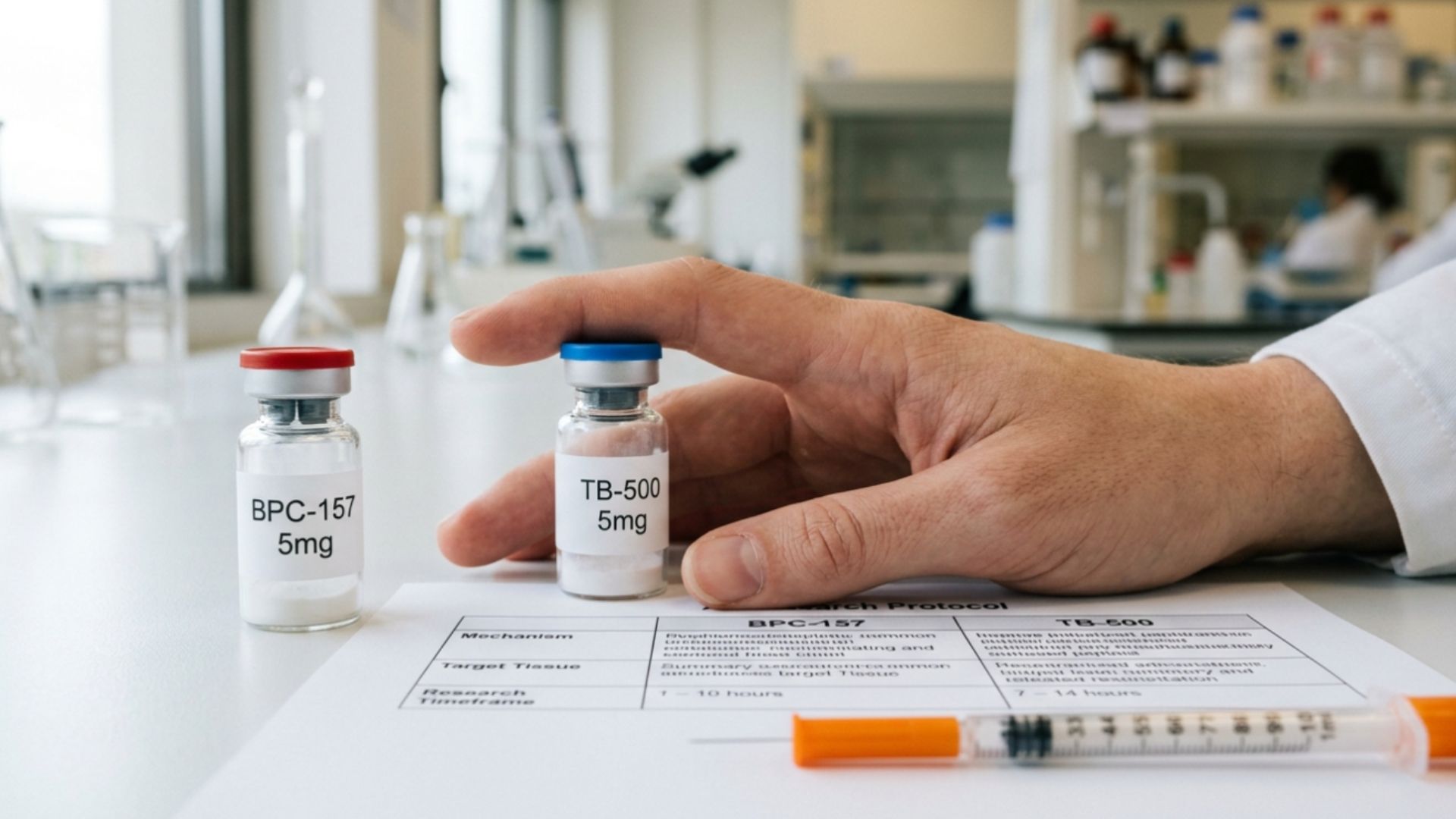
You’ve probably noticed how quickly peptides have burst onto the scene. In most cases, this is due to interest in biohacking. However, many peptides are still not approved in the United States and are classified as research peptides. This is true of both BPC-157 and TB-500 – these compounds are still not approved as drugs, yet there is enormous interest in them. They are mentioned together so often that it feels as if they are one molecule in two forms.
In reality, however, they are two different compounds with different mechanisms of action and different origins. The fact that they are constantly mentioned together is no coincidence. There is a specific research rationale behind this, which is worth discussing honestly.
⚠️ This material is for educational purposes only. BPC-157 and TB-500 are research compounds not approved for use in humans. This is not medical advice or a protocol for use. For any practical questions, please consult a specialist.
What Is BPC-157?
BPC-157 peptide stands for Body Protection Compound-157. It is a synthetic pentadecapeptide (15 amino acids). An important detail about its origin: it was isolated and synthesized based on a sequence discovered in human gastric juice. This explains part of the research interest, as gastrointestinal biology was the initial context in which it was studied.
The bulk of the publications on BPC-157 is associated with a Croatian research group led by Sikirić. They have been studying this compound since the early 1990s. During this time, a substantial body of work has been accumulated using animal models: tendons, muscles, bones, nervous tissue, and the gastrointestinal tract. In 2018, a review published in Current Neuropharmacology summarized preclinical data and described possible molecular mechanisms, including effects on nitric oxide synthesis and angiogenesis.
However, it is important to remember that animals and humans are different. There are no clinical trials in humans with sufficient evidence. This is the key reason why this compound has not yet been approved as a standalone prescription drug.
What Is TB-500?
TB-500 peptide is a synthetic analog of the active fragment of thymosin beta-4, an endogenous protein normally found in virtually all cells of the body. Specifically, this fragment contains the sequence LKKTETQ and is considered responsible for the primary biological activity of the full molecule.
The mechanism that makes TB-500 of interest to researchers is its interaction with G-actin. Thymosin beta-4 regulates the polymerization of actin filaments, which is directly linked to cell migration and tissue remodeling.
Status: investigational compound; no clinical trials in humans.
Different Mechanisms, Overlapping Research Interests
The most important thing here is not to confuse “studied in a similar context” with “functioning in the same way.”
BPC-157 and TB-500 have different mechanisms. In studies, BPC-157 is associated with effects on nitric oxide, growth factors, and vascular processes. TB-500 is associated with the actin cytoskeleton and cell migration. They do not duplicate each other’s effects; rather, they represent different entry points into processes that occur simultaneously in a living organism.
This is precisely what makes their overlap on the research agenda noteworthy.

Why They’re Studied Together
When two compounds with different mechanisms end up in the same research niche, it’s no coincidence and it’s certainly not just a marketing ploy. This raises the question of whether they act on different phases of the same process.
Let’s consider the example of tissue repair. Repair is not a single-step process. It is a sequence of events: inflammation, cell proliferation, angiogenesis, matrix restructuring, and remodeling. If BPC-157 is thought to influence the vascular and signaling components, while TB-500 affects cell migration and the cytoskeleton, then they could theoretically target different phases of the same sequence of events.
The study by Chang and colleagues in Regulatory Peptides specifically examined the interaction of BPC-157 with growth factor systems in angiogenesis; this is one of the mechanisms that theoretically complements the actin-mediated effects of thymosin.
Here, however, one caveat, often overlooked, must be noted: this is a research question, not a protocol. “Why are they studying together?” and “How should they be used together?” are fundamentally different matters. This is because, in this context, the first question pertains to science, while the second goes beyond what the data confirm.
Research vs. Marketing Claims
Many claims have accumulated around BPC-157 benefits, especially in sports and biohacking communities. It’s worth clearly separating what actually comes from research and what doesn’t.
| What is documented in scientific literature | What is not supported by data |
| Changes in healing parameters in animal models following BPC-157 administration, documented in several published studies | Claims about recovery in humans with specific timeframes and guaranteed outcomes |
| Effects of thymosin beta-4 and its fragments on cell migration, studied in vitro and in rodent models | Direct extrapolation of animal data to humans without corresponding clinical trials |
| Potential mechanisms related to angiogenesis and collagen synthesis, subject of ongoing preclinical investigation | Statements like “accelerates recovery” presented as established fact for humans |
The distinction between “observed in rats” and “works in athletes” is not a formality. Extrapolating rodent model data to humans is like wandering in the hope of arriving at a specific address – you might get there, but you have no way of knowing until someone actually maps the route. That’s precisely what clinical trials exist to do.
Side Effects and Safety Considerations
We need to be honest about BPC-157 side effects, because an information vacuum here is worse than an uncomfortable truth.
The human safety profiles for both compounds have not been established because no large-scale controlled trials have been conducted. No serious acute toxicity has been reported in preclinical studies. But “not observed in mouse models” and “safe for humans” are two different things. Rare adverse effects, long-term consequences, and interactions with other substances – all of these simply could not have been identified in the absence of the necessary studies.
No regulatory agency has approved either BPC-157 or TB-500 for use in humans. These are investigational compounds. Any questions regarding safety as it applies to a specific individual should be directed exclusively to a physician who is familiar with that person’s medical history.
Key Takeaways
BPC-157 and TB-500 are two different peptides, each with its own research history and mechanism of action. The first is being studied in relation to angiogenesis and repair signaling pathways. The second is being studied in the context of the actin cytoskeleton and cell migration. Together, they fall into the same niche because tissue repair is a multi-step process, and different mechanisms may act at different phases.
A few things to keep in mind:
- The data for both are primarily preclinical: mice, rats, and cell cultures.
- There are no human clinical trials with sufficient data for either of them.
- The safety profile in humans has not been established.
- Research interest in these compounds is real and well-founded. However, it is still too early to draw clinical conclusions from this research.
In the Grey Research Peptides catalog, both compounds are available for laboratory use: BPC-157 (10mg) and TB-500 (10mg). For in vitro research only, to be used by qualified professionals. Not for use in humans or animals.