
People usually search for this


The Science Behind the GLOW Blend: Research on Healing, Skin, and Regeneration

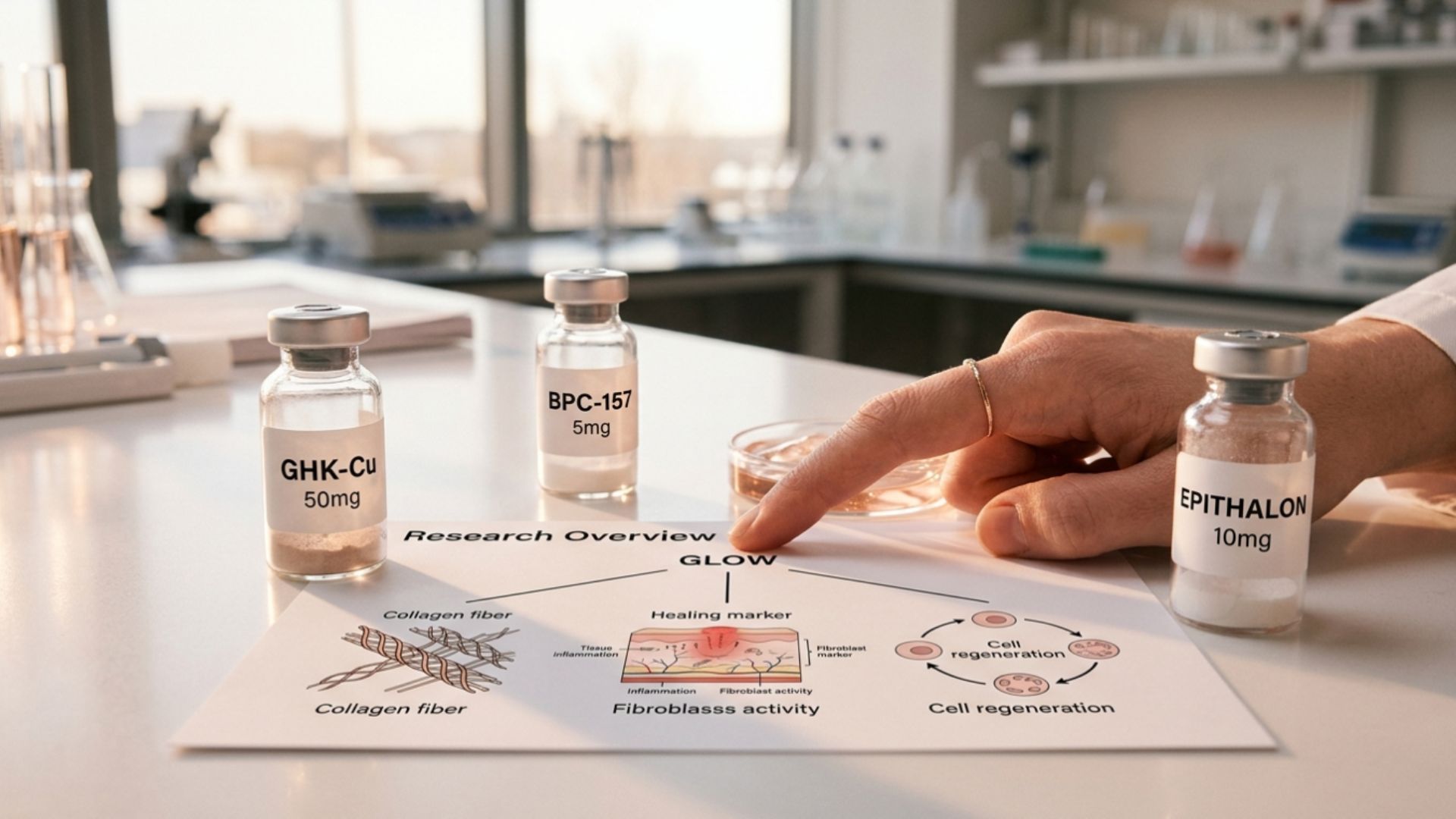
The term “GLOW” is increasingly appearing in discussions about peptides, sports communities, longevity, and even on dermatology forums. Before delving into any data, it is essential to establish one fundamental fact: there is no scientific research on the GLOW blend peptide as such. It is a marketing term for a combination of ingredients, each of which has been studied separately, and that is where the actual research base lies.
This article examines exactly what is included in the GLOW peptide blend, what is known about each component based on published data, and where the line is drawn between science and marketing claims.
⚠️ This material is provided for educational purposes only. GHK-Cu, BPC-157, and TB-500 are research compounds not approved for use in humans. Nothing in this text constitutes medical advice and should not be used as a guide for use. Please consult a licensed physician with any practical questions.
What Is the GLOW Blend (or Stack)?
GLOW stack peptide is the commercial name for an injectable combination that typically includes three compounds:
- GHK-Cu (copper tripeptide)
- BPC-157 (synthetic pentadecapeptide)
- TB-500 (synthetic thymosin beta-4 fragment)
The composition sometimes varies by manufacturer, but it is precisely this trio that forms the basis of what is commonly referred to as the GLOW peptide stack.
It is important to understand the nature of this product: it is not a single compound with its own molecular identity. It is a marketing bundle of three separate research peptides under a single brand name. None of the clinical or preclinical studies have examined this specific combination in this particular ratio. This, in itself, is a significant fact that we will return to below.
The “glow” theme in the name refers to the purported effects on the skin and tissue repair. The extent to which this is justified is determined by data on the individual components rather than on the blend itself.
The Components and What They’re Studied For
The actual research history of GLOW blend peptide benefits begins with individual molecules. It is these molecules that are worth examining separately to understand what effects can be expected from the GLOW blend:
- GHK-Cu. This is the tripeptide glycyl-L-histidyl-L-lysine complexed with copper, an endogenous molecule whose concentration in blood plasma decreases from approximately 200 ng/mL at age 20 to about 80 ng/mL by age 60. It has been studied primarily in a dermatological context: stimulation of the synthesis of collagen types I and III, elastin, and glycosaminoglycans, as well as its effect on the expression of genes associated with tissue repair. A review by Pickart and Margolina in the International Journal of Molecular Sciences (2018) synthesized the accumulated data and described the interaction of GHK-Cu with the regulation of more than 4,000 human genes.
- BPC-157. This is a synthetic pentadecapeptide developed based on a sequence derived from human gastric juice. It has been studied in a wide range of tissue contexts, from gastroprotection to tendons and muscles. Gwyer, Wragg, and Wilson summarized the data on its role in the musculoskeletal system in Cell and Tissue Research (2019).
- TB-500. This is a synthetic fragment of thymosin beta-4 (sequence: LKKTETQ) involved in regulating actin polymerization and cell migration. A recent scoping review in Applied Sciences (2026) synthesized the available data on thymosin beta-4 and TB-500 in the context of tissue healing. It noted that direct data on TB-500 in humans remain limited.
Each component has its own research history. You can learn more about each one on the respective catalog pages: GHK-Cu 50mg, BPC-157 10mg, TB-500 10mg.
Why There’s No “Blend-Level” Research
This is perhaps the most important point on the entire page, and it’s worth stating clearly.
The fact that these three compounds have been studied individually in the research literature does not mean that their combination has been studied as well. There is a fundamental difference between “components A, B, and C have a research base” and “the combination of A+B+C has been studied.” There are no published data on the interaction of these three specific compounds in the exact ratio used in the GLOW peptide stack.
The pharmacodynamic interaction of three molecules with different mechanisms of action when administered simultaneously is a separate research question that requires independent study. Claims about the properties of the blend as a whole are extrapolations, not conclusions drawn from the data.

Skin, Healing, and Regeneration: Research vs. Claims
The topic of skin and regeneration in the context of these three compounds is indeed present in the scientific literature. However, this presence differs somewhat from what is typically presented in marketing claims:
| What is documented in scientific literature (by component) | What is not supported by data |
| GHK-Cu: stimulation of collagen and elastin synthesis in vitro, influence on gene expression related to skin repair | Claims about the effects of the blend itself as a studied entity |
| BPC-157: changes in healing parameters in animal models – tendons, muscles, mucosa | Guaranteed skin transformations in humans within specific timeframes |
| TB-500: interaction with the actin cytoskeleton, influence on cell migration in vitro | Direct extrapolation of preclinical data to systemic effects in healthy humans |
| Preclinical data available for each component individually | Synergistic effect of the triple combination, not studied |
The “skin and glow” theme in the product name is based primarily on data regarding GHK-Cu, which indeed has the most extensive evidence base in a dermatological context. BPC-157 and TB-500 have been studied predominantly in the context of the musculoskeletal system and systemic recovery (but not specifically regarding the skin). This difference in research contexts is often lost in marketing descriptions.
“Before and After” Searches: What They Mean
The search query GLOW stack peptide before and after predictably arises in connection with any product marketed for skin and appearance.
The limitations of anecdotal “before and after” reports are well known, but here they are compounded by an additional factor: we are dealing with a combination of three injectable compounds used outside a clinical protocol. In such a situation, it is impossible to attribute a specific observed effect to a specific component, not to mention the placebo effect, lifestyle influences, and variability in individual responses. A “before and after” photograph is not scientific evidence under any circumstances, and in this case, even less so.
Safety and Status Considerations
All three components of the GLOW peptide blend are investigational injectable compounds. Beyond that, the combination itself adds a layer of uncertainty: the compatibility of the components when stored and administered together, sterility, and stability – all of these are separate issues for which no data is available. This does not mean the risks are necessarily high; it simply means they have not been sufficiently characterized.
- GHK-Cu: most extensively studied in topical cosmetic applications; data on systemic injectable use in humans are limited
- BPC-157: Not approved by any regulatory agency for use in humans; clinical trials have not been completed with sufficient endpoints
- TB-500: The FDA has listed the TB4 fragment (LKKTETQ) among substances that may pose risks in the preparation of compounded medications due to limited human safety data
The safety profile of the injectable triple combination in humans has not been established, and this is not a disclaimer, but a statement of fact.
Key Takeaways
GLOW is a marketing name for a combination of three separate investigational peptides. Each component has its own research history: varying in depth, in different tissue contexts, and predominantly preclinical. The combination itself does not exist as a studied entity in the scientific literature, and this is a fundamental fact that any claims about the “properties of the blend” fail to address.
A few things to keep in mind:
- The fact that the components have a research base does not mean that their combination has been studied.
- GHK-Cu is best supported in a dermatological context; BPC-157 and TB-500 have been studied primarily in relation to the musculoskeletal system.
- All three compounds are for injection and are unapproved; the safety profile of the combination in humans has not been established.
- Anecdotal before-and-after reports do not constitute proof of efficacy under any circumstances.
In the Grey Research Peptides catalog, the GLOW blend is available as BPC-157/TB-500/GHK-Cu 10+10+50mg – exclusively for in vitro research by qualified specialists. Not for use by humans or animals.