
People usually search for this


KLOW Blend Research Breakdown: Adding KPV to the Healing Equation

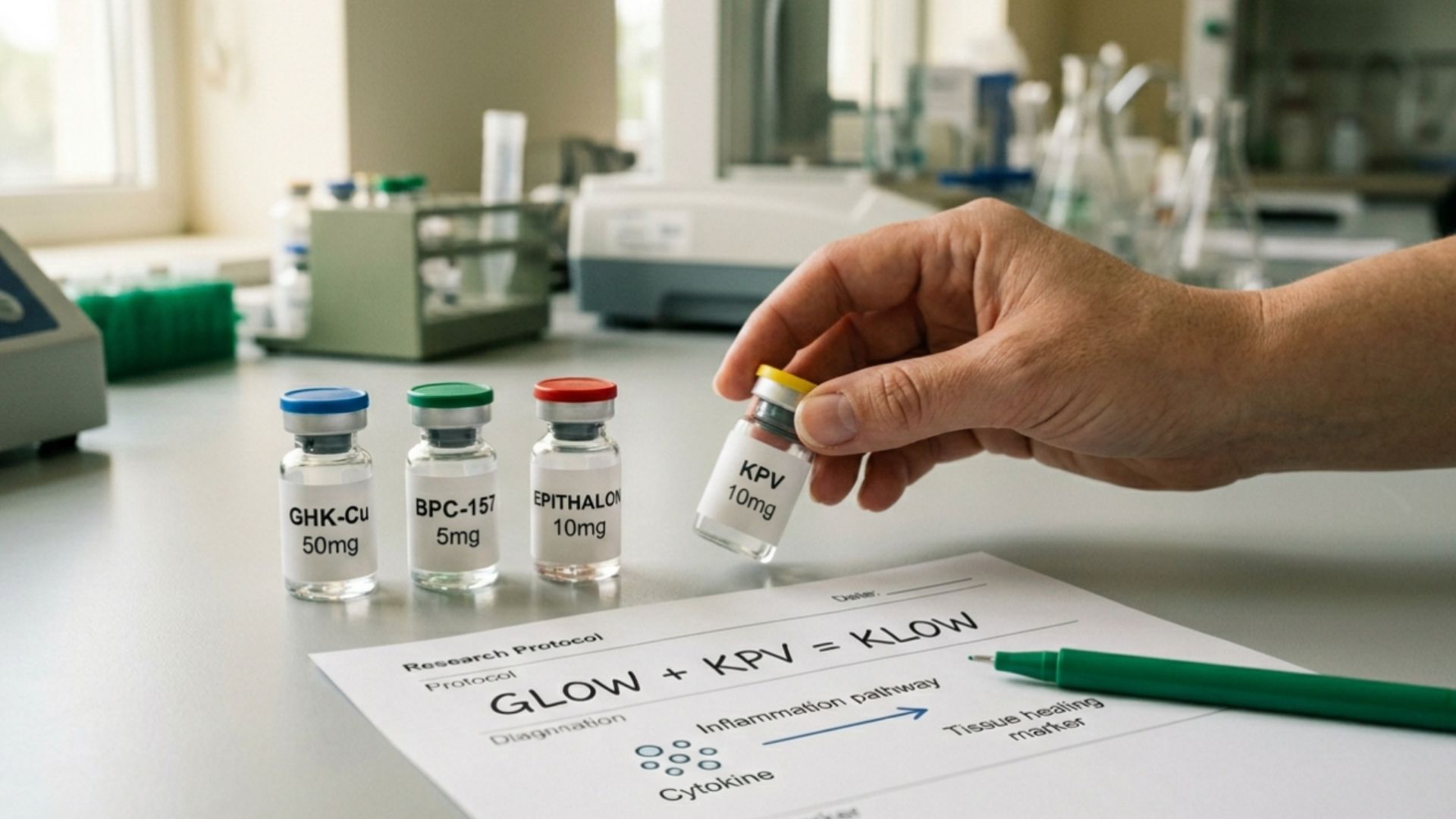
The KLOW Blend can be considered the next step in the same marketing narrative as the GLOW Blend. The GLOW Blend is a triple combination of GHK-Cu, BPC-157, and TB-500. The KLOW blend peptide, on the other hand, consists of those same three compounds plus one new one: KPV. This is the only substantive addition compared to the previous formula, and it is precisely this addition that forms the basis for this page.
As with GLOW, it is important to note a fundamental point: the KLOW peptide does not exist as a scientifically studied entity. The research literature addresses each component individually, not their combination in this specific formulation. While science does offer insights, they are at the level of individual molecules. And that is precisely where we are focusing our attention in this text, giving special attention to KPV as the most important new element in this discussion.
⚠️ This material is provided for educational purposes only. All compounds mentioned are investigational and not approved for use in humans. This is not medical advice or a guide to use. For any practical questions, consult a licensed physician.
What Is the KLOW Blend?
KLOW blend peptide is the commercial name for an injectable combination of four compounds: GHK-Cu, BPC-157, TB-500, and KPV. Essentially, it is the GLOW formula with the addition of one component, hence the letter “K” in the name. A detailed analysis of the three components shared with GLOW, their mechanisms, research contexts, and data limitations, is presented on the GLOW Blend page; here, we focus on what is unique to KLOW.
Like GLOW, KLOW peptide is a marketing grouping of individual molecules under a single brand name, rather than an independent compound with its own identity and established profile. No published study has examined this four-component combination as a subject of research. It is important to understand this before analyzing any claims about the blend’s overall properties.
The addition of KPV changes the combination’s research focus: while the three original components were studied primarily in the context of tissue and skin regeneration, KPV introduces a fundamentally different research context – anti-inflammatory. This is where the substantive discussion begins.
What Is KPV?
To answer the question, what is KPV peptide strictly and precisely: it is a synthetic tripeptide with the sequence Lys-Pro-Val, representing the C-terminal fragment of α-melanocyte-stimulating hormone (α-MSH) – positions 11-13 in its amino acid chain.
A biologically significant feature of KPV is that, despite its origin from α-MSH, it does not act through melanocortin receptors. This is a fundamental difference from the full α-MSH molecule, which activates MC1R and MC3R.
In 2003, Getting, Schiöth, and Perretti demonstrated in the Journal of Pharmacology and Experimental Therapeutics that the anti-inflammatory effect of KPV in a peritonitis model was not blocked by an MC3/MC4 melanocortin receptor antagonist, suggesting a mechanism independent of these receptors.
Instead of the receptor pathway, KPV enters cells via the PepT1 transporter, a di- and tripeptide transporter expressed on the intestinal epithelium. A noteworthy detail: PepT1 expression in the large intestine increases under inflammatory conditions. This means that inflamed tissue potentially absorbs KPV to a greater extent than healthy tissue. This observation set the direction for subsequent research in the field of gastroenterology.
KPV peptide currently remains an investigational compound without approved clinical use. The data on it are primarily preclinical and in vitro.
What KPV Is Studied For
The main line of research on KPV peptide benefits has centered on two interrelated topics: the inhibition of pro-inflammatory signaling cascades and the reduction of intestinal pathology.
In a study by Dalmasso et al. in Gastroenterology (2008), it was demonstrated that KPV, absorbed via PepT1, inhibits NF-κB activation in intestinal epithelial cells and immune cells, and also reduces the severity of inflammation in two mouse models of colitis – DSS-induced and TNBS-induced. To date, this is one of the most cited studies on KPV.
Importantly, all key data come from in vitro studies or mouse models. No clinical trials in humans have been conducted to provide sufficient evidence to conclude that efficacy exists. This sets a reasonable framework for interpreting any claims.

KLOW vs. GLOW: What KPV Adds
The KLOW vs. GLOW peptide question is about what one additional component brings to an existing combination.
The three original compounds from GLOW were studied in the following contexts: KPV adds a fundamentally different research vector to this profile: inhibition of inflammatory cascades via NF-κB and potential interaction with intestinal inflammation via a PepT1-mediated mechanism.
- GHK-Cu: collagen and elastin synthesis, skin repair, regulation of gene expression.
- BPC-157: healing of tendons, muscles, and mucous membranes; data on angiogenesis.
- TB-500: regulation of actin polymerization, cell migration; link to tissue repair.
The theoretical rationale for this combination is clear: tissue repair following injury involves both structural processes (collagen synthesis, cell migration, angiogenesis) and inflammatory processes (acute inflammation is necessary to initiate healing, but chronic inflammation hinders it). While BPC-157 and TB-500 have been studied in relation to structural aspects, KPV theoretically addresses the inflammatory component of this same chain of events.
However, it is important to remember that this is merely a research hypothesis, not a confirmed interaction. The combination of all four components in this specific formulation has not been studied in any published work.
Why There’s No “Blend-Level” Research
This point must be made explicitly, as it is precisely where the marketing narratives surrounding KLOW peptide benefits often go beyond what the data actually support.
The fact that each of the four components has its own research base does not mean that their combined use has been studied. The pharmacodynamic interaction among four molecules with different mechanisms when administered simultaneously is a distinct research question that requires separate investigation. It has not been addressed in any published studies. Claims regarding the properties of the “KLOW blend” as a whole represent an extrapolation of component-level data.
Healing and Anti-Inflammatory Claims: Research vs. Marketing
The theme of the “healing equation” in the product’s name is based on two parallel lines of research: tissue repair and anti-inflammatory activity. It is fundamentally important to distinguish between what is documented in the literature and what constitutes a marketing overlay.
At the component level, science does indeed provide some evidence. KPV, as demonstrated in the study by Dalmasso et al., inhibited NF-κB activation and reduced inflammation in two mouse models of colitis. GHK-Cu has been linked to the stimulation of collagen and elastin synthesis in vitro. BPC-157 and TB-500 have been studied for musculoskeletal recovery, each through its own mechanism. These are real data from published studies.
The problem arises when this data is applied to a blend as a single product. The anti-inflammatory context of KPV and the reparative context of the three source components represent different research niches that, in theory (!), may complement each other from a biological standpoint. But “theoretically complementing” is not the same as having already studied them together. The combined effect of all four compounds has not been investigated in any published study.
Furthermore, all available data on the components are from preclinical studies. Science does not support a direct extrapolation of these results to systemic effects in humans. Therefore, all marketing claims that the blend “reduces inflammation” or “accelerates healing” go beyond what science actually allows us to assert.
Safety, Status, and Key Takeaways
All four components of the KLOW blend peptides are injectable investigational compounds. Beyond that, the combination itself introduces additional uncertainties: the compatibility of the four compounds during storage and administration, sterility, and potential pharmacodynamic interactions – all areas for which no data exist. This does not mean that the risks are definitely high. It means that they have not been characterized.
- KPV: Safety data in humans is extremely limited; there are no data on chronic toxicity.
- GHK-Cu, BPC-157, TB-500: Similar status, investigational compounds without clinical approval.
A few points that honestly reflect the current state of affairs: Any practical questions (selection, applicability, risk assessment) are solely the responsibility of the physician.
- KLOW is a marketing name, not a scientifically studied compound.
- KPV has a genuine research history in anti-inflammatory and gastroenterological contexts, primarily preclinical.
- Adding an anti-inflammatory component to the GLOW formula is a logical concept, but the synergistic effect has not been confirmed.
- The safety profile of the four-component injectable combination in humans has not been established.
In the Grey Research Peptides catalog, the KLOW blend is available as BPC-157/TB-500/KPV/GHK-Cu 10+10+10+50mg – exclusively for in vitro research by qualified specialists. Not for use in humans or animals.